


Narrative Foundation and Environmental Premise
The plot of John Carpenter’s Toxic Commando is centered on a catastrophic failure in renewable energy research. In an attempt to harness the Earth’s core for clean energy, scientists inadvertently breached a subterranean prison, releasing an eldritch entity known as the "Sludge God." This ancient being possesses the ability to terraform the environment, sprouting massive organic tendrils and reanimating the deceased into a variety of mutated monstrosities.

The player characters are a group of mercenaries hired to escort Leon Dorsey, an eccentric billionaire and the scientist responsible for the initial disaster. Following an initial ambush by the Sludge God, the squad becomes "toxic"—infected by the entity’s supernatural sludge. However, Dorsey utilizes experimental technology to stabilize the infection, equipping the mercenaries with specialized vests that prevent total transformation while allowing them to harness certain superhuman abilities. This narrative framework justifies the game’s class-based power system and establishes a campy, high-stakes tone consistent with the "creature feature" films of the late 20th century.

Technical Architecture: The Swarm Engine and Terrain Physics
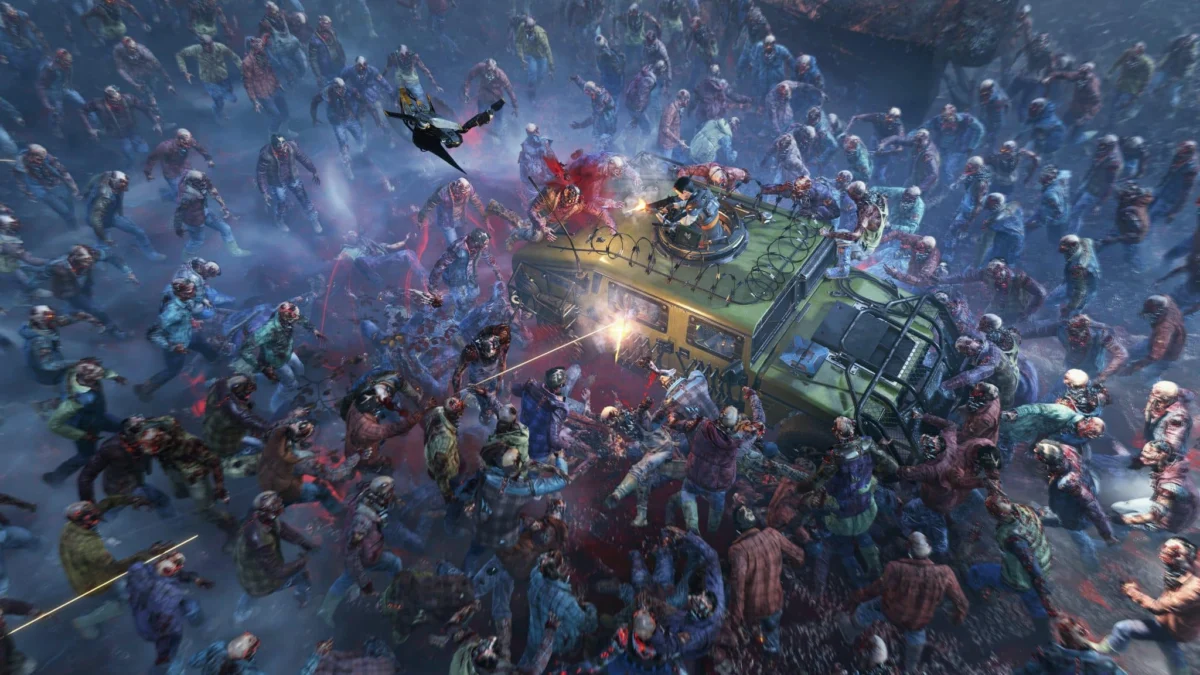
At the core of the experience is Saber Interactive’s Swarm Engine, which is designed to handle hundreds of active enemy units on screen simultaneously without compromising performance. In John Carpenter’s Toxic Commando, this technology is pushed to its limits to create "horde" moments where the sheer volume of enemies necessitates disciplined squad coordination.

A distinguishing feature of this title is the inclusion of terrain deformation and vehicular puzzling. While most shooters treat the ground as a static plane, this game employs physics-based systems where mud, sludge, and organic growth dynamically react to movement. Vehicles can become bogged down in thick mire, requiring players to utilize winches and environmental awareness to navigate. This mechanic introduces a layer of tactical pacing rarely seen in the "Left 4 Dead" style of cooperative shooters, forcing players to manage their mobility as carefully as their ammunition.

Class Systems and Tactical Specialization
The gameplay is structured around four distinct character classes, each offering a specific utility to the four-player squad. These classes are designed to complement one another, particularly on higher difficulty settings where individual survival is unlikely.

- The Strike: An offensive-focused build designed for high damage output. This class utilizes powers derived from the Sludge God’s infection to channel energy directly into combat maneuvers, making it the primary choice for clearing paths through dense hordes.
- The Defender: A frontline tank role. The Defender’s primary ability involves deploying protective barriers that not only block incoming attacks but also incapacitate enemies with electrical discharges. This class is essential for holding objectives during "last stand" scenarios.
- The Operator: A technical specialist focused on utility and reconnaissance. The Operator typically manages the squad’s mechanical advantages and provides fire support through advanced ballistic drones and specialized equipment.
- The Medic: The primary support class. Given the high lethality of the Sludge God’s minions, the Medic is responsible for deploying healing circles and managing the squad’s health pools, ensuring the team can endure prolonged engagements.
The synergy between these classes is tested across eight core campaign missions. Each mission features randomized objectives and event triggers, a design choice intended to increase replayability by ensuring that enemy spawn patterns and secondary goals shift with each playthrough.

Vehicular Integration and Environmental Navigation
Unlike many of its contemporaries that relegate vehicles to scripted sequences, John Carpenter’s Toxic Commando treats transportation as a core gameplay pillar. The vehicles provided to the "Toxic Commandos" are diverse and serve as mobile fortresses.

Available vehicles include pickups equipped with flamethrowers, military-grade trucks featuring heavy machine guns, and ambulances capable of healing the squad while they are in transit. The inclusion of a winch mechanic is a direct nod to the Mudrunner franchise, allowing players to pull teammates out of hazards, tear down heavy barricades, or open massive storage containers. This integration of vehicular physics adds a "puzzling" element to the combat, as players must often decide whether to abandon their transport for the safety of high ground or risk driving through a sludge-filled valley to reach an objective faster.

Progression, Customization, and the Hub World
Between missions, players retreat to a hub-style base managed by Leon Dorsey. This environment serves as the central location for character and gear progression. The game features a multi-tiered currency system centered on "Sludgite," a crystalline substance recovered during missions.

The progression system is notably deep for the genre:

- Weapon Customization: Players can spend Sludgite on a wide array of attachments that alter handling, damage, and accuracy. The "Prestige" system allows dedicated players to reset weapon levels in exchange for permanent stat boosts.
- Skill Trees: As players gain experience, they accrue skill points that can be invested into class-specific trees, enhancing the potency and cooldown rates of their innate abilities.
- Cosmetic Economy: Higher-tier Sludgite, found primarily on higher difficulty settings, is used to unlock character costumes, weapon skins, and vehicle paint jobs, allowing for visual personalization.
Analysis of Gameplay Loop and Industry Impact
The gameplay loop of John Carpenter’s Toxic Commando is a calculated blend of high-octane violence and resource management. Industry analysts note that Saber Interactive is carving out a specific niche by combining the "horde shooter" with high-fidelity physics. This strategy appears to be a response to the growing demand for "AA" titles—games that offer high production values and unique mechanics without the bloated scope or predatory monetization often found in "AAA" live-service offerings.

The decision to lean into 1980s tropes is also a strategic move. By embracing a "dumb fun" aesthetic, the game bypasses the need for a complex, serious narrative, instead focusing on the visceral satisfaction of its combat systems. However, the game does not lack sophistication; the interplay between terrain deformation and enemy swarms requires a level of environmental awareness that sets it apart from more traditional corridor shooters.

Critical Reception and Technical Performance
Initial reports from the review period indicate that while the game excels in its core combat and "spectacle" moments, it has faced some technical hurdles. Testers noted occasional crashes and stability issues, which are not uncommon for titles utilizing complex physics engines and high enemy counts. Furthermore, some critics pointed out the absence of certain modern movement mechanics, such as a "slide" function when transitioning from a sprint to a crouch, which can make the character movement feel somewhat rigid compared to contemporary titles like Call of Duty or Apex Legends.

Despite these minor criticisms, the general consensus highlights the game’s success in delivering a satisfying cooperative experience. The "finale" sequences of missions, which often culminate in massive defensive stands or confrontations with the Sludge God itself, are cited as the game’s highlights. The emergent gameplay—where a well-laid plan falls apart due to a "special" infected enemy appearing at the worst possible moment—provides the kind of unpredictable excitement that has made the cooperative shooter genre a staple of the industry.

Conclusion and Future Outlook
John Carpenter’s Toxic Commando is a bold attempt to modernize the cooperative shooter by looking backward at the golden age of horror cinema while looking forward with cutting-edge engine technology. Its unique combination of class-based combat, vehicular simulation, and massive enemy swarms offers a compelling package for players seeking a break from more traditional military shooters.

As the title moves past its launch window, the focus for Saber Interactive will likely shift toward technical optimization and the introduction of post-launch content. Given the structure of the game’s missions and the depth of its progression system, there is significant potential for long-term support through new classes, weapons, and environmental biomes. For fans of John Carpenter’s work and cooperative action, the game stands as a testament to the enduring appeal of high-concept, B-movie-inspired carnage.