


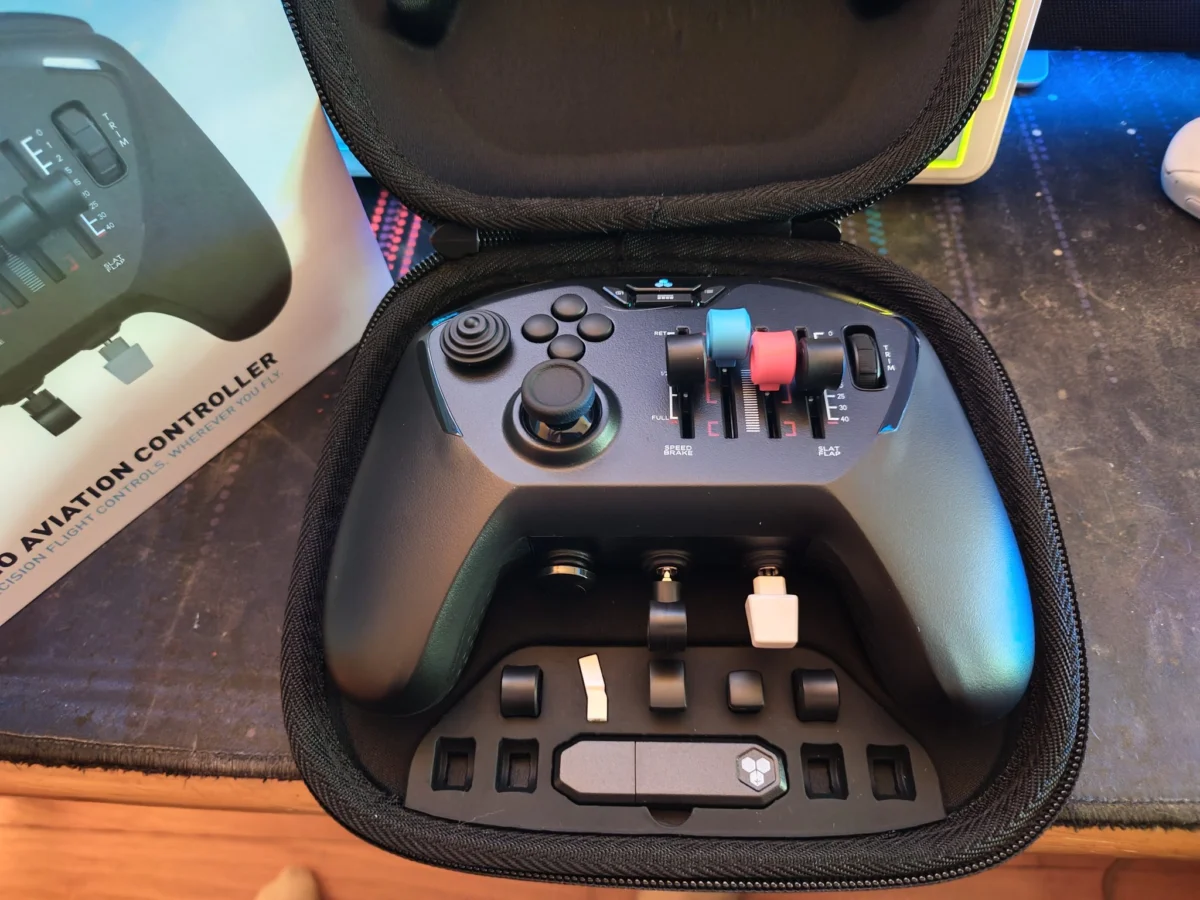
The landscape of flight simulation peripherals has undergone a significant transformation with the introduction of the Echo Aviation Controller by Honeycomb Aeronautical. Designed specifically to bridge the gap between traditional gaming controllers and professional-grade Hands On Throttle and Stick (HOTAS) systems, this specialized hardware aims to provide high-fidelity control within a compact, handheld form factor. As the flight simulation community transitions into the era of Microsoft Flight Simulator 2024, the demand for hardware that balances precision with portability has reached a critical peak. The Echo Aviation Controller enters this market at a retail price of $150 USD, positioning itself as a premium solution for enthusiasts who require a comprehensive cockpit experience without the desk-space requirements of full-sized yokes and throttle quadrants.
Hardware Architecture and Input Versatility
The Echo Aviation Controller is characterized by an exceptionally dense layout of inputs, featuring over 25 individual control points. This complexity is intentional, designed to map the myriad functions of modern aircraft—ranging from light Cessnas to complex commercial airliners—directly onto a handheld device. The left side of the controller features a circular eight-way directional nub for camera manipulation and menu navigation, supplemented by four primary action buttons and a high-precision analog stick.
The right side of the device introduces a departure from standard controller design with the inclusion of four dedicated speed levers. These levers operate on linear tracks, allowing for the granular control of throttle, mixture, propeller pitch, or flaps, depending on the aircraft configuration. Adjacent to these levers is a dedicated trim wheel that provides tactile, audible clicks with each increment, allowing pilots to make micro-adjustments to the aircraft’s pitch during level flight.
The lower portion of the controller is equipped with rocker switches designed for landing gear and light controls, alongside a specialized pull/push knob that mimics the functionality of a plunger-style throttle or cowl flap control found in general aviation aircraft. The top of the unit houses standard bumpers and triggers; notably, the triggers are designed with minimal travel distance to ensure instantaneous response times. One of the most innovative features is located on the rear of the device: a specialized rudder control system. This ergonomic solution allows for precise yaw control without the need for traditional floor-based rudder pedals, a significant advantage for users in restricted environments.

Technological Integration: Hall-Effect Sensors and Connectivity
A core component of the Echo Aviation Controller’s value proposition is the integration of Hall-Effect sensors within the analog sticks and rudder controls. Unlike traditional potentiometers, which rely on physical contact and are prone to wear, friction, and "stick drift" over time, Hall-Effect sensors utilize magnetic fields to detect movement. This technology ensures long-term durability and maintains a high degree of precision, which is vital for the subtle corrections required during crosswind landings or formation flying.
The device offers dual-mode connectivity, supporting both wired and wireless operations. Wireless connectivity is facilitated through a dedicated 2.4GHz dongle, which minimizes input latency compared to standard Bluetooth protocols. This ensures that the controller is compatible with both Windows PC and Apple Macintosh environments. However, it is important to note that the current iteration of the hardware does not support Xbox or PlayStation consoles, a strategic decision that focuses the device on the core flight simulation community on PC.
Power management is another area of focus, with the internal battery providing between 15 and 20 hours of continuous operation on a single charge. This capacity is sufficient for several medium-to-long-haul virtual flights, and the transition to wired mode via a USB-C connection allows for simultaneous charging and gameplay, ensuring that "engine-out" scenarios due to power loss are mitigated.
The Flight Simulation Context: MSFS 2024 and Beyond
The release of the Echo Aviation Controller coincides with the launch and maturation of Microsoft Flight Simulator 2024 (MSFS 24), a title that has significantly raised the bar for environmental physics and aircraft systems modeling. While MSFS 24 is accessible via standard gamepads, the complexity of its systems often requires a "shift-key" approach to controller mapping, where a single button must be held in combination with others to access secondary functions like flaps or trim.
The Echo Aviation Controller effectively eliminates this barrier by providing dedicated physical inputs for these critical systems. By utilizing the layout files provided by Honeycomb Aeronautical, users can achieve a 1:1 mapping for essential flight surfaces. This reduces the cognitive load on the pilot, allowing them to focus on navigation and procedures rather than struggling with control schemes. The controller also maintains compatibility with legacy titles and competitors such as X-Plane 11, X-Plane 12, and Prepar3D, ensuring its utility across the diverse ecosystem of flight simulation software.

Chronology of Development and Market Positioning
Honeycomb Aeronautical has established a reputation for disrupting the flight simulation market, which was historically divided between low-end plastic joysticks and multi-thousand-dollar professional training devices. The company’s previous successes, such as the Alpha Flight Controls and the Bravo Throttle Quadrant, set a high standard for build quality and functional realism.
The development of the Echo Aviation Controller represents a third tier in their product strategy: portability. The timeline of this product reflects a growing trend in the gaming industry toward "prosumer" handhelds. As more users adopt gaming laptops and handheld PCs (such as the Steam Deck or ROG Ally), the need for a flight-specific controller that can fit into a laptop bag has become apparent. To support this use case, the Echo Aviation is packaged with a ruggedized, custom-molded travel case designed to protect the various levers and switches from impact damage during transit.
Comparative Analysis and Industry Implications
When compared to traditional HOTAS setups, such as those produced by Thrustmaster or Turtle Beach, the Echo Aviation Controller offers a unique compromise. While a full yoke and pedal set provides the most realistic physical representation of a cockpit, they are often cumbersome to set up and require a dedicated desk space. For many hobbyists, the "barrier to entry" for a quick 30-minute flight is the physical labor of clamping hardware to a desk and managing cables.
The Echo Aviation addresses this by offering "HOTAS power in the palm of your hand." It provides the same degree of multi-axis control (pitch, roll, yaw, and throttle) as a full setup but with the convenience of a gamepad. Industry analysts suggest that this move could broaden the demographic of flight simulation enthusiasts, attracting gamers who were previously intimidated by the cost and space requirements of traditional peripherals.
Furthermore, the $150 MSRP places it in direct competition with "pro" controllers from Microsoft (Elite Series 2) and Sony (DualSense Edge). However, whereas those controllers are general-purpose devices, the Echo Aviation is a specialized tool. The inclusion of hall-effect sensors and aviation-specific inputs like speed levers and a trim wheel provides a specialized value that general-purpose controllers cannot replicate.

User Experience and Operational Efficiency
In operational testing within MSFS 24, the Echo Aviation Controller demonstrates a high level of efficiency in managing complex phases of flight. During the approach and landing phase, where a pilot must simultaneously manage airspeed (via throttle), descent rate (via pitch and trim), and alignment (via rudder and roll), the controller’s layout allows for simultaneous manipulation of all four axes.
The "clicky" feedback of the trim wheel is particularly beneficial for visual flight rules (VFR) navigation, where sensory feedback allows the pilot to make adjustments without taking their eyes off the horizon or the instruments. Similarly, the rudder controls on the back of the device provide a more intuitive experience for coordinated turns than the "stick-twist" method found on many entry-level joysticks, which can often lead to accidental pitch or roll inputs.
Final Technical Assessment
The Honeycomb Aeronautical Echo Aviation Controller stands as a sophisticated piece of engineering that successfully miniaturizes the flight deck experience. Its build quality is robust, utilizing high-grade plastics and textured grips to ensure stability during intense maneuvers. While the $150 price point is a significant investment for a handheld peripheral, the inclusion of Hall-Effect technology and the comprehensive array of aviation-specific inputs justify the cost for the dedicated flight simmer.
As the industry moves toward more complex simulation environments, the Echo Aviation Controller provides a necessary evolution in control interface design. It acknowledges that the modern pilot may not always be at a dedicated desk, but still requires the precision and depth of control that the hobby demands. By combining the portability of a gamepad with the functionality of a professional flight rig, Honeycomb Aeronautical has created a new category of peripheral that is likely to influence the design of flight simulation hardware for years to come.