


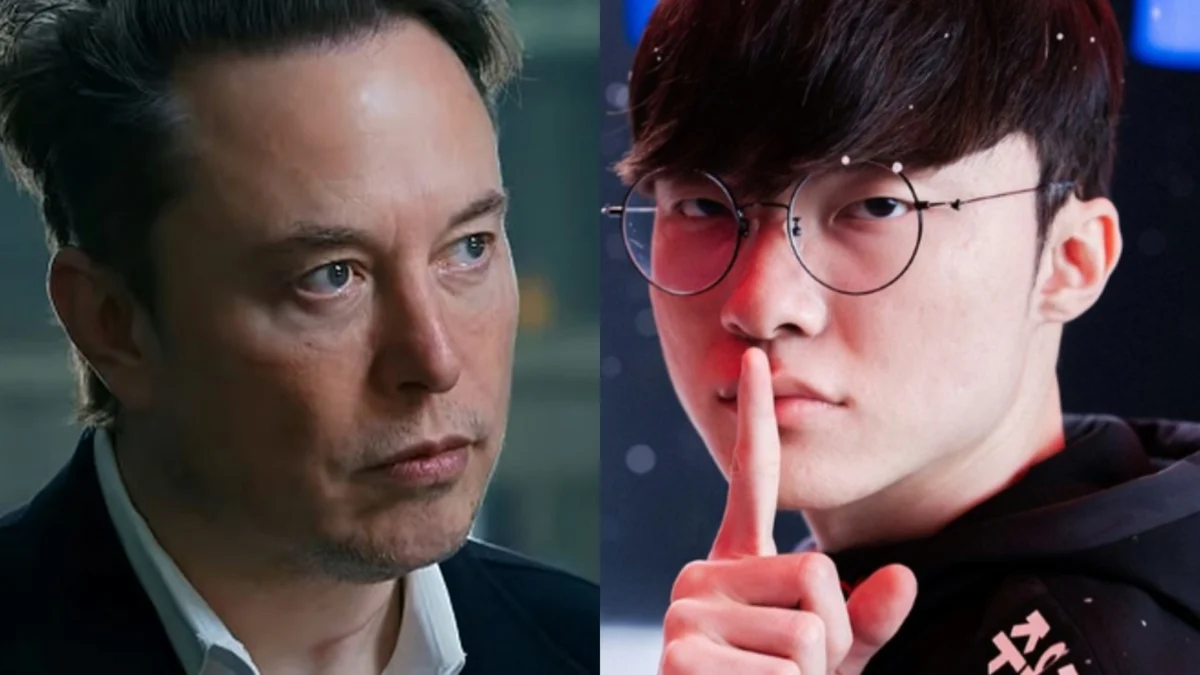
The esports world is abuzz with the unprecedented challenge issued by tech magnate Elon Musk: his advanced AI, Grok, will face off against the undisputed titans of League of Legends, T1, and their legendary mid-laner, Lee "Faker" Sang-hyeok. This proposed showdown, tentatively scheduled for 2026, draws a striking parallel to the pivotal chess match between IBM’s Deep Blue and world champion Garry Kasparov, signaling a potential watershed moment in the integration of artificial intelligence into competitive gaming.
Musk, who has been vocal about his ambitions for AI in game development, has consistently pushed the boundaries of what artificial intelligence can achieve. His vision extends beyond mere algorithmic play; he has previously expressed a belief that AI could be capable of developing an entire video game independently by 2029. The Grok AI, particularly its latest iteration, Grok 5, is being touted as a versatile intelligence designed to learn and adapt to any game simply by processing its instructions and engaging in experimental play. This proposed League of Legends match is the latest manifestation of Musk’s drive to test the limits of AI in highly complex, human-centric strategic environments.
The genesis of this challenge lies in Musk’s recent pronouncements on X, formerly Twitter. He articulated his intent to pit Grok 5 against the pinnacle of human League of Legends prowess. "Let’s see if Grok 5 can beat the best human team League Of Legends in 2026 with these important constraints," Musk posted, laying out specific parameters designed to level the playing field and ensure a more comparable contest. These crucial limitations are designed to prevent Grok from leveraging inherent computational advantages that would render the competition lopsided.
Constraints and the Human Element
Elon Musk’s proposed rules for the Grok vs. T1 match are meticulously crafted to mirror the experience of a human player. Firstly, Grok will be restricted to observing the game through a camera feed, simulating the visual input of a human player with standard 20/20 vision. This prevents the AI from accessing raw game data or having an omniscient view of the map, forcing it to rely on interpreted visual information. Secondly, and perhaps most critically, Grok’s reaction latency and click rate will be capped at humanly achievable speeds. This directly addresses the potential for AI to execute actions with superhuman rapidity, a common concern in AI versus human competitions. These constraints aim to ensure that the contest is a true test of strategic understanding, adaptability, and decision-making rather than raw processing power and reaction speed.
The AI’s ability to learn and adapt is central to Musk’s proposition. He has indicated that Grok 5 is designed to grasp game mechanics by simply reading rulesets and then iteratively experimenting. This approach mirrors how humans learn new games, albeit at a potentially accelerated pace. The challenge, therefore, is not just about whether Grok can be programmed to play League of Legends, but whether it can develop a sophisticated understanding of the game’s intricate meta, champion synergies, and real-time strategic demands to compete at the highest level.

A Legacy of AI vs. Human Competition
The proposed League of Legends match evokes a rich history of AI challenging human intellect in strategic domains. The most iconic precedent is the 1997 match between Deep Blue and Garry Kasparov. Deep Blue, an IBM supercomputer, famously defeated the reigning World Chess Champion in a six-game match. This event was a landmark moment, demonstrating the growing capabilities of AI in complex problem-solving and strategic thinking. More recently, AI has excelled in games like Go, with DeepMind’s AlphaGo defeating the world’s best players, and in various video games, including StarCraft II, where DeepMind’s AlphaStar achieved Grandmaster level.
However, League of Legends presents a unique set of challenges. Unlike chess or Go, which have perfect information and turn-based mechanics, League of Legends is a real-time strategy (RTS) MOBA (Multiplayer Online Battle Arena) characterized by incomplete information, constant action, and a high degree of team coordination. The dynamic nature of the game, with its shifting objectives, intricate champion interactions, and the necessity for nuanced team communication and macro-level strategy, makes it a significantly more complex arena for AI to conquer.
Reactions from the Esports Community
Elon Musk’s bold announcement quickly resonated throughout the esports and gaming communities, eliciting a spectrum of responses. Many welcomed the prospect of witnessing such a monumental clash, recognizing its potential to advance the understanding of AI capabilities in gaming.
Eugene "Pobelter" Park, a former professional League of Legends player, expressed keen interest, offering his expertise. "Would love to help and offer insight as a former League pro," Park stated on X, referencing the burgeoning field of AI in gaming. "I thought AI vs Dota 2 was really interesting and always wanted to see it vs League." His sentiment highlights the community’s fascination with how AI can be applied to different game genres and competitive landscapes.
Oriol Vinyals, a researcher known for his work in AI and gaming, particularly his achievement of Grandmaster status in StarCraft, caught Musk’s attention by suggesting a different competitive arena: Blizzard’s StarCraft. Vinyals playfully added, "Bonus points if you get the robots to operate the mouse and keyboard," a nod to the physical interface challenges. Musk’s enthusiastic "Sounds good" in response indicates an openness to exploring AI’s prowess across various strategic games.
Skepticism and Doubts
Not all reactions were universally positive or confident in Grok’s immediate success. Several prominent figures within the League of Legends professional circuit voiced skepticism regarding the AI’s ability to compete at the highest human level by 2026, especially given the proposed constraints.

Joedat "Voyboy" Esfahani, a respected former professional LoL player, articulated his doubts. "You wouldn’t even be able to beat an LCS team, much less Faker and the boys," Voyboy argued. "League has far too many variables / interaction & game knowledge context / legit team coordination required to win at the highest level." His analysis points to the multifaceted nature of League of Legends, emphasizing the strategic depth, contextual understanding, and intricate team dynamics that are exceptionally difficult for AI to replicate.
Yiliang "Doublelift" Peng, another highly acclaimed former professional player, echoed these sentiments with even stronger conviction. He expressed extreme doubt about Grok’s ability to defeat T1 or even himself in a match, going so far as to pledge a rather drastic personal consequence: "I will shave my head if Grok manages to best me." This bold statement underscores the perceived difficulty of the challenge for the AI, even with Musk’s carefully considered constraints.
Official Responses and Future Implications
The magnitude of Elon Musk’s challenge has also captured the attention of Riot Games, the developer and publisher of League of Legends. T1, the esports organization fielding the formidable roster, responded with a confident and direct message: "We are ready," accompanied by a GIF of Faker. The addition of "Are you?" injects a playful yet determined challenge back at Musk and his AI endeavor.
The potential for an official endorsement or promotion from Riot Games is significant. Marc Merrill, co-founder and president of Riot Games, directly engaged with Musk on X, stating, "Let’s discuss." This brief but impactful exchange suggests that Riot Games is actively considering how to integrate or support such an event, potentially elevating it to a major esports spectacle. The prospect of an official Riot Games-sanctioned match between a top-tier human team and an advanced AI could attract unprecedented viewership, further blurring the lines between human and artificial intelligence in the competitive gaming sphere.
The implications of this proposed match are far-reaching. If Grok, under the specified human-like constraints, can achieve a respectable level of play against T1, it would represent a monumental leap in AI’s ability to understand and strategize within complex, real-time environments. It could accelerate research into AI for game development, player training, and even emergent AI-driven gameplay experiences. Conversely, if Grok struggles significantly, it would highlight the persistent complexities of human strategy, teamwork, and intuitive decision-making that AI is yet to fully master. Regardless of the outcome, the "Grok vs. T1" challenge has already ignited a global conversation about the future of AI in gaming and its potential to redefine competitive esports. While the event is still in its nascent stages and no official agreement has been finalized, the possibility alone has positioned it as a potential contender for one of the most watched League of Legends matches in history.