


Developed by Pushka Studios and published by Assemble Entertainment, Grind Survivors represents the latest entry into the rapidly expanding "bullet heaven" or "survivors-like" subgenre, specifically tailored for the high-performance environment of the Xbox Series X. As the gaming industry continues to see a proliferation of titles inspired by the success of early genre pioneers, Grind Survivors attempts to distinguish itself by integrating deep action-RPG (ARPG) loot mechanics with the frantic, automated combat loops that have come to define the category. The title emphasizes high-speed mauling of demonic hordes, infinite scaling, and a competitive score-based endgame, positioning itself as a more visually intense and mechanically complex alternative to its pixel-art predecessors.
The Architectural Foundation of the Bullet Heaven Genre
The "bullet heaven" genre, characterized by top-down perspectives and automated weaponry, has undergone a significant transformation since its mainstream explosion in 2022. While early iterations relied heavily on 2D sprites and minimalist progression, Grind Survivors adopts a robust 3D engine capable of rendering massive quantities of on-screen projectiles and enemy entities. The core gameplay loop remains recognizable: players enter a hostile environment with a rudimentary weapon and must survive increasing waves of enemies.
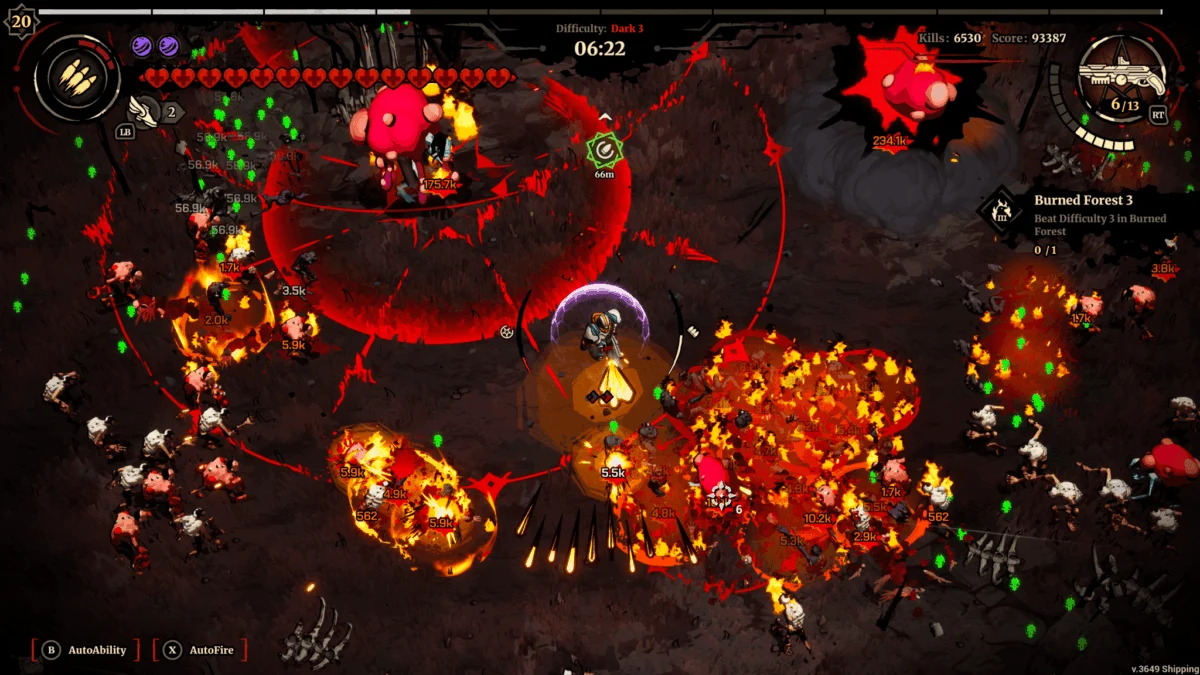
As enemies are defeated, they drop experience points (XP) represented by collectible gems or orbs. Collecting these allows the player to level up mid-run, presenting a choice between randomized upgrades, active abilities, or passive perks. The objective is to construct a "build" that can withstand the exponential growth of enemy health and density. In Grind Survivors, this formula is augmented by active movement mechanics, specifically a dash ability that becomes essential for navigating the "red zones"—large visual indicators of incoming heavy attacks or boss abilities. This shift toward active avoidance aligns the game more closely with "bullet hell" shooters, despite its primary classification as a survivors-like.
Mechanical Synergies and the Infinite Scaling Model
A defining feature of Grind Survivors is its approach to power-ups and stacking buffs. Unlike some competitors that cap player power to maintain a specific challenge level, this title encourages the creation of "broken" builds. Many of the game’s perks are designed around incremental stacking; for instance, certain buffs increase in efficacy as long as the player avoids taking damage or avoids reloading.

These synergies allow for astronomical damage output, which is visually represented by a screen filled with lightning, fire, and explosions. The game utilizes a sophisticated particle system to convey the sheer volume of combat data, a task the Xbox Series X handles with relative stability. The player’s survivability often hinges on a delicate balance of offensive output and defensive layers, such as energy shields, high dodge probabilities, and health regeneration. The synergy system is particularly vital in the game’s "Infinite Mode," where the standard stage timer is removed, and the player’s only goal is to survive against ever-increasing odds to climb global leaderboards.
The Loot Ecosystem: Borrowing from the ARPG Tradition
While many survivors-likes focus solely on permanent meta-progression through gold or currency, Grind Survivors introduces a comprehensive loot system reminiscent of the Diablo franchise. This adds a layer of persistent strategy that exists outside of individual runs. Players can collect firearms of varying rarity levels—Common, Rare, Epic, and Legendary—which can then be modified in the game’s "Forge."
The Forge serves as the central hub for character optimization. Here, players can engage in several distinct activities:
- Item Fusion: Players can combine multiple weapons of lower rarity to create a single item of higher tiering.
- Stat Rerolling: Individual attributes on a weapon, such as fire rate, critical hit chance, or elemental damage, can be rerolled to better suit a specific character class.
- Statistical Overclocking: Players can attempt to push a weapon’s stats beyond their natural maximums. However, this carries a high-risk, high-reward element; failure during the upgrade process can result in the loss of previous enhancements.
The weapon variety, while currently limited in total count, includes distinct archetypes such as rapid-fire SMGs, high-voltage Tesla guns, and melee-focused swords. Each weapon type fundamentally alters the player’s positioning and upgrade priorities, providing a level of tactical depth often missing from the genre.
Progression Chronology and Content Gating
Data gathered from initial gameplay assessments indicates a highly structured, albeit controversial, progression timeline. Unlike many modern titles that provide rapid access to the majority of content, Grind Survivors employs a strict gating system.

- The Initial Phase: Players begin with a single character class and one available map. The early hours are dedicated to learning enemy patterns and gathering enough resources to engage with the Forge.
- The Difficulty Wall: Accessing the second map requires the player to complete the first map across five escalating difficulty levels. Reports suggest this process can take approximately 10 hours of gameplay, depending on the player’s efficiency with the loot system.
- Character Unlocks: Secondary characters and specialized classes are tied to difficulty milestones. For example, the second playable character is only made available after the player successfully unlocks the fourth difficulty tier.
- The Late-Game Grind: The most powerful weapons and "infinite" versions of the stages are reserved for those who have mastered the high-difficulty tiers, creating a clear "endgame" phase focused on optimization and score-chasing.
Critics and players have noted that this progression model is significantly slower than that of Vampire Survivors or Halls of Torment. By "hiding" the majority of its variety behind significant time investments, the game risks alienating casual players, while providing a substantial "grind" for veterans of the genre.
Technical Analysis of the Xbox Series X Performance
The Xbox Series X version of Grind Survivors serves as a technical showcase for how the genre can scale with hardware. The console’s Velocity Architecture allows for rapid transitions between the Forge and the battlefield, while its GPU handles the high-intensity particle effects associated with late-game builds.
However, the technical experience is not without flaws. During peak combat intensity—where hundreds of enemies and thousands of damage numbers occupy the screen simultaneously—rare glitches have been documented. One specific issue involves the game failing to pause correctly during the upgrade selection screen, potentially leading to a "game over" state while the player is distracted by UI menus. Additionally, while the 3D graphics are solid and the art direction effectively conveys a dark, demonic atmosphere, the lack of environmental variety has been highlighted as a point of potential improvement. With only three maps currently available, the visual repetition can become apparent during the 10-hour push to unlock new content.
Broader Industry Implications and Market Positioning
The release of Grind Survivors highlights a growing trend in the indie and mid-tier publishing space: the "ARPG-fication" of simple arcade loops. By combining the low barrier to entry of a survivors-like with the addictive "one more run" nature of a loot-based RPG, Pushka Studios is targeting a demographic that craves both mechanical simplicity and statistical complexity.
From a market perspective, the title faces stiff competition. The genre is currently saturated with low-cost alternatives. However, by leveraging the publishing reach of Assemble Entertainment and focusing on a "premium" console experience on the Xbox Series X, Grind Survivors is positioning itself as a more robust, long-term hobby game rather than a fleeting distraction. The inclusion of complex mechanics like the Forge suggests that the developers intend to support the title with future content updates, including more classes and maps, to address current concerns regarding variety.

Final Summary of Gameplay Dynamics
Grind Survivors is a mechanically dense survivors-like that prioritizes the "grind" in both name and execution. It succeeds in providing a highly satisfying power fantasy through its stacking buff system and robust loot-based meta-progression. While the current version of the game suffers from a lack of environmental and class variety, and employs a progression system that many may find overly restrictive, the core combat remains among the most polished in the genre.
For players on the Xbox Series X, the game offers a high-fidelity take on the bullet heaven formula that justifies the hardware’s capabilities. As the developers continue to balance the difficulty curves and potentially expand the roster of available stages, Grind Survivors has the potential to move from a competent genre entry to a definitive staple for fans of roguelike action and loot-driven progression. The success of the title will ultimately depend on how the community responds to the long-term grind and whether future updates can provide the breadth of content necessary to match its mechanical depth.