


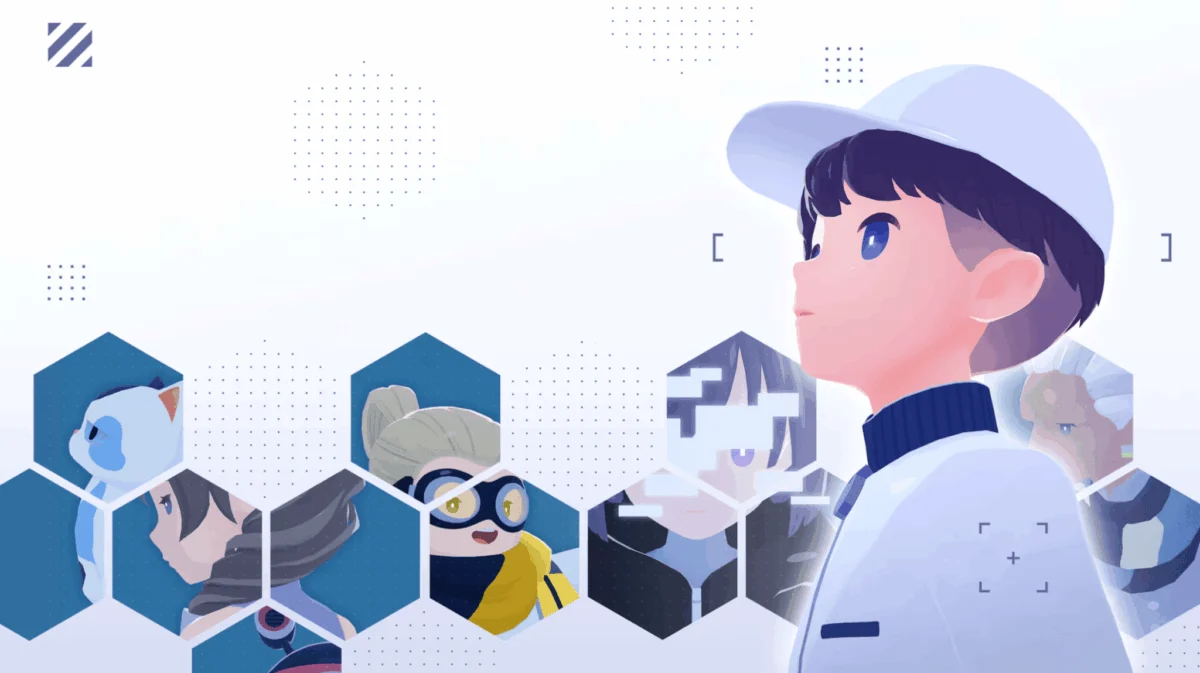
D-topia, the latest release from Marumittu Games, presents a clinical and narrative-driven exploration of a future where human agency has been surrendered to the precision of artificial intelligence. Set within the confines of the "Utopia Project," the game positions the player as Shiro, a newly appointed "Facilitator"—a role that blends the duties of a maintenance technician with those of a social welfare officer. The game functions as a linear, choice-based simulation that examines the friction between human complexity and algorithmic governance. While the aesthetic remains rooted in a minimalist, "cozy" art style, the thematic core of the experience delves into dark sociological territory, questioning the cost of a society engineered for "the greatest happiness of the greatest number."

The Framework of the Utopia Project
The narrative backdrop of D-topia is built upon a tiered societal structure established by the enigmatic Dr. Chloro. In this vision of the future, humanity is distributed across various facilities categorized alphabetically. While the titular D-topia serves as the primary setting, the lore suggests a vast network of similar hubs, ranging from the high-status A-topia to the marginalized Z-topia, where society’s "misfits" are relegated.

Governance is entirely automated. An all-seeing artificial intelligence manages every facet of daily existence, from caloric intake to career placement. This system is facilitated through "Optimization System Integrations," which are essentially technological implants required for all citizens. These implants monitor compatibility and ensure that individuals remain within the parameters of the AI’s grand design. The Facilitator, Shiro, is the human element within this machine—responsible for "fixing things when they go wrong," a mandate that applies as much to broken circuitry as it does to broken spirits.

Chronology of a Facilitator: The Seven-Day Cycle
The gameplay is structured around a rigid seven-day timeline, simulating a standard work week for Shiro. This chronological approach serves as the backbone of the narrative, allowing players to witness the gradual erosion of the "perfect" facade as the week progresses.

- Day One: Induction and Integration – Players are introduced to the daily routine: waking up to machine-prepared synthetic meals, undergoing mandatory health checks, and reporting to the facility for maintenance duties.
- Days Two through Four: Character Immersion – The middle of the week focuses on the introduction of key residents. During this period, the player begins to identify the "glitches" in the human element. These interactions reveal that despite the AI’s optimization, individual traumas and existential dread remain prevalent.
- Day Five: The Emergence of Conflict – The narrative tension shifts as the player is granted higher citizen rankings, allowing access to restricted areas and uncovering the more unsettling aspects of the Utopia Project’s infrastructure.
- Day Six: The Catalyst for Choice – The penultimate day forces a confrontation between the Facilitator’s duties and their personal ethics. Key decisions made here begin to lock the player into one of the three possible endings.
- Day Seven: Resolution and System Output – The final day concludes with the results of the player’s choices, determining the future of D-topia and Shiro’s place within it.
Technical Mechanics: Logic Gates and the Block Side
The gameplay in D-topia is divided between social interaction and a series of logic-based puzzles. The puzzles primarily utilize math-based logic gates and spatial reasoning. Players must navigate mazes where they are required to reach specific numerical values to activate exit gates or bypass security lockouts. These puzzles are integrated into the world as "health checks" or "system repairs," grounding the abstract mechanics in the game’s professional setting.

A central, though arguably underutilized, mechanic is the "Block Side." This is an alternate visual and functional layer of the world that represents the underlying technical infrastructure of D-topia. As a Facilitator, Shiro can switch to the Block Side to identify malfunctions that are invisible to the average citizen. While this mechanic offers a unique perspective on the environment, it often serves as a simple toggle for progression rather than a deep, interactive system.

Case Studies in Human Incompatibility
The narrative strength of D-topia lies in its character studies, which highlight the failures of an optimized society. These characters represent the outliers that the AI struggles to quantify:

- Muri: A chipper young woman who is revealed to be a clone of her "sister." Her purpose is purely biological; she exists as a living organ repository, designed to be harvested when her progenitor requires replacement parts. Her acceptance of this fate creates a chilling juxtaposition with the game’s soft art style.
- Tot: An individual suffering from severe anxiety and obesity. A faulty brain chip, which was supposed to be removed, continues to stimulate his hunger as a coping mechanism for stress. His situation illustrates the physical toll of technological malfunctions on the human body.
- The Frozen Man: A relic of the past, this character was cryogenically preserved in the hope of a future cure for his disease. Having woken up in D-topia, he finds himself cured but utterly alienated by a society that has evolved beyond his understanding of humanity.
The Brain Meeting: A Decision-Making Framework
When faced with critical ethical dilemmas, the game transitions into a "Brain Meeting." This is a formalized decision-making interface where Shiro (and the player) must analyze the facts of a situation through a flowchart of binary questions.

An early example involves a stray, ownerless cat. The AI, following strict utilitarian logic, determines that the animal is a resource drain and should be euthanized. The Brain Meeting allows the player to intervene, searching for alternative logic that the AI might accept. These meetings are the primary vehicle for the game’s branching paths, requiring the player to weigh the "greatest happiness" against individual mercy.

Analysis of Pacing and Player Retention
Despite the compelling narrative themes, D-topia faces significant challenges regarding its pacing. The game’s commitment to a "working day" structure results in a repetitive gameplay loop that some players may find taxing. The routine of waking, eating, and traveling to the same few locations is intended to mirror the monotony of a controlled life, but it occasionally results in player fatigue.

Furthermore, the game employs unskippable text message sequences. While these messages provide essential world-building and character development, the inability to control the speed of the text delivery has been noted as a point of friction. The citizen ranking system, which unlocks new areas and apartment decorations, provides some incentive for progression, but the rewards are often cosmetic, failing to significantly alter the core gameplay experience.

Broader Impact and Industry Context
D-topia enters a growing sub-genre of "dystopian cozy" games—titles that use inviting visuals to mask deep philosophical inquiries. It shares thematic DNA with games like Papers, Please and Not For Broadcast, where the player is a cog in a larger, often oppressive, machine.

From a sociological perspective, the game serves as a critique of radical utilitarianism. By showing the "dark side" of a perfect world, Marumittu Games prompts players to consider whether a life without suffering is worth the loss of autonomy. The inclusion of three distinct endings—accessible via a chapter select feature—encourages players to experiment with different ethical stances, from total system loyalty to quiet subversion.

Conclusion
D-topia is a clinical examination of a high-tech purgatory. It succeeds in creating a world that feels both familiar and deeply alien, using the role of the Facilitator to bridge the gap between the player and the machine. While the rigid structure and slow pacing may alienate those seeking a more traditional adventure, the game offers a substantive narrative for those willing to endure its routine. It stands as a reminder that even in a world optimized for happiness, the human spirit remains an unpredictable and often unfixable variable.