


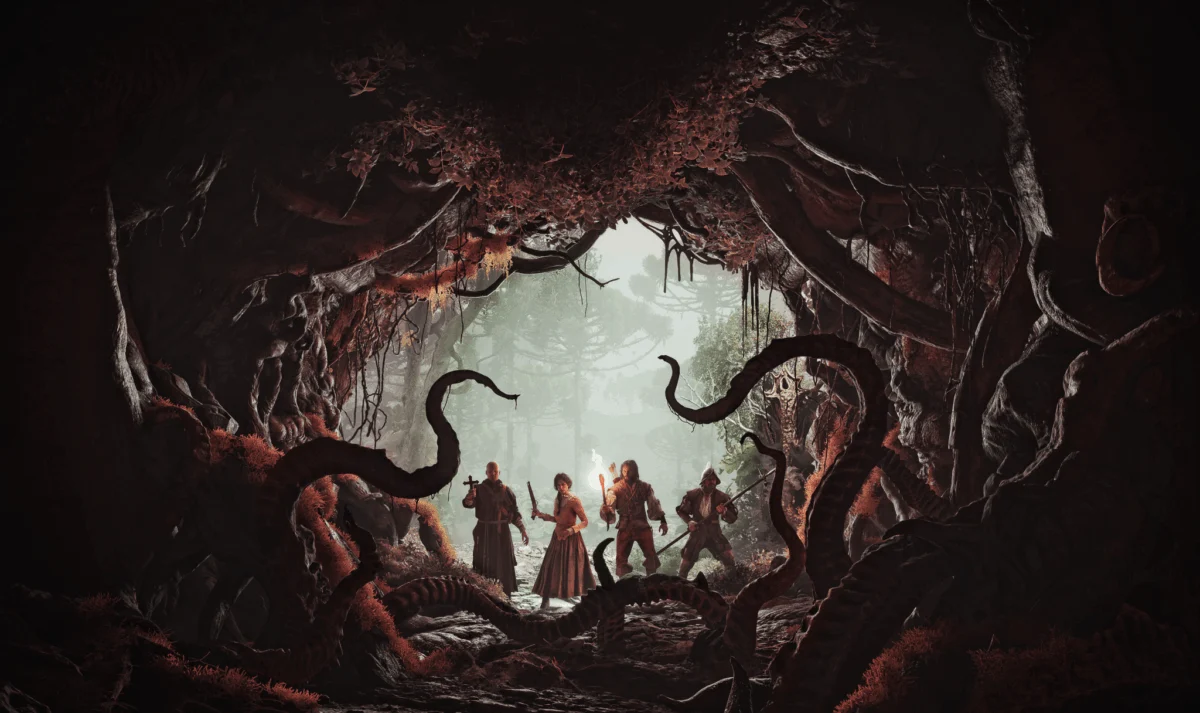
The Mound: Omen of Cthulhu represents a significant departure from traditional cosmic horror adaptations by merging 16th-century exploration with modern co-operative extraction mechanics. Developed by the Chilean studio ACE Team and published by NACON, the title draws its primary inspiration from the 1940 novella "The Mound," ghostwritten by H.P. Lovecraft for Zealia Bishop. While the original literary work focused on an archaeological discovery in Oklahoma during the 1920s, ACE Team has re-envisioned the narrative as a period-piece expedition into a cursed South American jungle. This review-in-Progress analyzes the first ten hours of gameplay, focusing on the title’s unique sanity mechanics, atmospheric design, and the technical challenges encountered during its initial launch window.

Historical and Narrative Framework
To understand the scope of The Mound: Omen of Cthulhu, one must look at its literary roots. The original Lovecraft/Bishop novella describes an underground realm called Xinaián, inhabited by a decadent, immortal race. ACE Team has shifted this setting to the 1500s, an era defined by the brutal realities of the Age of Discovery. Players assume the roles of explorers tasked with investigating a jungle island that serves as a gateway to eldritch horrors.
The game begins aboard the Tempestad, a Spanish-style galleon that serves as the player hub and lobby. This ship is the central point for character selection and mission preparation. Initially, players have access to four distinct characters—including a soldier and a priest—each possessing unique backstories. However, the core gameplay remains functionally similar across the roster, with the primary differences lying in the survivors players can rescue and unlock as they progress deeper into the island’s interior.

Core Gameplay Loop and Mission Structure
The Mound: Omen of Cthulhu utilizes a contract-based progression system. Players interact with the ship’s captain to select from an assortment of expeditions categorized into four difficulty tiers: Basic, Mid, Advanced, and Legendary. These missions are influenced by dynamic factors such as time of day and varying weather conditions, which directly impact visibility and survival.
The primary objective typically involves venturing into the jungle to retrieve idols, trinkets, and resources. Central to this expedition is an AI-controlled priest who manages an ox-drawn carriage. This cart serves several critical functions:

- Resource Storage: It acts as a mobile inventory for found treasure and hunted game.
- Revival System: The bodies of fallen teammates can be placed in the cart to be returned for revival.
- Navigation: As the cart moves, it leaves a trail of white paint on the jungle floor, providing a literal lifeline for players who become disoriented in the dense undergrowth.
While solo play is technically possible, the developers have explicitly designed the experience for co-operative play. The game scales difficulty based on the number of players, and the reliance on proximity-based communication suggests that a coordinated team is the intended way to survive the island’s more advanced challenges.
Psychological Horror and Sanity Mechanics
The most distinctive feature of The Mound: Omen of Cthulhu is its "Expedition to Madness" system. Unlike many horror games that rely on scripted jump scares, ACE Team has implemented a sanity system that focuses on sensory deception. The longer a team remains in the jungle, the more the environment begins to manipulate their perception.

Initial symptoms of insanity are subtle, such as movement in the peripheral vision or the sound of rustling in nearby bushes. As sanity depletes, these hallucinations become more aggressive. Players may hear phantom screams or otherworldly noises through their headsets. Eventually, the visual distortions extend to teammates; a fellow player may suddenly appear as a shambling undead corpse or a mass of squirming, worm-like creatures.
This creates a unique tactical dilemma. Because the game features friendly fire and lacks clear HUD indicators during high-stress moments, players often find themselves accidentally attacking their allies. If a player’s sanity fails completely, they become "corrupted." In this state, vines pull the character into the ground, and their communication via proximity chat is severed. The corrupted player then becomes a threat that the remaining team must neutralize to bring them back to the ship for restoration.

Technical Analysis and Patch Chronology
The review period for The Mound: Omen of Cthulhu was marked by significant fluctuations in game balance and stability. Upon the initial distribution of review codes, the game was noted for its extreme difficulty. Surviving even basic missions required near-perfect coordination, and many teams failed to return to the Tempestad with their spoils.
A mid-review patch released alongside the Steam version of the game appeared to overcorrect these issues. Following the update, the difficulty curve flattened significantly, allowing teams to breeze through "Advanced" missions with minimal resistance. This shift impacted the horror elements of the game; when the threat of the jungle is diminished, the psychological horror mechanics lose their edge, transitioning from "unnerving" to "predictable."

Furthermore, the patch introduced several network stability issues. Reviewers reported multiple connection crashes that ejected teammates in the middle of missions, leaving remaining players stranded in the jungle. In an extraction-style game where progress is tied to a successful return to the hub, these technical failures represent a significant hurdle for the player experience.
Combat, Navigation, and Gear
Combat in The Mound is primarily melee-focused, utilizing 16th-century weaponry such as axes, machetes, swords, and knives. For ranged encounters, players can utilize muskets, longbows, and crossbows. However, the use of firearms is discouraged by the game’s "noise" mechanic. Loud noises attract the attention of the island’s inhabitants, making stealth and quiet exploration the preferred method of travel.

The combat system has been criticized for its "janky" and rudimentary feel. There is currently no "jump" button, which can make navigating the dense jungle terrain feel restrictive. Perhaps more critically, the game launched without a parry or block mechanic. While ACE Team has acknowledged this omission and stated that a blocking system is currently in development, its absence at launch leaves the combat feeling one-dimensional and overly reliant on kitting and basic strikes.
Progression is managed through XP and tokens earned during successful missions. These tokens are used to purchase single-use items such as:

- Map Scraps: To reveal portions of the island.
- Medallions: To track high-value treasures.
- Survival Gear: Including bandages, rations, and smelling salts for revives.
Notably, even gear upgrades and improved weaponry are temporary, emphasizing the game’s survivalist themes but potentially frustrating players looking for a more permanent sense of character growth.
Broader Implications for the Extraction Genre
The Mound: Omen of Cthulhu arrives at a time when the "extraction" genre—popularized by titles like Escape from Tarkov and Hunt: Showdown—is diversifying. By leaning heavily into psychological horror and a specific historical setting, ACE Team is attempting to carve out a niche for players who prefer atmosphere and mystery over pure competitive gunplay.

The game’s reliance on discovered lore—told through journal entries and notes scattered throughout abandoned forts—aligns with the Lovecraftian tradition of "forbidden knowledge." However, the long-term viability of the title will likely depend on how the developers manage the balance between horror and repetition. As the review indicates, the "WTF" moments that define the early hours of the game can quickly become banal if the underlying mechanics do not evolve alongside the player’s familiarity with the island.
Final Review-in-Progress Assessment
After approximately ten hours of play, The Mound: Omen of Cthulhu shows a high level of ambition in its audio-visual design and its commitment to a unique horror sub-genre. The use of proximity chat and sensory manipulation creates a genuine sense of unease that few co-op games achieve.

However, the game is currently hampered by inconsistent difficulty balancing, a lack of fundamental movement and defensive options, and technical instability. For players who value atmosphere and are willing to overlook "janky" combat in favor of a unique psychological experience, the game offers a compelling mystery. As the community moves closer to uncovering the secrets of "the mound," the success of the game will depend on ACE Team’s ability to refine the combat loop and maintain the tension of the jungle over dozens of hours of play.
The title remains a unique, if unpolished, entry in the 2026 gaming landscape, proving that the works of H.P. Lovecraft still offer fertile ground for experimentation when handled with the surrealist flair for which ACE Team is known.

Data Summary Table
| Feature | Specification |
|---|---|
| Developer | ACE Team |
| Publisher | NACON |
| Platform | PC (Steam) |
| Genre | Co-op Psychological Horror / Extraction |
| Setting | 16th Century South American Jungle |
| Difficulty Tiers | Basic, Mid, Advanced, Legendary |
| Sanity System | Auditory/Visual Hallucinations, Team Perception Shifting |
| Key Mechanics | Ox-Cart Logistics, Proximity Chat, White Paint Navigation |
| Current Status | Review-in-Progress (10+ hours logged) |