


Big Walk, the latest title from the Melbourne-based independent studio House House, represents a significant departure from the chaotic, solo-centric mischief of their previous global phenomenon, Untitled Goose Game. Released in 2026, the game challenges the prevailing trends of the cooperative multiplayer genre, often colloquially and sometimes disparagingly referred to as "friendslop"—a term used to describe low-effort, repetitive co-op titles designed primarily for streamer engagement. Instead, House House has delivered a meticulously crafted experience that prioritizes genuine interpersonal connection, spatial communication, and the joy of shared discovery. By mandating a minimum of two players and supporting groups of up to twelve, Big Walk positions itself not merely as a game, but as a digital social experiment centered on the mechanics of coordination.

Development Context and Studio Evolution
House House first gained international prominence with the 2019 release of Untitled Goose Game, which sold millions of copies and permeated popular culture. Before that success, the four-person team—comprising Nico Disseldorp, Michael McMaster, Alec Dawson, and Stuart Gillespie-Cook—developed Push Me Pull You, a game that similarly explored the physical proximity and awkward coordination of players. Big Walk serves as a spiritual successor to these themes, scaling the intimacy of their earlier work into a vast, open-world environment.
The game was officially announced during The Game Awards in December 2023, where its surrealist art style and emphasis on "walking and talking" immediately sparked intrigue. During the development cycle, the studio emphasized that the game was built around the concept of a "group outing." Unlike traditional cooperative shooters or survival games that use combat or resource scarcity as the primary driver of interaction, Big Walk relies entirely on the navigation of space and the resolution of environmental puzzles through verbal and non-verbal cues.

Technical Framework and the Proximity Audio Pillar
At the core of the Big Walk experience is a sophisticated proximity-based audio system. This mechanic dictates that the volume and clarity of a player’s voice are determined by their physical distance from others in the game world. This design choice is foundational to the gameplay loop; it creates a tangible sense of presence and vulnerability. When a player wanders too far from the group, they are met with a deafening natural silence, effectively cutting them off from the collective decision-making process.
Industry analysts have noted that this reliance on in-game audio serves as a counter-measure to the "Discord-normalization" of modern gaming, where external third-party chat applications often bypass in-game limitations. House House’s design encourages—and arguably requires—players to remain within earshot, thereby making the act of "staying together" a central mechanical challenge rather than a passive choice.

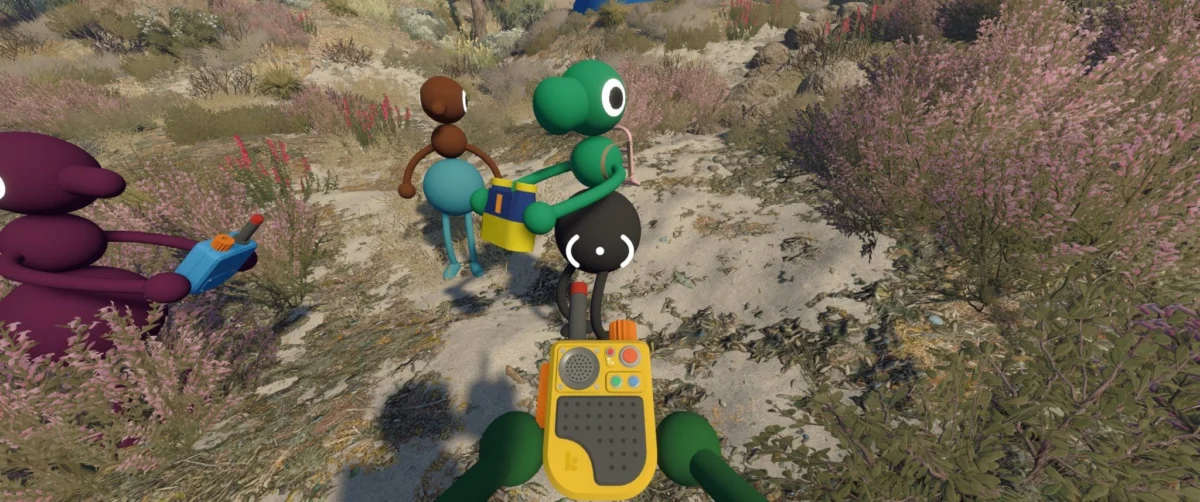
The player avatars are stylized, bird-like creatures with gangly limbs and expressive beaks that fluctuate in size based on the volume of the player’s real-world speech. Beyond voice, the control scheme offers granular manipulation of the character’s arms, allowing players to point, wave, or hold objects above their heads. These physical gestures become vital when puzzles or environmental barriers separate the group, forcing players to develop a makeshift sign language to communicate across chasms or through glass partitions.
Environmental Design and Visual Contrast
The setting of Big Walk is a sprawling, naturalistic island characterized by dense forests, deep valleys, and a dynamic day-to-night cycle. The visual direction is defined by a striking contrast: the environment is rendered with a high degree of natural detail—swaying trees, intricate plant life, and realistic lighting—while the players and man-made structures are rendered in bright, flat, primary colors with minimalist geometries.

This aesthetic choice serves a functional purpose. The eye-catching, artificial structures scattered across the island act as landmarks and puzzle hubs, drawing the players’ attention amidst the vast greenery. The island is designed to be navigated without the aid of a traditional "mini-map" or GPS waypoints. Instead, players must rely on sightlines, shared landmarks, and tools like compasses or maps that exist as physical objects within the game world.
The Gameplay Loop: Nubbins, Keys, and Coordination
The progression system in Big Walk is elegantly simple yet intellectually demanding. The primary objective involves exploring the island to locate and solve various puzzles. Successful completion of these challenges rewards the group with "nubbins"—small, abstract items that serve as the game’s primary currency of progress. These nubbins are eventually used to obtain keys, which unlock new sectors of the island, leading to more complex challenges and further narrative breadcrumbs.

The puzzles themselves are diverse and specifically scaled to the number of players in a session. House House implemented a dynamic scaling system that adjusts puzzle requirements based on whether a group consists of two players or twelve. This ensures that the difficulty remains consistent and that every player has a role to play. Examples of these challenges include:
- Symmetrical Coordination: Groups must split into pairs on opposite sides of a soundproof barrier, using only hand gestures to relay complex sequences of symbols to one another.
- Aural Synchronization: One player wears in-game headphones to monitor frequencies while others manipulate external microphones and switches, requiring the "listener" to direct the "operators" through verbal commands.
- Long-Distance Signaling: Puzzles that require players to be stationed at opposite ends of a valley, using flares or high-powered torches to signal timing for simultaneous switch activations.
This loop creates a constant need for "Big Talk," where the group must pause to deliberate, assign roles, and plan their route. The "slowness" of the game is an intentional design choice, encouraging players to inhabit the space rather than rushing toward an endgame.

Toolsets and Equipment Utility
To assist in the traversal of the island’s rugged terrain, players can discover and equip various tools. These are not merely cosmetic; they are essential for managing the logistics of a large group.
- Torches and Flares: Used for navigation during the pitch-black night cycles or for signaling distress when a player becomes separated from the group.
- Walkie-Talkies: A rare and valuable resource that allows for long-distance communication, bypassing the limitations of proximity chat but requiring players to manage battery life or signal clarity.
- Backpacks and Holsters: Essential for carrying multiple nubbins or tools, necessitating a "logistics officer" role within the group to ensure the team is prepared for extended treks.
- Laser Pointers: Used for highlighting specific distant objects or directing the group’s attention during complex puzzle explanations.
Market Impact and Critical Implications
The release of Big Walk has prompted a broader discussion within the gaming industry regarding the "loneliness" of modern multiplayer experiences. While many contemporary titles offer matchmaking and competitive ladders, they often lack the "social glue" that fosters genuine friendship. House House’s decision to exclude a single-player mode and enforce a two-player minimum is a bold stance against the commodification of gaming as a solo, repeatable "content" stream.

Data from the first quarter of 2026 suggests that Big Walk has found a dedicated audience among "close-knit" gaming circles. Unlike viral "horror-extraction" games that rely on jump scares for engagement, Big Walk’s retention is driven by the quality of the social interactions it facilitates. Critics have lauded the game for its "pure video-game magic," noting that it successfully gamifies the act of friendship itself.
However, the game’s reliance on a pre-existing social circle presents a barrier to entry. Players without a consistent group of friends may find the experience inaccessible, as the game does not feature a traditional "public lobby" system, preferring instead to emphasize private, curated experiences. This exclusivity is a calculated risk by House House, prioritizing the depth of the experience over broad, shallow accessibility.

Chronology of Key Events
- September 2019: Untitled Goose Game launches, establishing House House as a major indie developer.
- December 2023: Big Walk is revealed at The Game Awards with a debut trailer showcasing its communication-heavy gameplay.
- 2024–2025: House House conducts private playtests to refine the proximity audio and puzzle scaling systems.
- August 2026: Big Walk is released on PC and major consoles, receiving critical acclaim for its innovation in the cooperative genre.
- Late 2026: The game is recognized in several year-end awards for "Best Multiplayer" and "Innovation in Communication."
Conclusion: The Legacy of the Walk
Big Walk stands as a testament to the power of intentional limitations in game design. By stripping away combat, complex UI, and competitive pressure, House House has exposed the core appeal of multiplayer gaming: the simple pleasure of being in a space with others. The game’s "nubbin" economy and "bird-like" avatars provide a whimsical wrapper for what is essentially a masterclass in social engineering.
As the industry continues to grapple with the balance between monetization and player experience, Big Walk serves as a reminder that some of the most memorable digital moments are not scripted by developers, but are the result of a group of friends trying to find their way through the woods, talking all the way. The "Big Walk" is not just a journey across an island; it is a journey toward a more connected and communicative form of interactive entertainment.