


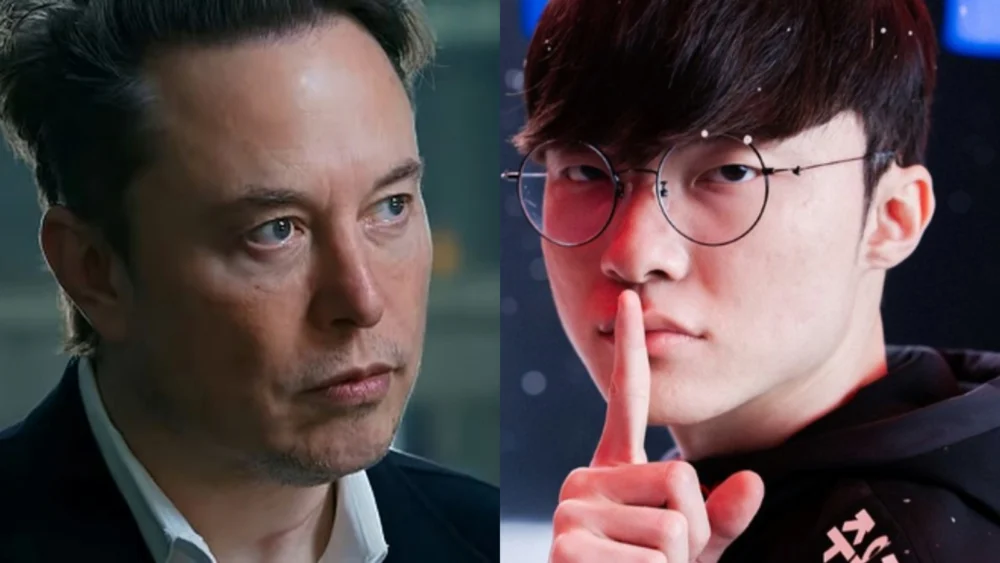
The esports world is buzzing with the announcement of a monumental challenge that pits the pinnacle of human skill in League of Legends against cutting-edge artificial intelligence. Elon Musk, the visionary entrepreneur behind SpaceX and Tesla, has formally proposed a competitive match between his advanced AI, Grok, and the legendary T1 team, featuring the iconic player Faker. This ambitious proposal, announced via Musk’s social media platform X, aims to test the capabilities of AI in a complex, real-time strategic environment, drawing parallels to historical confrontations between human intellect and artificial intelligence in games like chess.
The genesis of this challenge lies in Musk’s broader vision for artificial intelligence and its integration into various sectors, including entertainment and gaming. For some time, Musk has been vocal about his aspirations for Grok, particularly its potential in game development. He has previously expressed his belief that AI could revolutionize the video game industry, even suggesting that an AI could potentially develop an entire game autonomously by 2029. This League of Legends challenge, however, represents a more immediate and direct test of AI prowess, focusing on its ability to compete at the highest human level within a defined, highly competitive framework. The target date for this extraordinary exhibition match is set for 2026, providing a two-year window for Grok’s development and for T1 to prepare.
The stakes are immense, aiming to replicate the significance of historic AI milestones such as IBM’s Deep Blue defeating chess grandmaster Garry Kasparov. The League of Legends arena, with its intricate team dynamics, strategic depth, and lightning-fast decision-making, presents a far more complex and dynamic challenge than chess. Musk’s proposition is not merely a speculative thought experiment; it is a direct invitation to the reigning champions and the most celebrated player in the game’s history.
Grok’s Capabilities and Musk’s Proposed Constraints
Elon Musk outlined the core of his challenge on X, specifying that Grok 5, the AI in question, is designed with the inherent ability to learn and adapt to any game simply by reading its instructions and engaging in experimental play. He articulated the challenge with a clear statement: "Let’s see if Grok 5 can beat the best human team League Of Legends in 2026 with these important constraints." This statement was accompanied by two crucial conditions designed to level the playing field and ensure a fair comparison with human players.
The first constraint dictates that Grok will only be able to perceive the game through a camera feed, mimicking the visual input a human player would receive. This means the AI’s "vision" will be limited to what a person with 20/20 eyesight could see on a standard monitor, preventing any form of "wall-hacking" or omniscient awareness of the game map. This limitation is critical in replicating the human experience of fog of war and limited information.

The second constraint addresses the operational speed of the AI. Grok’s reaction latency and click rate will be capped to match that of a human player. This is a significant stipulation, as AI systems can typically process information and execute actions at speeds far exceeding human capabilities. By imposing these limitations, Musk is not aiming for an AI that simply overwhelms its human opponents with raw processing power and speed, but rather one that can demonstrate strategic understanding, tactical execution, and adaptive decision-making within human-like operational parameters. These rules aim to ensure that any victory by Grok would be a testament to its strategic intelligence rather than its computational speed advantage.
The Esports Community’s Reactions and Expert Opinions
The announcement quickly gained traction within the esports community, eliciting a wide range of responses from professional players, analysts, and developers. The sheer audacity of the challenge sparked immediate discussion about the future of AI in competitive gaming.
Eugene "Pobelter" Park, a former professional League of Legends player and analyst, expressed keen interest, stating, "Would love to help and offer insight as a former League pro, I thought AI vs Dota 2 was really interesting and always wanted to see it vs League." His comment highlights the existing fascination with AI’s potential in esports and suggests a willingness from experienced individuals to contribute to such a groundbreaking event.
Oriol Vinyals, a researcher known for his work in AI and gaming, notably achieving Grandmaster status in StarCraft, piqued Musk’s interest by proposing a StarCraft match instead. He humorously added, "Bonus points if you get the robots to operate the mouse and keyboard," to which Musk responded, "Sounds good." This exchange underscores the broader implications and potential avenues for AI competition beyond League of Legends, indicating Musk’s enthusiasm for pushing AI boundaries across different gaming genres.
However, not all reactions were optimistic about Grok’s chances, particularly given the proposed 2026 timeline. Joedat "Voyboy" Esfahani, another prominent former LoL pro, voiced significant skepticism. He argued, "You wouldn’t even be able to beat an LCS team, much less Faker and the boys. League has far too many variables / interaction & game knowledge context / legit team coordination required to win at the highest level." His statement points to the immense complexity of League of Legends, emphasizing the deep strategic understanding, nuanced team coordination, and extensive game knowledge that are crucial for success at the professional level, suggesting that these are particularly challenging areas for AI to master.
Similarly, Yiliang "Doublelift" Peng, a highly decorated former professional player, shared his doubts. He expressed extreme skepticism about Grok’s ability to defeat T1 or even him personally, going as far as to claim he would shave his head if Grok managed to best him. This sentiment reflects a common perspective among elite players who understand the intricate, often intangible, elements of high-level competitive play that are difficult to codify.

Official Responses and Potential Implications
The challenge has not only captured the attention of the esports community but also that of the game’s developer, Riot Games, and T1 itself. T1 responded with a confident declaration: "We are ready," accompanied by a GIF of Faker, and a direct challenge back to Musk, "Are you?" This response signifies T1’s readiness to accept the unprecedented challenge, showcasing their faith in their team and their legendary player. The inclusion of Faker’s image is a powerful statement, acknowledging the player at the heart of the challenge and his unparalleled legacy in League of Legends.
Riot Games, the publisher of League of Legends, has also indicated its interest. Marc Merrill, co-founder and president of Riot Games, replied directly to Elon Musk’s post with a simple yet significant "let’s discuss." This suggests that Riot Games is open to officially sanctioning or even promoting such an event, potentially elevating it from a social media challenge to a formally organized esports spectacle. The involvement of Riot Games would lend significant legitimacy to the match and could pave the way for it to become one of the most-watched League of Legends events in history. The potential for a fully endorsed AI versus human professional esports match is unprecedented and could set a new benchmark for the intersection of technology and competitive gaming.
A Glimpse into the Future of Gaming and AI
The prospect of Grok competing against T1 and Faker in 2026 is more than just a hypothetical matchup; it represents a significant inflection point in the evolution of artificial intelligence and its relationship with human endeavor. While the challenges are substantial, the potential rewards for understanding AI’s capabilities are immense. If Grok can even approach the level of T1 under the proposed constraints, it would signify a monumental leap in AI’s ability to understand and execute complex, dynamic strategies.
The implications extend beyond competitive gaming. Success in a game like League of Legends, with its constant adaptation, emergent strategies, and complex team coordination, could translate to advancements in AI for fields requiring similar capabilities, such as robotics, autonomous systems, and advanced strategic planning. The data generated from such a competition would provide invaluable insights into AI learning, decision-making under pressure, and the nuances of human-AI interaction.
The journey from a social media post to a globally broadcast event is still unfolding. However, the challenge issued by Elon Musk has undeniably ignited a conversation about the future of AI and its potential to compete with, and perhaps even surpass, human capabilities in domains previously thought to be exclusively within the human realm. The coming years will be critical in observing Grok’s development and T1’s preparation, as the esports world braces for what could be the most talked-about competition in its history. This unprecedented contest is poised to redefine the boundaries of artificial intelligence and human achievement in the digital arena.