


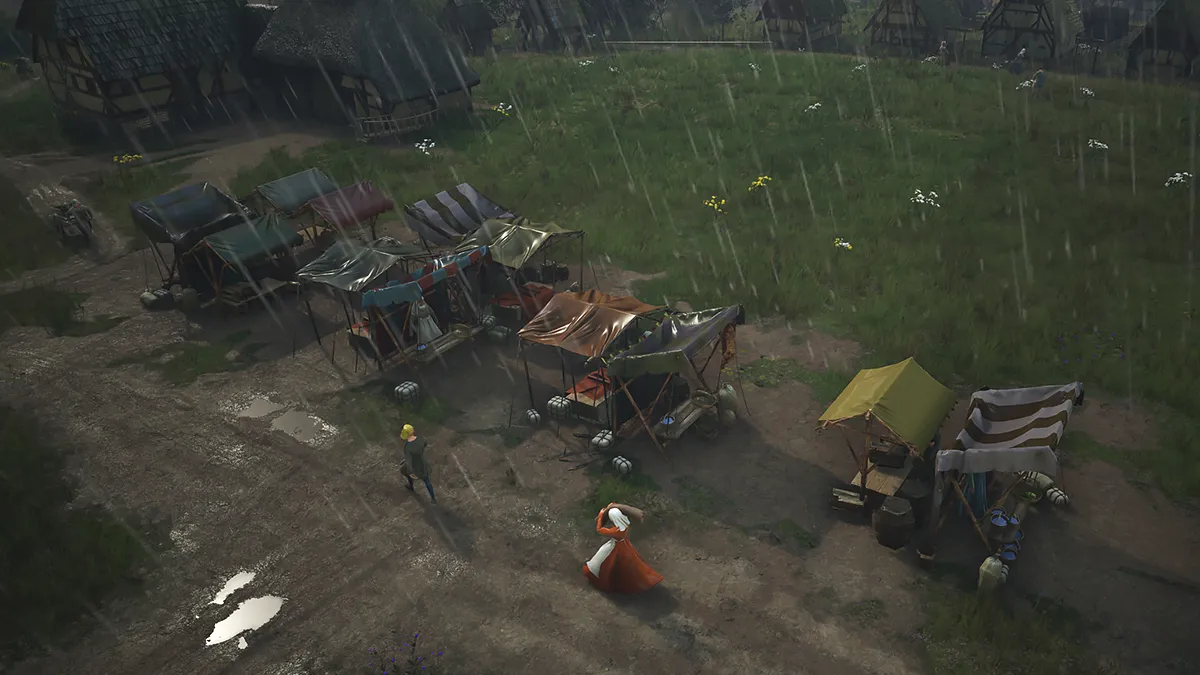
The intricate world of Manor Lords, the highly anticipated medieval city-builder and real-time strategy game, presents players with a multitude of challenges, from establishing burgeoning settlements to repelling bandit incursions. Among the more frequently discussed and occasionally perplexing elements of gameplay is the management of loose supplies and resources that seemingly defy efficient collection. Players often find themselves observing lingering piles of construction materials or individual logs scattered across their meticulously planned territories, an issue that can significantly impede progress, particularly after the demolition of structures or during active logging operations. These uncollected goods, exposed to the elements, are susceptible to decay over time, leading to valuable resource loss. Furthermore, their presence can actively obstruct the construction of new buildings, creating frustrating bottlenecks in a game where spatial planning and timely development are paramount. This logistical conundrum becomes particularly pronounced when, despite the apparent availability of nearby storage facilities and a populace of idle villagers, these crucial items remain stubbornly unaddressed, testing the patience of players striving for an orderly and efficient medieval domain.
The core of this challenge lies in Manor Lords‘ detailed simulation of medieval logistics and the autonomy of its villager AI. Unlike some city-builders where resources instantly teleport to storage or are immediately picked up, Manor Lords strives for a degree of realism. Villagers have specific roles, pathfinding considerations, and workload priorities that dictate their actions. When a building is dismantled, or logs are felled, the resulting materials are not automatically assigned to an immediate collection task with the highest priority. Instead, they become part of the general pool of exposed goods, waiting for a villager with the appropriate role and proximity to transport them to designated storage. This system, while contributing to the game’s immersive quality, can lead to inefficiencies if not properly managed, transforming what appears to be a minor aesthetic imperfection into a significant operational hurdle.
The Economic and Developmental Ramifications of Uncollected Goods
The implications of unmanaged supplies extend beyond mere visual clutter. Economically, resources left exposed face degradation due to weather conditions. Timber might rot, stone might erode, and other materials could become unusable, representing a direct loss of invested labor and potential trade value. In the early stages of a settlement, where every unit of resource is critical for survival and growth, such losses can stunt development, delay essential upgrades, and even trigger resource shortages. A player might, for instance, be waiting on a handful of logs to complete a vital building, only to find those logs slowly decaying while available villagers are engaged in less critical tasks or simply not prioritizing the collection.
From a developmental perspective, uncollected supplies pose a direct obstacle to construction. The game’s building placement mechanics often require a clear footprint. If a strategic plot of land is earmarked for a new dwelling, a market, or an essential production facility, but is partially occupied by a few stray logs or a pile of discarded stones, construction cannot proceed. This forces players to either redesign their layout, potentially sacrificing optimal placement, or endure frustrating delays while they await the eventual, often seemingly random, collection of the offending items. This can be particularly disruptive when attempting to establish a compact, efficient urban core or when responding to urgent needs such as constructing defensive structures. The accumulation of these minor delays across multiple projects can collectively slow the expansion of the entire manor, impacting population growth, resource generation, and overall regional power.
Community feedback across various Manor Lords forums and social media platforms, including Reddit and the official Discord, consistently highlights the issue of uncollected supplies as a frequent source of player frustration. While specific data points on the exact percentage of players affected or the average delay incurred are not officially released by the developer, the sheer volume of discussions, troubleshooting requests, and shared workarounds underscores its prevalence. Many players, accustomed to the more immediate resource management systems of other city-building titles, initially perceive this as a bug rather than an intended, albeit challenging, game mechanic. The quest for "order in their medieval town" is a common theme among Manor Lords players, making the persistent presence of unkempt resources a direct affront to their strategic aspirations.
Navigating the Logistical Labyrinth: Strategies for Expedited Collection

While the default behavior of villagers may sometimes appear inefficient, Manor Lords does provide players with tools and strategies to exert greater control over resource logistics. The key lies in understanding villager priorities and leveraging specific building functionalities.
Managing General Goods (Storehouse and Granary):
For miscellaneous supplies such as planks, stone, hides, or processed goods that are not logs, the primary storage facilities are the Storehouse and the Granary (for food items). When an "Exposed Goods" warning icon appears on the info bar at the top of the screen, it signifies that valuable resources are lying unprotected and vulnerable. The intuitive first response for many players is to ensure workers are assigned to these storage buildings, assuming they will then automatically prioritize clearing exposed items. While this is partially true, the speed and efficiency of this process can vary.
-
Assigning Additional Workers: The most straightforward approach is to increase the number of families assigned to the Storehouse or Granary. More workers mean more potential haulers. While villagers assigned to these buildings also handle distribution and inventory management, a larger workforce increases the likelihood that one will be available to pick up exposed goods. It is crucial to monitor the "idle" status of villagers; simply having workers assigned does not guarantee immediate action if they are occupied with other tasks within their building’s purview. Temporarily reassigning workers from less critical jobs to the Storehouse/Granary can provide a short-term boost to hauling capacity.
-
Optimizing Road Networks: Manor Lords simulates physical movement, and effective road infrastructure is critical. Ensuring a clear, direct road connection between the location of the exposed supplies and the relevant storage building can significantly reduce travel time for villagers. Long, winding paths or obstructed routes will inherently slow down the collection process. Investing in a well-planned road system early on pays dividends in logistical efficiency.
-
The "Limit Work Area" Functionality: A Precision Tool: This is arguably the most powerful tool for expediting the collection of general exposed goods. Every production or storage building in Manor Lords has an interface that includes an option to "Limit Work Area." This function allows players to define a specific geographical zone where the assigned workers will focus their activities.
- Implementation: To utilize this, click on the Storehouse or Granary. In its interface, locate and select the "Limit Work Area" option. A circular or square overlay will appear, which you can then resize and reposition. Drag this work area directly over the cluster of exposed goods you wish to have collected.
- Effect: By limiting the work area, you effectively tell the villagers assigned to that building to prioritize all tasks within that designated zone. This includes the collection of exposed goods. They will largely ignore resources outside this area until the designated zone is cleared, or the work area is reset. This provides an immediate, targeted solution for clearing specific problematic areas.
- Post-Collection: Once the exposed goods within the limited work area have been successfully hauled to storage, it is crucial to return to the Storehouse or Granary interface and select "Clear Work Area." Failure to do so will keep your workers confined to that small zone, potentially neglecting other important hauling or distribution tasks across your wider settlement. This micromanagement step is vital for maintaining overall logistical fluidity.
Managing Logs (Logging Camp):
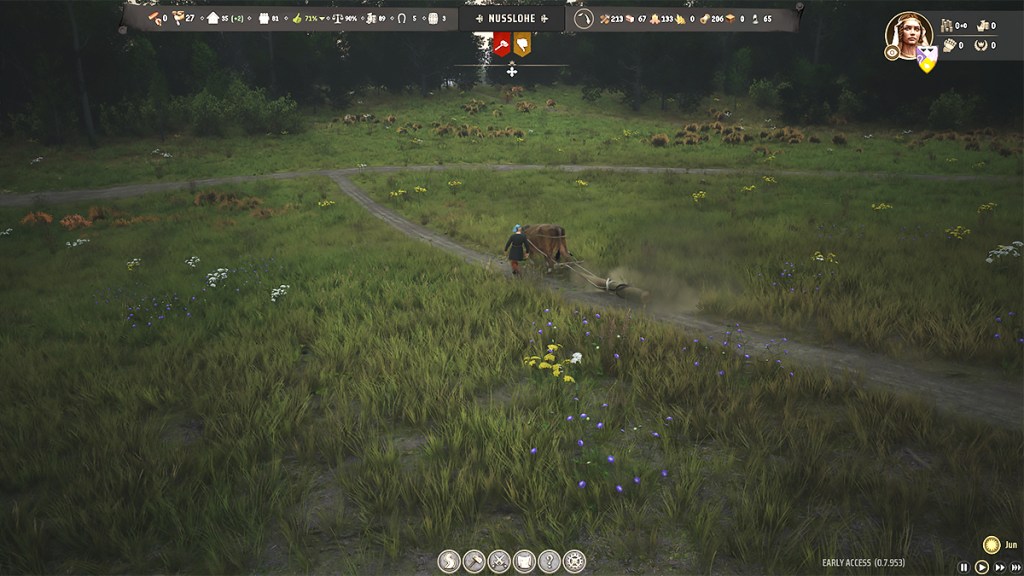
Logs are handled separately from other general goods. They are stored in Logging Camps, and their transportation is often facilitated by oxen, which are essential for moving heavy timber. The principles for expediting log collection are similar to general goods but with specific considerations for the Logging Camp and oxen.
-
Dedicated Logging Camp Workers: Ensure that the Logging Camp has assigned workers. These villagers, often accompanied by oxen, are responsible for felling trees and transporting logs to the camp’s storage. If logs are accumulating, it might indicate that the Logging Camp is understaffed or that its workers are overburdened.
-
Optimizing Oxen Allocation: Oxen are a shared resource. If your Logging Camp workers are constantly waiting for an ox, it will significantly delay log collection. Consider if other buildings are monopolizing oxen (e.g., construction sites, other transport hubs). Sometimes, simply having more oxen available in your settlement can improve overall transport efficiency.
-
"Limit Work Area" for Logging Camps: Just like Storehouses and Granaries, Logging Camps also feature the "Limit Work Area" option.
- Implementation: Click on the Logging Camp, select "Limit Work Area," and reposition the zone to encompass the abandoned logs.
- Effect: This will direct the loggers to prioritize collecting any logs within that specific area and transporting them back to their camp. This is particularly useful for clearing logs left behind after the demolition of a timber-intensive structure or when you need to clear a specific plot of land.
-
Strategic Logging Camp Placement/Relocation: If a large quantity of logs is consistently appearing in an area far from your existing Logging Camp, it might be more efficient to build a new, temporary Logging Camp closer to the source of the logs. Once the area is cleared, the temporary camp can be dismantled, and its workers reassigned. This is a more drastic measure but can be highly effective for large-scale clearance operations.
-
Un-assigning Workers to Force Hauling: A slightly less intuitive, but effective, trick for clearing stubborn logs involves the temporary un-assignment of workers. If your loggers are busy felling new trees or performing other duties, they might not prioritize scattered logs. By temporarily un-assigning workers from an active Logging Camp, you free up both the villagers and any associated oxen. These now-idle villagers, particularly those who were previously involved with logging, may then automatically prioritize the collection of any abandoned logs as an unassigned task, using the available oxen. Once the logs are cleared, you can re-assign the workers to their original camp. This method essentially "resets" their priority list, forcing them to look for available hauling jobs.
-
Post-Clearance: As with other buildings, remember to "Clear Work Area" in the Logging Camp interface once the targeted logs have been moved.
Broader Context: Manor Lords’ Approach to Realism and Player Engagement
The challenge of uncollected supplies is indicative of Manor Lords‘ broader design philosophy, which emphasizes realism and granular management over instant gratification. The game, developed by Slavic Magic and published by Hooded Horse, entered early access with a strong commitment to historical authenticity, featuring intricate supply chains, detailed seasonal cycles, and nuanced AI behavior. This focus often translates into gameplay mechanics that demand careful planning, adaptation, and a degree of micromanagement not always present in more abstract city-building simulations.

The existence of such a "puzzle" element—where seemingly simple tasks require specific player intervention and strategic use of game mechanics—can be seen as both a source of frustration and a deep well of engagement. For players who enjoy dissecting game systems and optimizing workflows, discovering and implementing these logistical workarounds becomes a rewarding part of the experience. It adds another layer of complexity to the strategic depth, moving beyond mere resource production to encompass the entire lifecycle of goods, from acquisition to storage and distribution.
The ongoing early access phase of Manor Lords means that the game is still actively being developed and refined. Developer Slavic Magic has been responsive to community feedback, and it is plausible that future updates may introduce quality-of-life improvements related to logistical AI, potentially offering more automated or intuitive ways for villagers to handle exposed goods. This could include improved pathfinding, more dynamic task prioritization, or perhaps even new dedicated "hauling" roles. However, as of the current build, the manual intervention techniques described remain the most reliable methods for ensuring a tidy and efficient settlement.
Conclusion: Mastering the Medieval Supply Chain
In Manor Lords, the journey from a humble encampment to a thriving manor is paved not just with strategic decisions and martial prowess, but also with the diligent management of everyday logistics. The seemingly minor issue of uncollected supplies, if left unchecked, can evolve into a significant impediment to progress, costing valuable resources and delaying critical construction. By understanding the underlying mechanics of villager AI and leveraging the "Limit Work Area" functionality for both general storage and logging operations, players can transform a frustrating bottleneck into a manageable aspect of their medieval domain.
The ability to quickly clear construction sites, recover valuable materials, and maintain an orderly settlement is not just about aesthetics; it is about economic efficiency, developmental momentum, and ultimately, the long-term prosperity of the player’s manor. A few quick clicks and a touch of micromanagement can prevent resource decay, expedite building projects, and ensure that prime real estate, whether for a new pasture for sheep or a vital marketplace, is always ready for its intended purpose. Mastering these logistical nuances is a testament to a player’s strategic acumen, transforming potential chaos into the controlled, productive flow of a well-governed medieval economy. As Manor Lords continues its development journey, these community-forged strategies remain indispensable tools for any aspiring lord or lady aiming to build a truly magnificent and efficient medieval realm.