


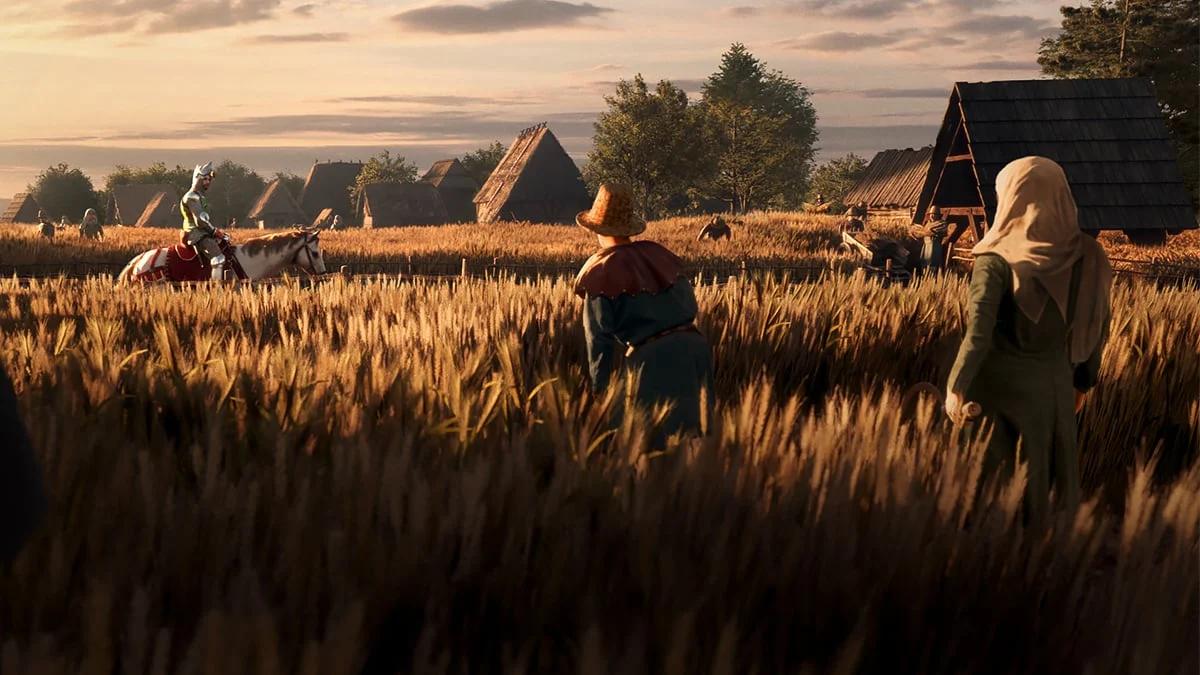
Farming stands as a foundational pillar for any burgeoning settlement in Manor Lords, offering the essential sustenance that dictates the very survival and prosperity of a burgeoning medieval populace, alongside fueling the social dynamics through the production of coveted commodities like ale. Effective agricultural management is not merely a matter of planting seeds; it is a complex interplay of strategic planning, resource allocation, and a deep understanding of environmental factors and technological advancements that will ultimately determine the longevity and expansion of your dominion.
The Indispensable Role of Early Game Farming
From the moment a player establishes their first settlement, farming immediately asserts itself as the paramount activity. The initial objective is clear: secure a stable food supply to navigate the challenging early winters. Wheat, or more accurately in the game’s historically informed terminology, Emmer, should be the primary focus. This grain forms the basis of bread, a fundamental foodstuff that prevents starvation and maintains villager morale. The unforgiving cycle of seasons in Manor Lords means that winter months yield no harvest, making a substantial surplus of grain by autumn an absolute necessity.
To transform harvested Emmer into a consumable form, the establishment of a Windmill for grinding grain into flour, followed by a Communal Oven or a dedicated Bakery for baking bread, is critical. These structures complete the food production chain, ensuring that raw agricultural output is processed into a usable and storable resource. A failure to stockpile sufficient grain and process it into bread before the harsh winter sets in invariably leads to widespread hunger, diminishing morale, and ultimately, the tragic decline of the settlement. Once the immediate threat of starvation is mitigated and a reliable Emmer supply is established, strategic diversification into other crops, notably Barley for ale production, becomes the next logical step in fostering a thriving economy and contented populace.
Understanding Crop Types and Their Strategic Applications
Manor Lords offers players a selection of distinct crop types, each with specific attributes and economic implications for a medieval settlement. These include Emmer (Wheat), Barley, Flax, and Rye. Each crop not only serves a different purpose but also exhibits varying degrees of fertility preference and resilience, demanding careful consideration from the player regarding their placement and rotation.
- Emmer (Wheat): As previously noted, Emmer is the primary grain for bread production. Its cultivation is crucial for sustaining the core population. High fertility plots are ideal for maximizing yield, making early game scouting for suitable land a priority.
- Barley: This grain is essential for brewing ale, a significant commodity for maintaining villager satisfaction and fostering trade. While not directly a food source, its economic and social value is immense. A steady supply of Barley enables the operation of Malt Houses and Breweries, turning agricultural output into a valuable luxury good.
- Flax: Flax is a versatile crop primarily used for producing linen, which in turn can be crafted into clothing. Clothing is another basic necessity for villagers, particularly as the settlement grows and demands for higher-quality goods emerge. Flax cultivation adds a crucial layer to the settlement’s industrial and trade capabilities.
- Rye: Often considered a hardier grain than Emmer, Rye can be a valuable addition to a diversified agricultural strategy. While also used for bread, its potential resilience to less fertile soil or harsher conditions could make it a strategic choice for expanding farming operations into marginal lands or as a buffer against crop failures.
Essential Agricultural Infrastructure
The success of farming operations in Manor Lords hinges on the strategic placement and efficient management of several key structures:
- Farmhouse: This is the central hub of all farming activities. Villagers assigned to a Farmhouse will undertake all tasks related to field management, including plowing, sowing, harvesting, and transporting crops. Upgrading the Farmhouse can increase the number of families it can support, boosting overall agricultural efficiency.
- Windmill: Crucial for processing harvested grain (Emmer, Rye, Barley) into flour or malt. Placement near fields and the settlement center can reduce travel times for workers and optimize the production chain.
- Communal Oven / Bakery: These structures convert flour into bread. A Communal Oven is a basic shared facility, while a dedicated Bakery, often an extension of a Burgage Plot, offers higher efficiency and capacity as the settlement grows.
- Granary: Absolutely vital for storing harvested crops and processed goods. A well-placed Granary minimizes spoilage and ensures that food resources are readily available to villagers and processing facilities. Early investment in storage is paramount to prevent loss of valuable harvests.
- Malt House / Brewery: These buildings are dedicated to transforming Barley into ale. A Malt House prepares the malt, which is then used in a Brewery to produce the final beverage. These facilities are key to leveraging Barley production for economic gain and villager happiness.
- Weaver’s Workshop: While not directly a farming structure, the Weaver’s Workshop is where Flax is processed into linen and then into clothing. It completes the Flax production chain, transforming raw agricultural material into a valuable manufactured good.
The Crucial Role of Fertility Indicators and Soil Management
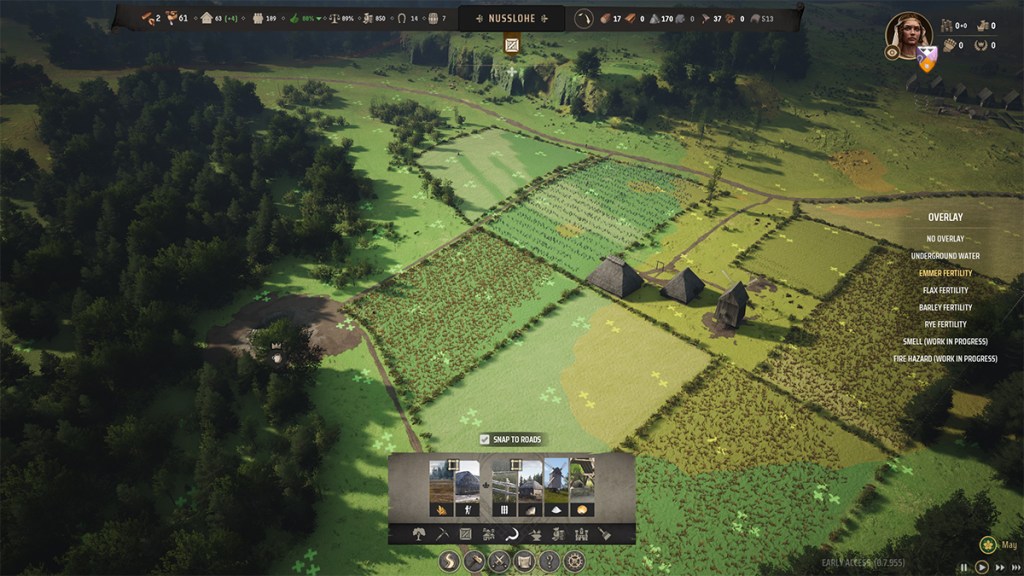
One of the most nuanced and critical aspects of farming in Manor Lords is understanding and managing soil fertility. Within the Construction menu, under the Farming tab, players can access a fertility overlay map for Emmer, Flax, Barley, and Rye. This invaluable tool visually represents the suitability of land for each crop using a color-coded system: bright green indicates highly fertile ground, transitioning through yellow and orange to red, which signifies poor or unsuitable land.
This overlay is indispensable for initial field placement. Building fields on highly fertile green areas for the chosen crop will maximize yield, significantly impacting the efficiency of food production. Conversely, attempting to grow crops on red-designated land will result in meager harvests, wasting precious time and labor.
Deciphering "Emmer Fertility" and Crop Terminology
A common point of confusion for new players arises from the game’s use of "Emmer Fertility" instead of "Wheat Fertility." Historically, Emmer is an ancient variety of wheat, a predecessor to modern bread wheat. The game’s decision to employ this historically accurate terminology, while enriching the medieval immersion, can initially mislead players expecting a "Wheat" specific indicator. It’s important for players to understand that when the game refers to "Emmer," it is referring to the primary wheat crop. This small detail underscores the game’s commitment to historical authenticity, even if it requires a slight adjustment in player vocabulary.
Implementing Sustainable Soil Fertility and Crop Rotation
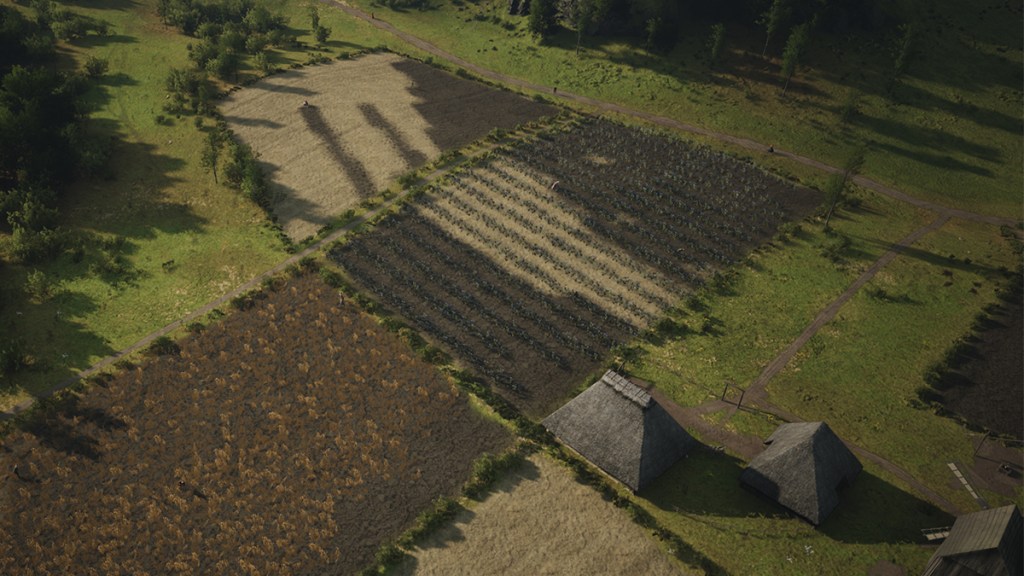
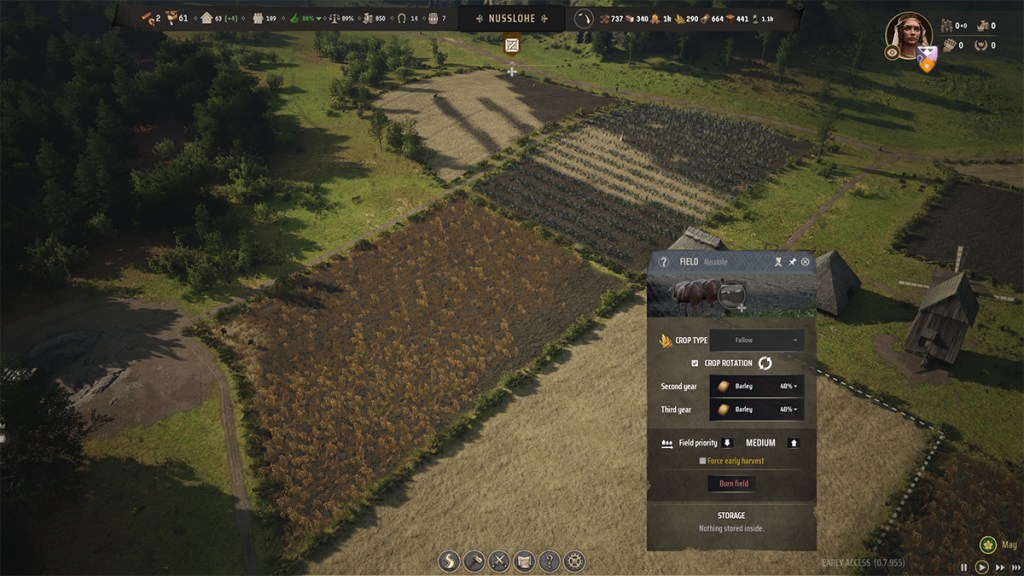
The fertile lands of Manor Lords are not inexhaustible. Continuous cultivation of a single crop on the same plot will inevitably deplete the soil’s nutrients, leading to diminishing returns over time. To combat this, the game incorporates a realistic and essential mechanic: crop rotation. Players can schedule a three-year cycle for each field, an ancient agricultural practice vital for long-term sustainability.
The cornerstone of effective crop rotation is the fallow period. Allowing a field to lie fallow for at least one year within the three-year cycle is crucial for soil replenishment. During this period, the land rests, naturally restoring its fertility. A typical rotation might involve:
- Year 1: Cultivate a demanding crop like Emmer.
- Year 2: Cultivate a less demanding crop like Barley or Flax, or perhaps a different grain that draws different nutrients.
- Year 3: Leave the field fallow.
Alternatively, a simpler and often effective early-game strategy is a "Fallow-Crop-Fallow" or "Crop-Fallow-Crop" system, ensuring that the soil has ample time to recover.
Field Sizing and Labor Management: The Morgen System
Fields in Manor Lords are measured in "morgen," an old Germanic unit of land measurement historically representing the amount of land that could be plowed by an ox in a morning. In game terms, a single family assigned to a Farmhouse can realistically manage approximately 2/3 of a morgen per year.
While a common tooltip might suggest creating fields of 1 morgen, and a single 1-morgen plot of Emmer can indeed feed a small town initially, this advice must be balanced with the reality of diminishing fertility and labor constraints. Given that a field needs to lie fallow to recover, players will ideally need at least three fields for each primary crop type to maintain continuous production: two fields actively growing crops in rotation, and one field lying fallow or perhaps converted to pasture for a period to further enhance fertility through animal grazing.
For instance, to ensure a constant supply of Emmer, a player might aim for three fields, each roughly 1 morgen in size. This setup allows for a robust three-year rotation cycle, providing sustained yields without overworking the land or laborers. Strategic planning of field sizes in relation to available family units is critical to avoid understaffing fields and consequently suffering from reduced yields.
Strategic Development Options for Agricultural Advancement
As a settlement grows and Burgage Plots are upgraded, players earn Development Points, which can be invested across various skill trees to unlock powerful bonuses. One of these trees is dedicated to farming, offering significant enhancements to agricultural efficiency and productivity. While specific names may vary, common and highly beneficial farming development options often include:
- Heavy Plow: Investing in the Heavy Plow development significantly increases the efficiency of field preparation. This allows villagers to plow larger areas more quickly, reducing the labor required per morgen and potentially enabling larger fields or more efficient crop rotation cycles. It’s a crucial upgrade for expanding agricultural output.
- Fertilization: This development often unlocks the ability to use manure from livestock (e.g., cattle, sheep) to directly fertilize fields. Manure acts as a powerful organic fertilizer, rapidly replenishing soil fertility and reducing the need for lengthy fallow periods. This can dramatically increase long-term yields and allow for more intensive farming practices.
- Advanced Husbandry / Sheep Breeding (Indirectly related): While not exclusively in the farming tree, related developments in animal husbandry can indirectly benefit farming by increasing the availability of manure for fertilization. A holistic approach to farming often involves integrating livestock for this purpose.
- Improved Grain Storage / Silos: While not explicitly mentioned in the snippet, such developments are common in city-building games and would logically enhance a farming tree by reducing spoilage and increasing storage capacity, thus safeguarding harvests more effectively. (Assuming the game might have this or similar for future updates/broader scope).
These development points represent strategic investments that can transform basic subsistence farming into a highly productive and sustainable agricultural system, essential for supporting a large and prosperous settlement.
Broader Impact and Implications of a Robust Agricultural System
The strategic management of farming in Manor Lords extends far beyond merely feeding the populace. Its implications ripple through every aspect of settlement life:
- Population Growth and Stability: A consistent and abundant food supply is the primary driver for population growth. Well-fed villagers are healthy, productive, and more likely to attract new families to the settlement. Conversely, food shortages lead to declining population, unrest, and ultimately, the abandonment of the settlement.
- Economic Prosperity: Surplus crops, particularly processed goods like bread, ale, and linen, become valuable commodities for trade. Establishing trade routes for these goods generates regional wealth, which can then be reinvested into further development, military expansion, or the acquisition of rare resources. Ale, in particular, contributes significantly to regional wealth and trade opportunities.
- Villager Morale and Public Order: A varied diet, access to ale, and the availability of essential goods like clothing (derived from flax) significantly boost villager morale. High morale contributes to higher productivity, reduces crime, and prevents outbreaks of dissent or rebellion.
- Settlement Specialization: As a settlement grows, efficient farming frees up labor to specialize in other industries, such as mining, forestry, or crafting. This specialization is crucial for developing a diverse and resilient economy.
- Resilience to Challenges: A well-established agricultural system with diversified crops and robust storage capacity provides a buffer against unforeseen challenges such as bad harvests, plagues, or raiding parties. Having a significant food surplus can mean the difference between weathering a crisis and collapse.
Challenges and Best Practices for Optimal Farming
Players must anticipate and mitigate several challenges to maintain optimal farming operations:
- Seasonal Management: The strict seasonal cycle necessitates careful planning. Fields must be plowed and sown in spring, crops tended in summer, and harvested in autumn. Any delay can lead to reduced yields or even total crop loss, especially as winter approaches.
- Weather Variability: While not explicitly detailed, in many city-builders, weather events (e.g., droughts, heavy rains) can impact harvests. Players should maintain a buffer of food to withstand potential poor harvest years.
- Pest Control (Inferred): While not a direct mechanic in the original snippet, historically, pests were a constant threat. In Manor Lords, this might be abstracted as random yield reductions or implied by the need for robust storage to prevent spoilage.
- Balancing Food vs. Cash Crops: Deciding how much land to dedicate to basic food production (Emmer/Rye) versus cash crops (Barley for ale, Flax for linen) requires careful economic calculation. Early game priorities lean heavily towards food, but later, a balanced approach maximizes both stability and wealth.
- Strategic Placement: Farms should ideally be located on the most fertile land, which may not always be immediately adjacent to the settlement center. Balancing travel times for workers with optimal yield from fertile plots is a key logistical challenge. Access to water sources for potential irrigation (if that mechanic exists or is implied) could also be a factor.
In conclusion, farming in Manor Lords is far more than a simple resource gathering mechanic; it is a sophisticated system that demands foresight, adaptability, and a comprehensive understanding of its intricate dependencies. From the initial struggle for winter survival to the long-term goal of fostering a prosperous medieval empire, a meticulously planned and efficiently managed agricultural sector remains the bedrock of success. Strategic field placement, judicious crop rotation, timely processing, and continuous investment in farming developments will ensure that the sprawling fields stretching to the horizon are not merely an aesthetic choice but a testament to a thriving and self-sufficient dominion.