


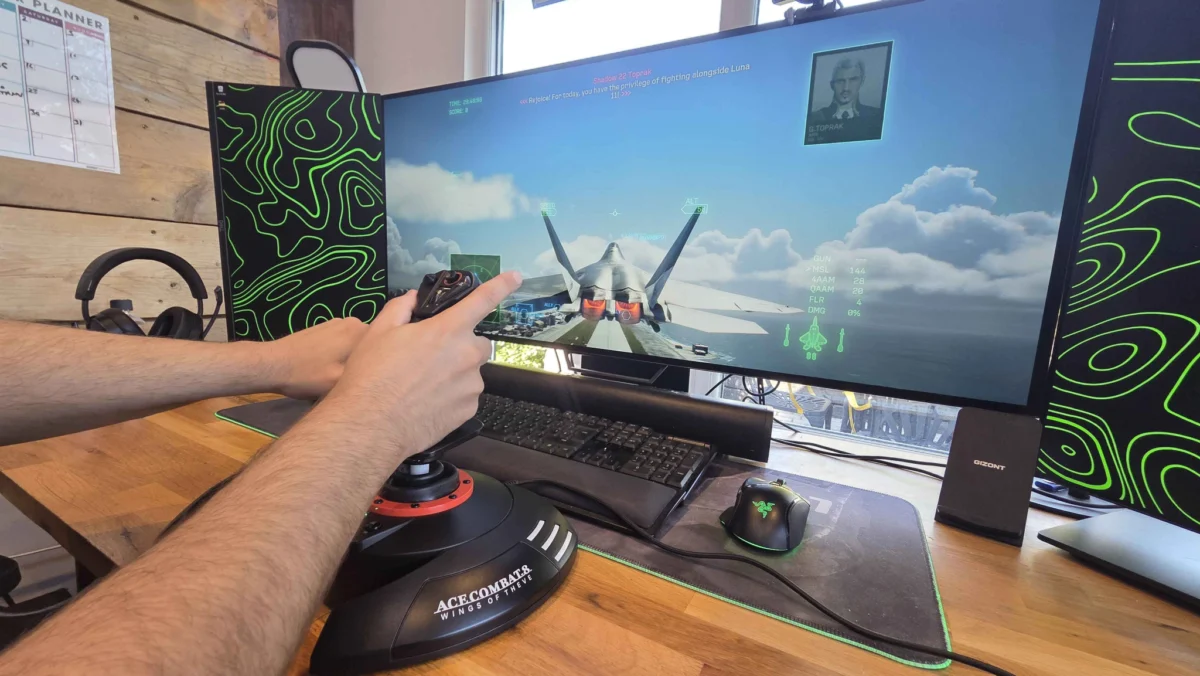
The release of Ace Combat 8: Wings of Theve has served as a primary catalyst for the introduction of specialized flight hardware designed to accommodate both console and PC audiences. Thrustmaster, a prominent manufacturer of flight simulation peripherals, has launched the T.Flight Neo, an entry-level Hands-On Throttle-And-Stick (HOTAS) system specifically branded and optimized for Bandai Namco’s latest aerial combat title. This hardware release comes at a critical juncture for the flight simulation market, which has seen a resurgence in interest following the success of high-fidelity simulators and arcade-style dogfighting games. The T.Flight Neo is positioned as a direct successor and refinement of the long-standing T.Flight One and T.Flight Hotas 4 models, aiming to provide an immersive interface for the skies of the fictional "Strangereal" universe.
Product Overview and Strategic Positioning
The T.Flight Neo is a mid-range peripheral designed to lower the barrier of entry for players transitioning from standard gamepads to dedicated flight controls. In the context of Ace Combat 8: Wings of Theve, the hardware serves a vital role due to the software’s specific launch-day input requirements. Reports indicate that at the time of release, the game features limited native support for legacy or third-party HOTAS setups, making the T.Flight Neo the primary hardware solution for players seeking a cockpit-style experience.

Thrustmaster has released two distinct versions of the T.Flight Neo to ensure cross-platform compatibility: one variant designed for PlayStation 5, PlayStation 4, and PC, and another tailored for Xbox Series X|S, Xbox One, and PC. Both versions retain the core ergonomic design and button mapping optimized for the Ace Combat control scheme, which emphasizes rapid maneuvering and weapon switching over the complex systems management found in more realistic simulators.
Technical Design and Ergonomic Features
The T.Flight Neo maintains a modular design philosophy, allowing the joystick and throttle units to be operated as a single integrated base or as two separate components. The units are permanently tethered via a connecting cable, with the underside of the base featuring routing grooves to manage excess wiring. For users who prefer a unified setup, the two halves can be mechanically locked together using a hex-key system. A dedicated storage slot for the hex-key is integrated into the chassis to prevent loss during transport or reconfiguration.
The joystick component features a contoured grip designed for extended play sessions. A key technical feature is the adjustable tension mechanism located on the underside of the joystick base. This allows pilots to calibrate the resistance of the stick to their personal preference, a feature often reserved for higher-end peripherals. The stick also incorporates a twist-rudder (Z-axis) function, providing control over aircraft yaw without the need for dedicated floor pedals.

The button layout on the joystick includes a primary trigger for machine guns, a secondary button for special weapons, and a target selection toggle. Additionally, the stick features two mini-joysticks: one dedicated to camera movement (POV) and another acting as a multidirectional switch to replace the standard directional pad (D-pad) found on console controllers.
The throttle quadrant is designed with a center-detent position, which is essential for managing airspeed in combat scenarios. The throttle handle includes buttons mapped to the X, A, B, and Y (or equivalent PlayStation) inputs, along with a rocker paddle on the rear for alternative yaw control. Additional toggles for landing gear and radar range are positioned for easy access without requiring the player to release the primary controls.
Integration and Connectivity Standards
The T.Flight Neo utilizes a USB-C to USB-A connection, reflecting modern hardware standards. The provided two-meter cable offers sufficient length for most desk-based setups. A notable feature of the device is its internal mode-switching capability. By holding the "View" button for five seconds and using the joystick’s directional switch, users can toggle the device between "PC Mode" and "Console Mode."

Technical data indicates that the device uses an LED indicator system to confirm the active mode: a green light signifies PC compatibility, while a white light indicates console mode (Xbox or PlayStation, depending on the model). This internal firmware-level switching is designed to bypass common driver conflicts, although early user reports have noted occasional synchronization issues during the initial setup on Windows-based systems.
Contextual Background: The Evolution of Ace Combat Peripherals
The partnership between Thrustmaster and Bandai Namco is part of a long-term strategy to monetize the "Ace Combat" ecosystem through licensed hardware. Historically, the Ace Combat series has driven significant spikes in peripheral sales. For instance, the launch of Ace Combat 7: Skies Unknown in 2019 led to a temporary shortage of the T.Flight Hotas 4 and T.Flight One units.
The T.Flight Neo represents an evolution in this partnership, incorporating feedback from previous generations regarding build quality and sensor precision. While the T.Flight line has traditionally utilized potentiometer-based sensors, the Neo model aims for improved durability in the centering mechanisms to combat "stick drift," a common failure point in entry-level flight sticks.

Comparative Market Analysis
In the current peripheral market, the T.Flight Neo occupies a unique niche. It is priced significantly lower than enthusiast-grade equipment from manufacturers like Virpil or VKB, yet it offers more functionality than a standard Xbox or DualSense controller.
| Feature | T.Flight Neo | High-End HOTAS (e.g., Warthog) |
|---|---|---|
| Material | High-grade Polymer | Zinc Alloy/Metal |
| Connectivity | Plug-and-Play USB | Proprietary/Multi-USB |
| Customization | Tension Dial | Interchangeable Springs/Cams |
| Platform | Console + PC | PC Only |
| Price Point | Entry-Level ($) | Enthusiast ($$$) |
The lack of comprehensive button remapping within the Ace Combat 8 software at launch places a greater emphasis on the hardware’s native ergonomics. The T.Flight Neo’s layout is a 1:1 mirror of the game’s recommended flight deck, which reduces the learning curve for new pilots but may limit the device’s utility for users who prefer highly customized control schemes in more complex sims like Microsoft Flight Simulator or DCS World.
Chronology of the T.Flight Neo Launch
The development and release of the T.Flight Neo followed a precise timeline synchronized with the marketing beats of Ace Combat 8: Wings of Theve:

- Announcement (Q1 2026): Thrustmaster announces a new partnership with Project Aces to develop the "next generation" of entry-level flight controls.
- Technical Reveal (Q2 2026): Prototypes of the T.Flight Neo are showcased at major gaming expos, highlighting the detachable base and adjustable tension.
- Pre-Order Phase (Q3 2026): Retailers open pre-orders alongside the Ace Combat 8 digital pre-orders, offering bundled discounts in certain regions.
- Hardware Launch (September 2026): The T.Flight Neo officially hits the market one week prior to the release of Wings of Theve to allow for driver installations and setup.
Industry Implications and Broader Impact
The release of the T.Flight Neo signals a broader trend in the gaming industry where hardware manufacturers are increasingly relying on "hero titles" to drive peripheral adoption. By securing launch-day exclusivity for HOTAS support in a major franchise like Ace Combat, Thrustmaster effectively captures the majority of the "immersion-seeking" market segment.
From a technical standpoint, the move toward USB-C and internal mode-switching reflects a desire to simplify the user experience for console gamers who may be intimidated by the complexities of traditional PC flight simulation setups. However, the reported lack of support for other HOTAS systems at the launch of Ace Combat 8 has drawn criticism from the simulation community, suggesting a potential tension between proprietary hardware partnerships and open-standard compatibility.
Conclusion of Technical Assessment
The Thrustmaster T.Flight Neo Ace Combat 8 Edition serves as a robust, functional, and accessible entry point for the modern flight combat genre. While it utilizes a predominantly plastic construction to maintain its entry-level price point, the inclusion of adjustable tension and a modular base provides a level of versatility that distinguishes it from its predecessors. As Ace Combat 8: Wings of Theve continues to expand its player base, the T.Flight Neo is expected to remain the benchmark peripheral for the title, setting a standard for how arcade-style flight hardware integrates with high-profile console releases. The success of this unit will likely influence future hardware iterations, potentially leading to more specialized, title-specific peripherals in the flight and racing simulation categories.