


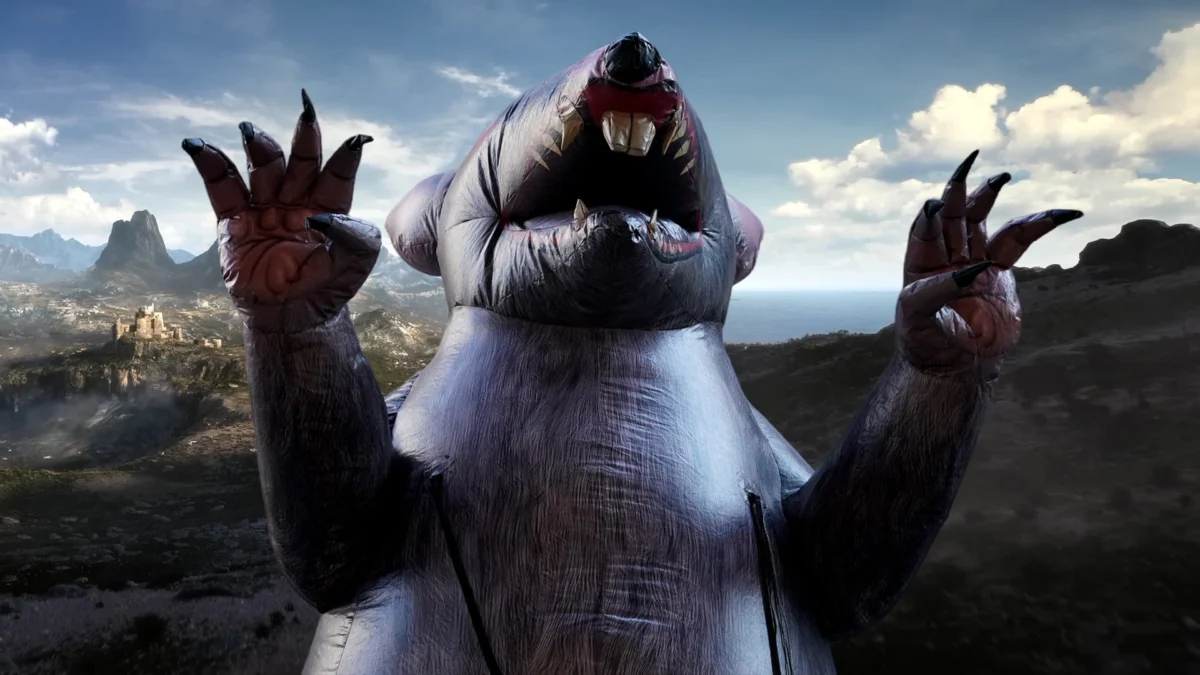
Rockville, Maryland – Xbox CEO Asha Sharma’s recent visit to Bethesda’s Rockville, Maryland headquarters on Tuesday was intended to showcase a "live playthrough" of the highly anticipated The Elder Scrolls VI. While the glimpse into the next installment of the iconic fantasy RPG series undoubtedly generated excitement within the gaming community, the event was overshadowed by a prominent and poignant protest: the towering presence of "Scabby," a giant inflatable rat, symbolizing ongoing labor disputes and widespread job cuts within Microsoft’s Xbox division.
A Glimpse into Tamriel, Amidst Turmoil
Sharma’s visit, which took place in mid-August 2026, offered a rare executive-level preview of The Elder Scrolls VI, a game that has been in development for several years and remains one of the most eagerly awaited titles in the industry. Following her viewing, Sharma took to X (formerly Twitter) to share her initial impressions. In a post that quickly garnered significant attention, she expressed profound admiration for the game, stating, "The scale and grandeur are incredible. The story is even greater." She further teased fans by hinting at a potential subtitle for the game, using a series of asterisks, fueling speculation among dedicated followers of the franchise. Such positive executive endorsements are typically met with universal enthusiasm, acting as powerful marketing signals for an upcoming release. However, the context surrounding this particular announcement painted a far more complex picture.
The Shadow of Layoffs: A Corporate Reset
Sharma’s enthusiastic remarks about The Elder Scrolls VI came just weeks after Microsoft, the parent company of Xbox, initiated a sweeping restructuring effort across its gaming division. This "major reset," as described by Sharma herself in earlier statements, involved a significant reduction in workforce and a strategic re-evaluation of its studio portfolio. In July 2026, Microsoft announced the initial phase of these job cuts, impacting approximately 1,600 employees across various Xbox teams. This was followed by a further announcement indicating that another 1,600 employees would be let go throughout the remainder of the year, bringing the total number of affected individuals to a staggering 3,200.
These layoffs were not isolated incidents but part of a broader corporate realignment that also saw the cancellation of several projects and the departure of multiple development studios from the Xbox ecosystem. In June 2026, it was confirmed that Ninja Theory’s Project Mara had been cancelled, a decision that surprised many given the studio’s innovative work. Shortly thereafter, in July, it was reported that Compulsion Games, Double Fine, and Undead Labs — all previously part of Xbox Game Studios — had either been closed or had their publishing agreements terminated, effectively ceasing their association with Xbox. These moves sent ripples of concern throughout the industry, raising questions about Microsoft’s long-term strategy and its commitment to diverse creative endeavors. The "reset" appeared to be a focused effort to streamline operations, consolidate resources, and potentially shift focus towards fewer, larger, and potentially more profitable titles or services.

Union’s Response: A Visible and Vocal Protest
Against this backdrop of corporate restructuring and job losses, the Bethesda Game Studios Union decided to make its voice heard during Sharma’s high-profile visit. Members of the union orchestrated a powerful and visually striking protest outside the Rockville headquarters, transforming the corporate entrance into a stark visual commentary on the human cost of the "reset." Central to their demonstration was "Scabby," the giant inflatable rat, a well-known symbol of labor disputes and unfair labor practices in the United States. Scabby’s imposing figure served as an unmistakable sign of discontent, visible to all who approached the building, including Xbox leadership.
Complementing Scabby’s presence, union members planted 800 red flags across the lawn outside the office. Each flag represented an individual whose employment had been terminated from Bethesda Game Studios’ teams, making a direct and visceral connection between the corporate decisions and the affected employees. Nathan Hahn, a member of the OneBGS (Organizing Network of Bethesda Game Studios) union, articulated the motivation behind the protest. "We heard that Microsoft leadership was coming to our office this week, and decided to make our presence visible at the office to show how our developers have been impacted by these devastating layoffs," Hahn stated, underscoring the union’s intent to bring the human element of the layoffs directly to the attention of decision-makers.
Hahn further emphasized the union’s unwavering commitment to advocating for affected workers and challenging the prevailing trend of mass layoffs in the gaming industry. "We’re mobilizing to fight back against these layoffs not just to ensure impacted XBOX devs and testers get treated fairly, but to remind our company and game studios everywhere that layoffs like this cannot continue," he declared. This statement highlighted the union’s dual objective: immediate support for those affected and a broader campaign to establish new precedents for worker protection in a volatile industry.
The Bethesda Game Studios Union: A Growing Voice
The Bethesda Game Studios Union is part of a nascent but growing labor movement within the video game industry. Formed in recent years, often under the umbrella of larger labor organizations like the Communications Workers of America (CWA) and its Campaign to Organize Digital Employees (CODE-CWA), these unions represent a significant shift in a sector historically resistant to formal labor organizing. The Bethesda Game Studios Union, specifically, emerged from a desire among developers, quality assurance testers, and other staff to have a collective voice in decisions affecting their working conditions, compensation, and job security.

Their formation and subsequent activism reflect increasing concerns over issues such as "crunch culture" (periods of intense, often unpaid, overtime), precarious employment, and the disproportionate impact of corporate mergers and acquisitions on rank-and-file employees. The use of symbols like Scabby and the red flags demonstrates a strategic understanding of public relations and the power of visual messaging in conveying their grievances. The union’s actions during Sharma’s visit were not merely about expressing anger; they were a calculated effort to leverage a high-profile corporate event to amplify their message and exert pressure on management to engage in meaningful dialogue and reform.
Broader Industry Context: A Wave of Layoffs
The job cuts at Microsoft’s Xbox division are not an isolated incident but rather indicative of a broader and concerning trend sweeping across the global video game industry. The years leading up to 2026 have seen an unprecedented wave of layoffs, impacting thousands of developers, artists, producers, and support staff across companies of all sizes, from indie studios to major publishers. Economic uncertainties, shifts in consumer spending habits post-pandemic, an over-saturation of the market, and the consolidation efforts by large corporations have all been cited as contributing factors.
Major players like Embracer Group, Unity Technologies, Epic Games, and others have all announced significant workforce reductions. This widespread instability has fueled the growth of unionization efforts, as employees seek greater job security and a stronger say in corporate decision-making. The protest at Bethesda HQ, therefore, serves as a microcosm of a much larger struggle playing out across the entire industry, where the pursuit of creative innovation and immersive entertainment often clashes with the harsh realities of corporate profitability and market pressures. The industry’s rapid growth during the pandemic era may have led to over-hiring, and companies are now "right-sizing" in a more challenging economic climate, often to the detriment of their workforce.
Implications for Microsoft and the Gaming Landscape
The juxtaposition of an "incredible" Elder Scrolls VI with the stark reality of mass layoffs presents a complex challenge for Microsoft and its Xbox brand. While the company is eager to highlight its technological prowess and its commitment to delivering blockbuster titles, the ongoing labor disputes threaten to tarnish its public image and potentially impact employee morale and retention. The gaming community, increasingly aware of worker rights issues, is often divided between excitement for new games and sympathy for affected developers.

For Microsoft, the "reset" is framed as a necessary step for long-term sustainability and strategic focus. However, the manner in which these changes are implemented and the subsequent protests raise questions about the company’s commitment to its workforce, particularly those acquired through various studio acquisitions over the years. The future success of The Elder Scrolls VI, while critical for Xbox’s first-party lineup, will also be viewed through the lens of these recent events. Can a game born from such turmoil truly represent the unbridled creativity and passion that players expect?
The incident also underscores the increasing power and visibility of gaming unions. Their ability to mobilize and stage effective protests demonstrates a growing capacity to influence public discourse and potentially exert pressure on corporate practices. As the industry continues to evolve, the relationship between management and labor is likely to become a central theme, with implications for everything from development timelines to workplace culture.
Looking Ahead: The Road for Elder Scrolls VI and Labor Relations
As the gaming world eagerly awaits further details on The Elder Scrolls VI and its hinted subtitle, the persistent presence of "Scabby" and the red flags outside Bethesda’s headquarters serve as a potent reminder that the creation of digital worlds is deeply intertwined with the real-world experiences of the people who build them. Xbox’s path forward will involve not only delivering on the promise of "incredible" new games but also navigating the complex landscape of employee relations and societal expectations for corporate responsibility.
The fight, as Nathan Hahn noted, will continue. For the Bethesda Game Studios Union and other labor organizations, the objective is clear: to ensure that the human cost of corporate restructuring is acknowledged and addressed, and that the future of the video game industry is built on a foundation of fairness and respect for its creators. The "incredible" grandeur of Tamriel may be on the horizon, but for many, the immediate focus remains on the very real struggles unfolding in the offices where those worlds are brought to life. The tension between corporate ambition and worker welfare will undoubtedly define the narrative of Xbox and the broader gaming industry in the years to come.