


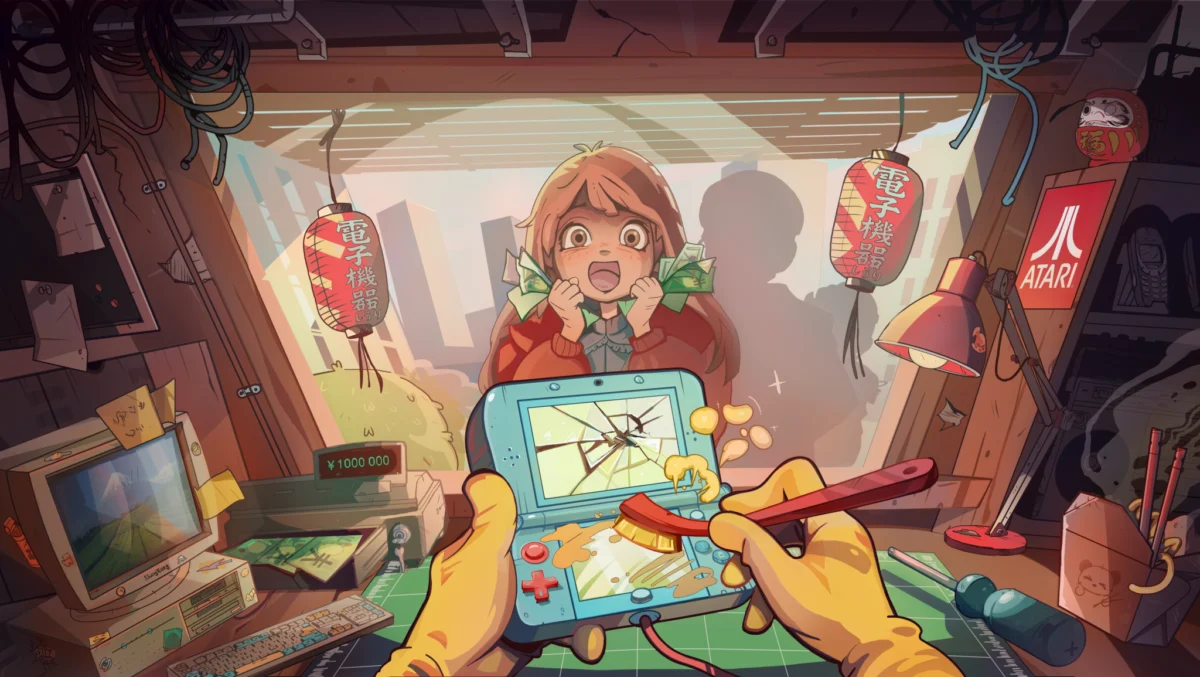
Historical Context and Setting: Tokyo at the Dawn of the Millennium
The setting of ReStory is not merely aesthetic; it serves as a functional component of the gameplay experience. The early 2000s in Tokyo represented a period of unprecedented technological churn. This was the era of the "Millennium Bug" aftermath, the transition from traditional cel animation to digital pipelines, and the rise of the sixth generation of video game consoles. By placing the player in a "dinky corner store" in the eaves of this era, Mandragora captures the specific atmosphere of Akihabara and similar electronics districts before the total dominance of modern smartphones.
During this period, hardware was becoming increasingly complex yet remained largely repairable by skilled hobbyists. The game mirrors this reality, presenting players with devices that represent the pinnacle of late-90s and early-2000s engineering. This includes fictionalized versions of iconic hardware, alongside officially licensed Atari components, providing an educational look at the internal architecture of devices that defined a generation.

Core Gameplay Mechanics and Technical Fidelity
The primary loop of ReStory revolves around the "Repair Tatsujin" (Master) experience. Unlike more arcade-style simulators, ReStory emphasizes a methodical approach to hardware maintenance. The gameplay is structured around several key phases:
- Diagnosis and Disassembly: Players must physically unscrew casings and navigate the internal layouts of various devices. The game tracks the placement of every screw and component, requiring a logical sequence of operations to avoid damaging fragile internal ribbons or clips.
- Cleaning and Maintenance: A significant portion of the "restoration" involves removing decades of accumulated dust and grime. The use of specialized brushes and compressed air mimics the real-world ASMR-inducing process of cleaning vintage electronics.
- Component Replacement: Utilizing an in-game "Compaq" workstation, players must source parts via early-2000s-style web interfaces. This adds a layer of resource management, as players must balance the cost of parts against the service fees charged to clients.
- Soldering and Technical Repair: For more advanced orders, players engage in precision tasks such as soldering. While the current version focuses on fundamental repairs, the system provides a realistic representation of circuit board topography and the delicacy required to restore connectivity without causing thermal damage.
The game’s commitment to technical accuracy is bolstered by its collaboration with Atari. This partnership allows for the inclusion of "full-fat" branding, providing a sense of legitimacy that is often missing from simulation titles that rely solely on parodies. For non-licensed items, such as the "Hi-Box" or portable "PSP" analogues, the developers have maintained a near one-to-one internal layout similarity to their real-world counterparts, the Xbox and PlayStation Portable, respectively.
The Economy of Restoration: Managing a Service Simulation
ReStory functions as a business management simulator as much as a mechanical one. Players are tasked with managing overhead, including bills and inventory costs. The game introduces a "surprise bag" mechanic, where players can purchase bulk lots of broken parts or "junk" electronics. This mirrors the real-world "junk bin" culture prevalent in Japanese second-hand stores like Hard-Off.

By pairing parts from these bulk purchases with broken customer units, players can maximize profit margins. The game operates on a strict in-game clock, with the shop open from 8:00 AM to midnight. While most orders have a three-day turnaround, efficient players can optimize their workflow to complete repairs within a single business day, allowing for higher throughput and the accumulation of yen for shop upgrades. These upgrades include quality-of-life improvements that speed up the unscrewing process or provide more advanced diagnostic tools, essential for the timed "challenge" repairs that appear in the mid-to-late game.
Narrative Integration and Community Dynamics
Beyond the workbench, ReStory incorporates a narrative layer involving the local community. Customers who visit the shop window often bring more than just broken hardware; they bring "oodles of text" regarding local drama and personal anecdotes. While the primary focus remains on the hardware, these interactions serve to ground the player in the 2000s Tokyo setting.
The narrative explores the concept of "memory repair." In many cases, the devices brought to the player are not just electronics but vessels for personal history—a saved game on a memory card, a family photo on a digital camera, or a favorite album on a portable player. This thematic focus aligns with the broader cultural movement of digital preservation, highlighting the importance of maintaining hardware to access the data and memories stored within.

Supporting Data: The Rise of the Simulation Genre
The release of ReStory comes at a time of significant growth for the simulation market. According to industry analysis data, the "Job Simulation" sub-genre has seen a 35% increase in player engagement over the last three years. Titles like PowerWash Simulator and Gas Station Simulator have demonstrated that there is a massive global audience for games that turn "mundane" professional tasks into relaxing, gamified experiences.
Furthermore, the "Right to Repair" movement has gained significant political and social traction in North America and Europe. This movement advocates for the consumer’s right to repair their own electronics, pushing back against "planned obsolescence" and restrictive manufacturer policies. ReStory taps into this zeitgeist, empowering players to understand the "magic" inside their devices and fostering a sense of agency over technology that is often viewed as a "black box" by modern consumers.
Broader Implications and Educational Value
ReStory: Memory Repair Shop serves as an unofficial educational tool for basic electronics. By demystifying the internals of consoles and computers, the game encourages a DIY ethos. Analysts suggest that such simulations can serve as a "gateway" for younger generations to pursue interests in STEM (Science, Technology, Engineering, and Mathematics) or vocational trades.

The game also addresses the environmental impact of electronic waste (e-waste). By emphasizing restoration over replacement, ReStory promotes a sustainable view of technology. In a world where millions of tons of electronics are discarded annually, the game’s focus on "giving new life" to old hardware is a timely reflection on consumption habits.
Technical Specifications and Platform Availability
ReStory is designed to be accessible across a wide range of hardware, reflecting its own theme of technical versatility. The title is currently available and optimized for:
- Windows 11: Utilizing modern DirectX features for realistic lighting on metallic components.
- macOS: Providing a rare simulation entry for Apple users.
- Linux (Fedora-based): Ensuring compatibility for the open-source community, which historically champions the repair and customization of hardware.
Conclusion: A Specialized Experience for the Digital Age
ReStory Memory Repair Shop is more than a simple management game; it is a meticulous tribute to the era of screws, solder, and circuit boards. By combining high-fidelity mechanical simulation with a nostalgic Tokyo aesthetic and a narrative focused on community memory, Mandragora and tinyBuild have produced a title that resonates with both tech enthusiasts and casual players looking for a "chill" experience. As the simulation genre continues to evolve, ReStory stands as a testament to the enduring appeal of fixing what is broken and preserving the technological heritage of the recent past.