


The initial engagement with the MOLE, a sophisticated subterranean exploration vehicle, can appear bewildering. Players are often presented with a series of cryptic directives, a stark contrast to the immediate and critical need to guide this vessel for the survival of Earth. This guide aims to demystify the process of acquiring vital coordinates and charting a course within the intricate gameplay of MOLE, offering a detailed walkthrough for aspiring navigators.
The Imperative of Navigation: Earth’s Last Hope
The premise of MOLE places players in a pivotal role: that of the navigator responsible for the Earth’s future. This narrative framing underscores the importance of understanding the game’s core mechanics, particularly those related to spatial positioning and vehicle control. The MOLE, a marvel of engineering designed for deep-earth penetration, relies entirely on its navigator to interpret complex data and execute precise maneuvers through hazardous subterranean environments. The game’s design intentionally begins with an information deficit, compelling players to actively seek out and process the necessary data streams, mirroring a real-world scenario where critical missions depend on meticulous data analysis and skillful execution.
Deciphering the Subterranean Landscape: Acquiring Coordinates
The journey to understanding MOLE’s navigation begins with the acquisition of coordinates. Initially, players will primarily rely on a method that forms the core gameplay loop: the utilization of Navigation Cassettes. Upon entering the Cockpit, a terminal to the immediate left serves as the primary interface for this process. This console features a small display, a lever, and a slot for inserting the cassette.
The procedure involves inserting a Navigation Cassette into the designated slot and then activating the lever. This action initiates the upload of seismic data, a process visually represented by a progress bar. It is crucial to allow this upload to complete fully, reaching 100 percent, before removing the cassette.
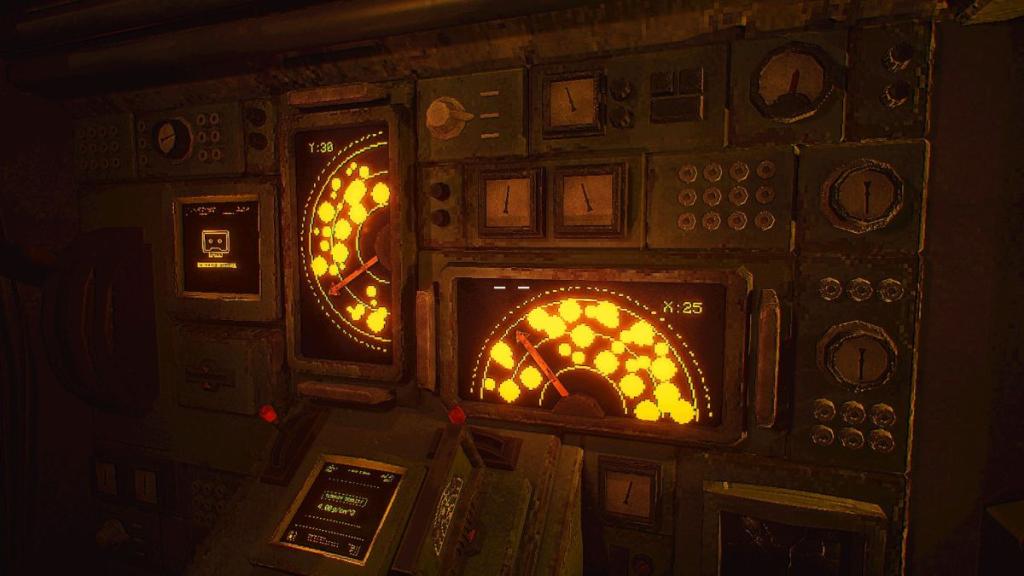
Following the seismic data upload, players must transition to a secondary terminal, positioned opposite the cassette insertion point. Interacting with this terminal, typically by pressing the Spacebar, allows for the decryption of the collected seismic data. Once decrypted, the Navigation Cassette is then inserted into the main console, located on the left wall of the Cockpit. This console is equipped with two smaller levers, each associated with a display.
The critical step here involves manipulating these levers to align with empty spaces depicted on the overhead displays. The game visually represents rock clusters, and players are instructed to avoid these formations, using the levers to create a direct, unobstructed path through the empty space. Successfully achieving this alignment will yield both the Y and X coordinates. These numerical values are then inputted into the keypads situated at the pilot’s seat, accessible after engaging a red handle. This systematic approach ensures that the MOLE is precisely positioned for its subterranean journey.
Mastering the Drill: Speed Calibration and Piloting Techniques
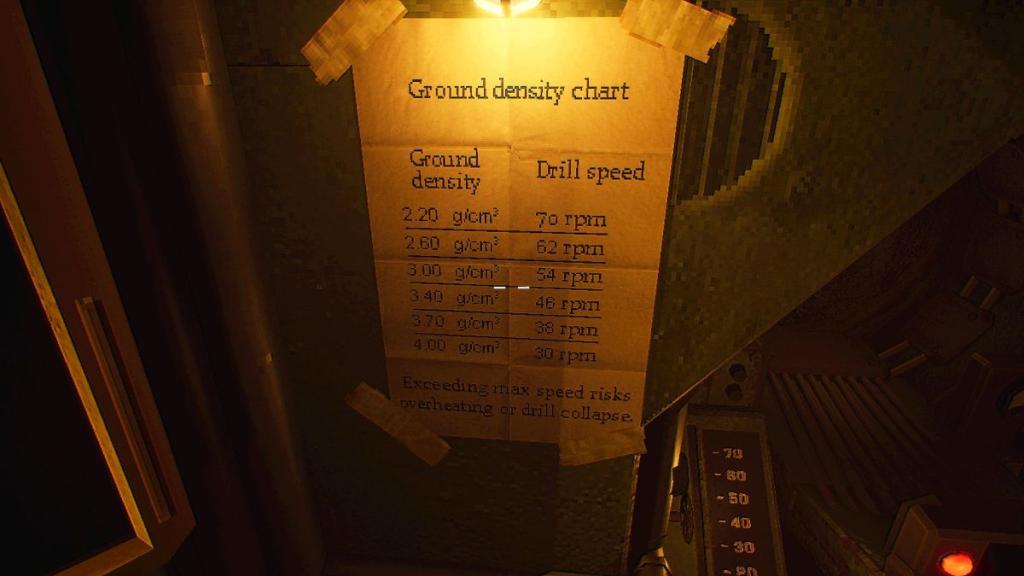
With coordinates successfully inputted, the next crucial phase involves calibrating the MOLE’s drilling speed and initiating its movement. This calibration is directly linked to the Terrain Density display, which is accessed via the two small levers previously used for coordinate alignment.
Players are provided with a Ground Density Chart, typically located near the pilot’s seat. This chart serves as a conversion key, translating the g/cm³ measurements of ground density into appropriate drill speeds. It is imperative to consult this chart meticulously, as the depicted ground density may not always correspond precisely with a readily available drill speed setting. Players must exercise judgment and make adjustments based on the chart’s guidance. This reference tool is not a one-time utility; it must be revisited and utilized with each new set of coordinates acquired, ensuring optimal performance and safety throughout the mission.
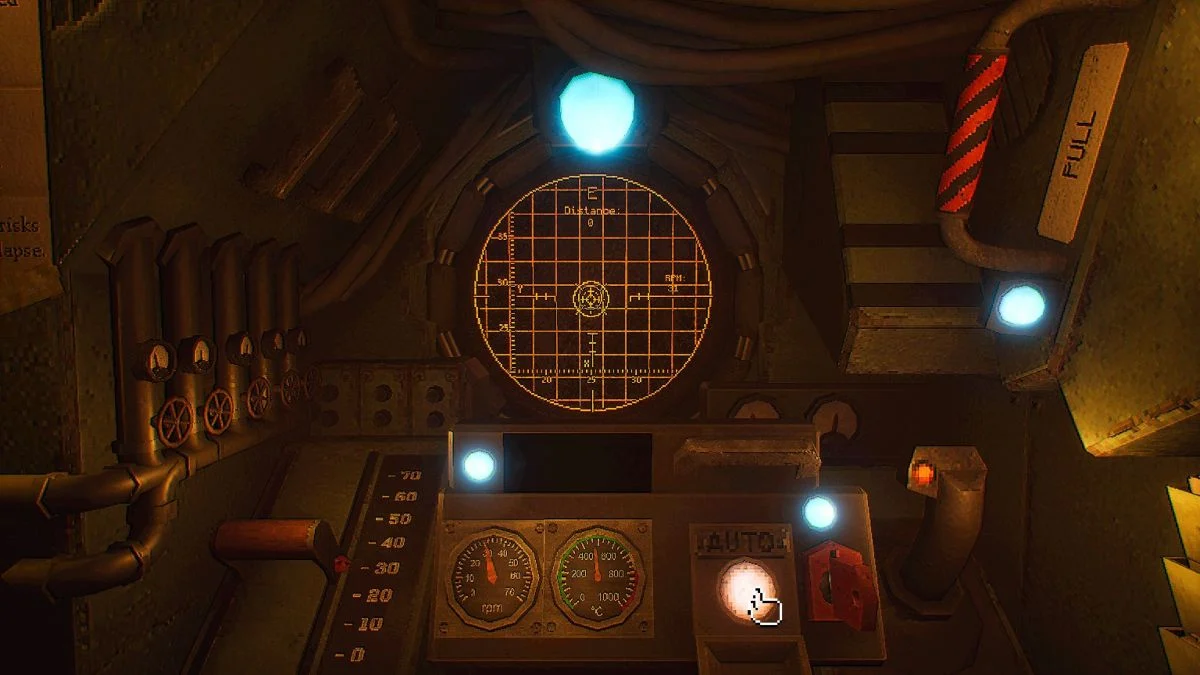
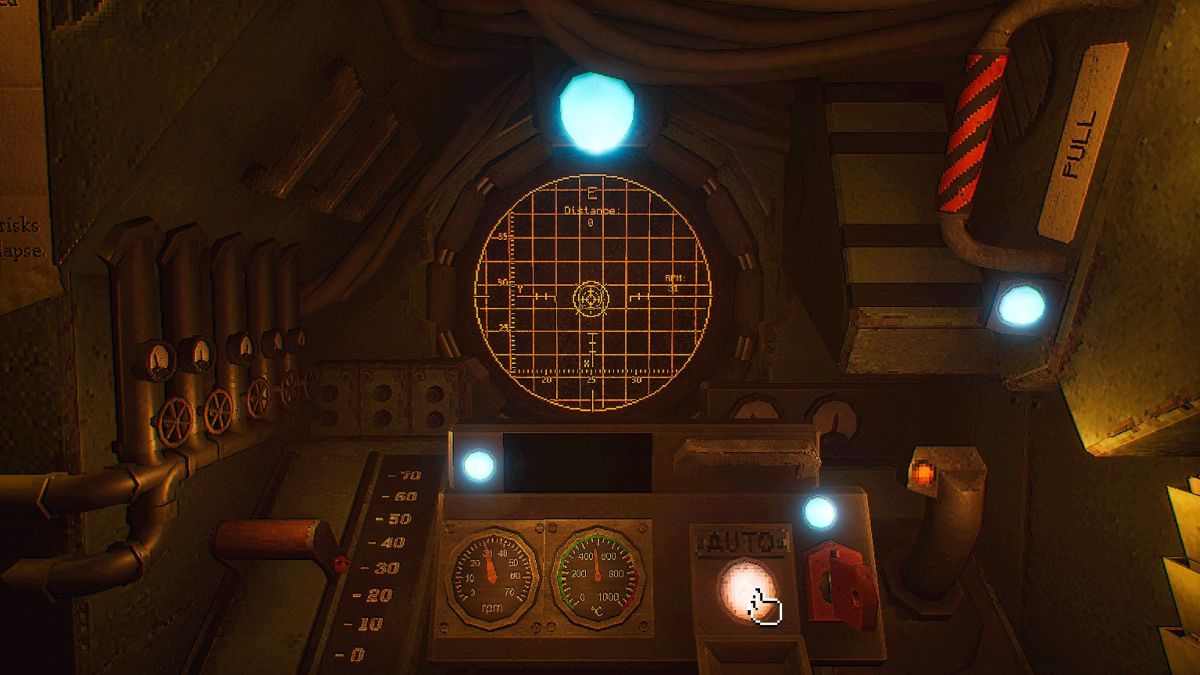
Upon returning to the pilot’s seat, the calibrated speed is set using the red lever situated on the left. Piloting the MOLE itself is achieved through a navigation stick, typically located on the right. The objective during this manual piloting phase is to guide the drill along a grid, following an on-screen arrow until a piloting circle aligns perfectly with a stationary circle, indicating the destination. Once this alignment is achieved and the option becomes available, players can switch to Auto mode by pressing a designated button, allowing the MOLE to proceed autonomously to the target coordinates.
Advanced Navigation: The Role of Specialized Cassettes
MOLE’s navigation system extends beyond the basic acquisition of coordinates through seismic data. The game introduces specialized cassettes that unlock more advanced piloting capabilities and narrative progression. Two cassettes are particularly relevant to the piloting experience: the Navigation Cassette and the Targeting Cassette.
The Navigation Cassette, as previously detailed, is instrumental in obtaining seismic data, which is then decrypted to derive positional coordinates. Its function is fundamental to the initial stages of any subterranean excursion.
The Targeting Cassette, however, introduces a new dimension to navigation, becoming integrated into the piloting process once the in-game "Lab" becomes accessible, typically on the second day of gameplay. To utilize this cassette, players must first acquire a crystal from the Geologist’s workstation. This crystal is then placed on a motherboard situated beneath a monitor that displays the "White Rabbit Signal."
This step initiates a sequence requiring careful observation and interaction. Players are instructed to turn off the lights in the vicinity. With the lights dimmed, they must interact with the White Rabbit Signal. This interaction causes beams of light to emanate, encircling a portion of the player’s vision. Following this visual cue, players should interact with the wall behind them. This interaction reveals a grid, which, when examined, provides a crucial radio frequency.
Upon switching the lights back on, the Targeting Cassette is inserted into a radio. The cassette’s tuning mechanism involves two knobs: the top knob is adjusted to the first two digits of the radio frequency, while the bottom knob is set to the subsequent three digits. A small lever, distinguished by a red light beneath it, must then be pulled to finalize the tuning process.
The information gleaned from the Targeting Cassette is then converted into usable coordinates. Players return to the Cockpit and interact with the computer terminal. Here, they select three files with the ".xyx" extension, a process typically initiated by pressing the Spacebar for each selection. Pressing Enter twice after all three files are selected completes the conversion. Subsequently, players can revert to using the Navigation Cassette and follow the established methods for piloting the drill to these newly acquired coordinates. This layered approach to navigation suggests a progression in the game’s complexity and narrative, requiring players to master multiple interconnected systems.
Implications and Future Prospects
The intricate navigation system within MOLE serves not only as a core gameplay mechanic but also as a narrative device, emphasizing the critical nature of precise data interpretation and execution in high-stakes scenarios. The game’s design, which progressively reveals new tools and methods, encourages players to adapt and learn, mirroring the challenges faced by real-world scientific and exploratory missions. The introduction of specialized cassettes and the dependence on visual and auditory cues suggest a sophisticated simulation of complex data processing.
The implications of MOLE’s gameplay loop extend beyond mere entertainment. The emphasis on problem-solving, pattern recognition, and meticulous procedural execution can foster valuable cognitive skills in players. The narrative backdrop, with Earth’s fate hanging in the balance, imbues these mechanics with a sense of urgency and purpose, potentially enhancing player engagement and investment. As players delve deeper into the game, they are not just navigating a virtual world; they are actively participating in a simulated mission that highlights the importance of scientific understanding and technological prowess in overcoming formidable challenges. The continued development and exploration within the game’s narrative will likely reveal further layers of complexity, demanding even greater mastery of its unique navigation and piloting systems.