


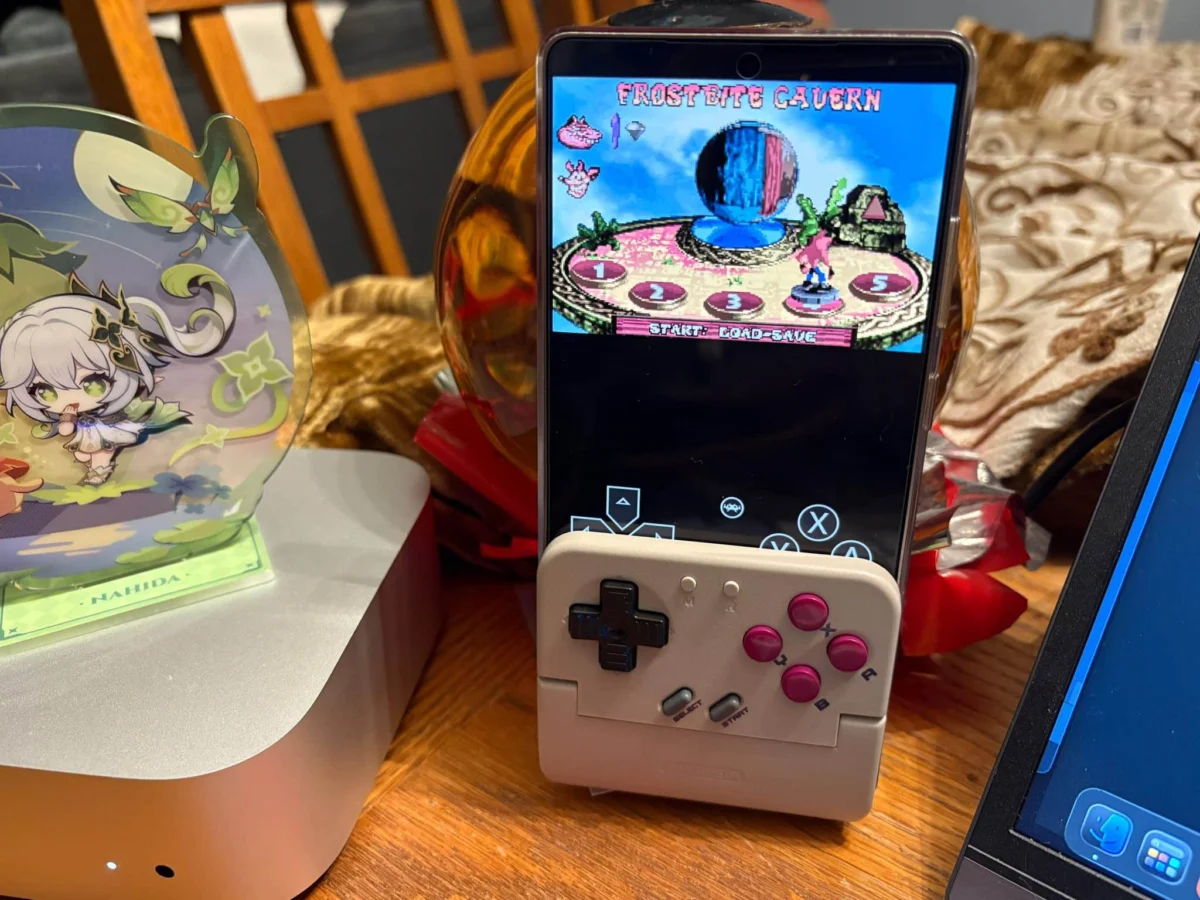
The mobile gaming peripheral market has seen a significant shift toward specialized hardware as internal smartphone specifications continue to rival dedicated handheld consoles. GameSir, a prominent manufacturer in the gaming accessory sector, has released the Pocket Taco, a controller designed specifically to address the nuances of 2D and retro emulation. Following the successful launch of the G8 Plus Bluetooth mobile controller, the Pocket Taco enters the market as a niche alternative for users who prioritize directional pad (D-pad) precision over the dual-analog stick configurations standard in modern mobile gamepads.
Product Overview and Aesthetic Design
The GameSir Pocket Taco distinguishes itself through a design philosophy rooted in nostalgia and portability. Drawing visual inspiration from the Nintendo Famicom, the unit features a distinctive off-white plastic chassis complemented by a black D-pad and multi-colored face buttons. This aesthetic choice aligns the product with the retro gaming community, targeting users who utilize mobile devices for emulating consoles from the 8-bit and 16-bit eras.
Unlike many contemporary controllers that utilize mechanical switches for tactile feedback, the Pocket Taco employs membrane-based buttons. Engineering analysis suggests this choice was made to balance responsiveness with a traditional feel, avoiding the audible "click" of mechanical keys while maintaining a tactile actuation point. The device utilizes a clamshell mechanism to secure the smartphone, a design intended to minimize the overall footprint when not in use.

Technical Specifications and Software Integration
The Pocket Taco is engineered to function as a plug-and-play peripheral for both Android and iOS ecosystems. Connection is established via Bluetooth, with GameSir providing frequent firmware updates to ensure compatibility with the latest operating system iterations.
The Role of the GameSir App
The proprietary GameSir mobile application serves as the central hub for the Pocket Taco’s advanced features. Through the app, users can access:
- Button Mapping: The ability to reconfigure the two pairs of rear bumpers.
- Keyboard Mode: A specialized input protocol that allows the controller to interface with applications not natively supporting gamepads.
- Firmware Management: Critical for resolving Bluetooth latency issues, particularly on iOS devices.
- Turbo Functionality: Onboard settings allow for rapid-fire inputs without the necessity of external software.
Integration with RetroArch
In testing environments, the Pocket Taco demonstrated high synergy with RetroArch, the open-source front-end for emulators. RetroArch’s architecture, which utilizes various "cores" to run legacy software, recognized the Pocket Taco immediately upon synchronization. The controller’s D-pad-centric layout is particularly effective for navigating RetroArch’s menu systems and managing game libraries without the drift often associated with mobile-centric analog sticks.
Ergonomics and Hardware Limitations
While the Pocket Taco excels in portability, its compact form factor introduces specific ergonomic considerations. The device is designed to accommodate a wide range of smartphone sizes, including flagship models such as the Samsung Galaxy S25 Ultra and the iPhone 17 Pro Max. However, the physical dimensions of the controller can present challenges for users with larger hands.

Shoulder Button Placement
The rear bumpers are positioned toward the center of the unit. During extended gameplay sessions, particularly in titles requiring complex combinations or frequent use of secondary triggers (R2/L2), the proximity of these buttons to the device’s center can lead to hand fatigue. Analysts suggest that a concave design for the shoulder buttons might have mitigated these issues, though the current flat profile was likely chosen to maintain the unit’s slim profile when folded.
Power and Connectivity Constraints
A notable hardware limitation involves the recessed charging port located on the bottom of the controller. Technical evaluations have revealed that the clearance provided is insufficient for standard high-gauge USB-C cables, such as those provided with modern Samsung devices. This lack of universal clearance prevents users from utilizing pass-through charging or even charging the controller with common household cables, requiring specific, slim-profile connectors.
Performance in the Emulation Ecosystem
The primary value proposition of the Pocket Taco lies in its performance with 2D titles. Modern mobile controllers often "skimp" on D-pad quality, leading to dropped inputs or unintended diagonal movements in precision-heavy games like Super Mario Bros. or Crash Bandicoot. The Pocket Taco’s D-pad is engineered for high-fidelity input, ensuring that character movement remains consistent with the original hardware experience.
In modern application testing, such as with Arknights: Endfield, the controller is recognized as a standard gamepad. However, the absence of analog sticks limits its utility in 3D environments or modern action-RPGs that require 360-degree movement. For titles that rely on digital inputs—such as classic first-person shooters like Doom or traditional fighting games—the Pocket Taco remains a highly efficient tool.

Chronology of GameSir Development
The release of the Pocket Taco is part of a broader strategy by GameSir to segment the mobile controller market. A timeline of recent developments highlights this trajectory:
- August 2024: Release of the G8 Plus, focusing on console-grade ergonomics and dual-analog support for cloud gaming (Xbox Cloud Gaming, PS Remote Play).
- Late 2025: Initial announcement of a "compact retro series" aimed at the growing emulation market on iOS following Apple’s policy shift regarding emulator apps.
- February 2026: Preview phase for the Pocket Taco, allowing early testers to provide feedback on the clamshell design.
- March 2026: Full commercial launch and integration of firmware fixes for Bluetooth stability on the latest smartphone hardware.
Market Context and Industry Implications
The Pocket Taco arrives at a critical juncture for mobile gaming. With the release of high-performance mobile chipsets capable of running sophisticated emulation software, the demand for physical buttons has never been higher. Touchscreen controls are widely considered inadequate for the precision required in retro gaming, creating a lucrative market for third-party peripheral manufacturers.
The "Keep Android Open" Movement
The review of hardware like the Pocket Taco cannot be separated from the current legislative and corporate climate surrounding mobile operating systems. Reports indicate that Google is preparing to implement stricter lockdowns on the Android OS by September 2026. These changes could potentially restrict the installation of third-party APKs and emulation cores, which are the lifeblood of devices like the Pocket Taco.
Advocacy groups, such as those behind the "Keep Android Open" initiative, argue that such lockdowns dictate how consumers use the hardware they own. If sideloading is restricted, the utility of specialized emulation controllers would be significantly diminished, potentially impacting the bottom line for accessory manufacturers who rely on an open software ecosystem.

Supporting Data and Comparative Analysis
When compared to competitors in the "mini-controller" space, such as the 8BitDo Micro or the Razer Kishi series, the Pocket Taco occupies a middle ground.
| Feature | GameSir Pocket Taco | 8BitDo Micro | Razer Kishi V2 |
|---|---|---|---|
| Primary Input | D-Pad / Membrane | D-Pad / Digital | Analog / Micro-switch |
| Portability | Clamshell Foldable | Keychain Size | Telescopic |
| App Support | GameSir App (Custom) | 8BitDo Ultimate | Razer Nexus |
| Target Use | 2D Emulation | Ultra-portable/Auxiliary | Modern Mobile/Cloud |
Market data suggests that while the Razer Kishi V2 remains the choice for "triple-A" mobile gaming, the Pocket Taco’s bespoke build for 2D gaming offers a more authentic experience for the retro community. The tactile response of the membrane buttons, while less durable than micro-switches over millions of actuations, provides the "mushy" yet responsive feel synonymous with 1990s handhelds.
Official Reactions and Consumer Safety
GameSir has emphasized that the Pocket Taco is intended for "on-the-go" gaming, though early consumer reports have raised concerns regarding the included carrying case. The case features a wrist strap, but the internal grip on the controller is minimal. Testing has shown that sudden movements or jolts can cause the controller to dislodge from the case. GameSir has not officially commented on a redesign for the case but recommends users store the unit in a secure bag during transit.
Regarding the USB-C clearance issue, engineering teams at GameSir have acknowledged the feedback. In a technical brief, the company stated that the design was intended to maximize structural integrity around the hinge, though they are evaluating "increased clearance" for future iterations of the "Pocket" line.

Conclusion: A Niche Essential
The GameSir Pocket Taco represents a successful, albeit specialized, addition to the mobile gaming landscape. It ignores the trend of "universal" controllers in favor of a focused, high-quality experience for 2D gaming enthusiasts. While it faces challenges regarding charging cable compatibility and ergonomic constraints for users with larger hands, its responsiveness and software integration make it a formidable tool for emulation.
As the industry moves toward a potential showdown over software openness in late 2026, the Pocket Taco stands as a testament to the versatility of current mobile hardware. For the price of admission, users receive a compact, aesthetically pleasing, and technically sound peripheral that transforms a modern smartphone into a dedicated retro machine, provided they have the correct charging cables on hand.