


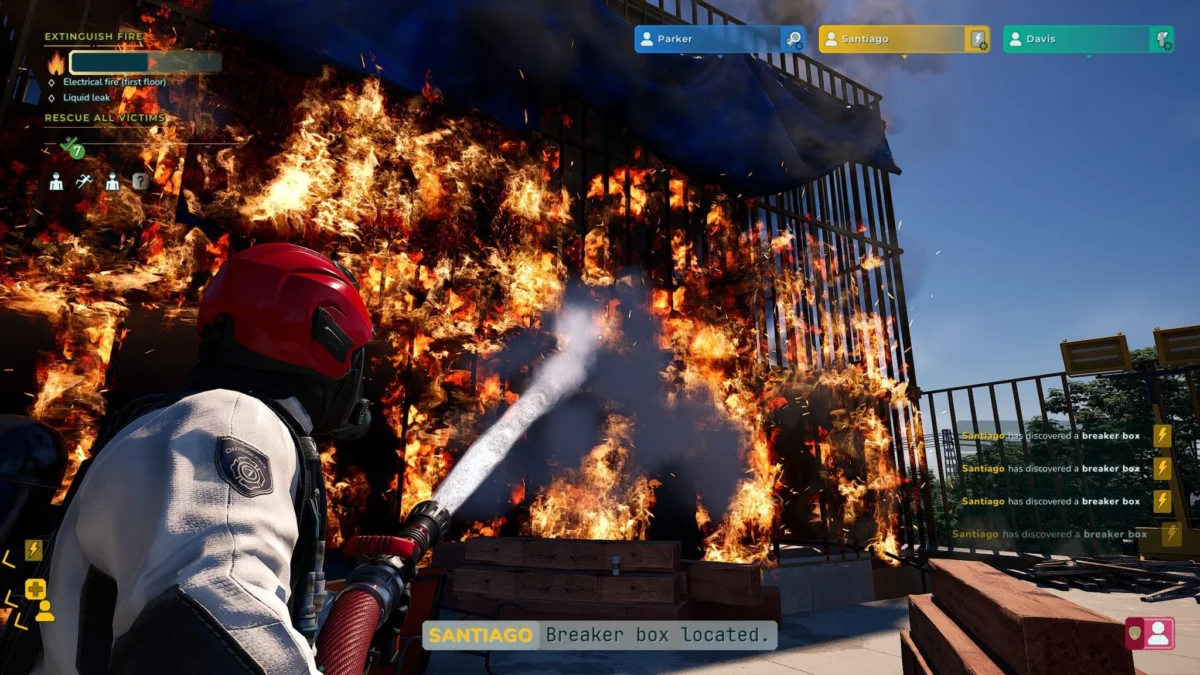
Firefighting Simulator Ignite represents the latest evolution in the specialized genre of emergency services simulation, developed by weltenbauer. and published by astragon Entertainment. This iteration, which builds upon the foundation of the 2020 release, aims to provide a high-fidelity representation of the tactical and physical challenges faced by modern fire departments. Set in the fictional American metropolitan area of Oakridge, the title transitions away from the arcade-style mechanics often associated with fire-themed games, opting instead for a physics-driven approach to thermal dynamics and structural hazards. The release is further bolstered by the Construction Site Mission DLC, an expansion designed to test the limits of player coordination through high-risk industrial scenarios.

Core Gameplay Mechanics and Career Progression
The structural framework of Firefighting Simulator Ignite revolves around the Oakridge Community Fire Department. Players begin their tenure as new recruits, undergoing a progression system that mirrors professional advancement. As players successfully complete calls, they earn promotions and access to an increasingly sophisticated inventory of firefighting equipment. This equipment is not merely cosmetic; the game’s internal logic requires specific tools for specific hazards, ranging from specialized nozzles and axes to thermal imaging cameras and various types of extinguishers.
The game features a centralized hub—the Oakridge Fire Station—which serves as a staging area for training and equipment management. This environment provides a narrative grounding for the player’s squad, including interactions with team members and the department’s mascot, Simi. From this hub, players transition to active duty, responding to a variety of emergency calls that escalate in complexity as the player’s rank increases.

Advanced Fire Dynamics and Simulation Fidelity
The defining technical achievement of the Ignite edition is its implementation of dynamic fire behavior. Unlike scripted sequences found in many action titles, fires in this simulation are governed by a complex set of variables including oxygen supply, fuel sources, and environmental geometry. The developers have integrated realistic fire phenomena such as flashovers and backdrafts, which serve as critical tactical hurdles.
A flashover occurs when the thermal radiation within a room causes all exposed combustible surfaces to ignite simultaneously, a transition that can occur with little warning if the player fails to manage room temperatures. Similarly, backdrafts simulate the explosive re-ignition of a fire when oxygen is suddenly introduced to a depleted, high-temperature environment—usually when a player opens a door without checking for heat signatures first. These mechanics force a methodical approach to entry and suppression, requiring players to utilize ventilation tactics, such as cutting holes in roofs or breaking windows, to clear smoke and heat before entering a structure.

Operational Logistics and Urban Navigation
Each mission begins with a logistics phase involving the transit from the station to the emergency site. While the game provides a fast-travel option, the manual driving component offers a detailed view of the Oakridge metropolitan area. The city is designed with a distinct American aesthetic, featuring a variety of residential, commercial, and industrial districts.
The driving mechanics involve maneuvering massive fire apparatus through active traffic. The game’s artificial intelligence (AI) is programmed to respond to sirens and emergency lighting; however, the behavior of civilian drivers is intentionally varied to reflect real-world unpredictability. Reports from the field indicate that while many AI vehicles pull to the right as required by law, others may freeze in the path of the oncoming truck or attempt erratic maneuvers. This adds a layer of defensive driving to the simulation, as collisions can delay arrival times and impact the final mission rating.

The mission scoring system utilizes a tiered ranking (Gold, Silver, Bronze), primarily influenced by response time and the efficiency of fire suppression. Data suggests that achieving Gold ranks requires near-perfect navigation and rapid deployment, a feat that becomes increasingly difficult at lower frame rates due to the precision required in handling the vehicles.
The Multi-Player Framework and AI Limitations
Firefighting Simulator Ignite supports a cooperative multiplayer mode for up to four participants, offering cross-platform functionality between PC and console versions. This mode is widely considered the optimal way to experience the title, as it allows for the division of labor essential to professional firefighting, such as dedicated hose teams, search and rescue units, and utility management (shutting off gas and electricity).

However, the single-player experience relies on a CPU-controlled squad. Analysis of the squad AI reveals a significant disparity in performance. While the AI is capable of basic suppression tasks and victim extraction, it frequently exhibits pathfinding issues and tactical errors. Common reported issues include:
- Equipment Mismanagement: AI teammates have been observed using water on grease or electrical fires, which in the game’s physics engine causes rapid fire expansion and potential explosions.
- Ghost Suppression: Teammates may become stuck in loops where they attempt to extinguish areas where no active flame exists, neglecting nearby raging infernos.
- Environmental Obstruction: CPU units often struggle with complex geometry, refusing to move past minor obstacles or failing to reach victims in multi-story structures.
These inconsistencies can transform a standard ten-minute mission into a protracted struggle against the game’s own mechanics, particularly in high-level calls where the margin for error is slim.

Technical Specifications and Hardware Optimization
Firefighting Simulator Ignite is built on a demanding engine that prioritizes visual fidelity in fire rendering and particle effects. The game utilizes high-resolution textures and complex lighting models to depict the "glow" of a spreading fire, which can be visually striking but taxing on hardware.
Performance benchmarks indicate that the game is highly sensitive to GPU architecture. While it runs efficiently on mid-to-high-range NVIDIA hardware (such as the RTX 4060 and the newer RTX 5070), it has encountered stability issues on Intel Arc graphics cards. Furthermore, mobile gaming handhelds like the ROG Ally have been reported to struggle with the title, with some users experiencing system reboots during high-load scenarios.

A notable quirk in the game’s code is the relationship between frame rate and fire spread. Observations suggest that lower frame rates may inadvertently slow down the rate of fire expansion, providing a slight unintended advantage to players on weaker hardware, though this is offset by the increased difficulty in precise movement and aiming.
The Construction Site Mission DLC: Strategic Expansion
The recently released Construction Site Mission DLC expands the game’s content library with advanced levels centered on industrial accidents. These missions are characterized by high-risk environments that include scaffolding, open pits, exposed electrical wiring, and explosive materials.

The level design in this DLC emphasizes triage and search-and-rescue. Unlike residential fires, construction sites offer multiple points of entry and vertical hazards that require players to carefully plan their approach. The presence of trapped civilians in hard-to-reach areas necessitates the use of specialized rescue equipment and coordinated team movements.
Tactical analysis of the DLC suggests that the "fail state" conditions are more aggressive than in the base game. Failure to secure gas valves or electrical panels within the first few minutes of a mission often leads to uncontrollable fire spread, making these missions particularly punishing for those relying on the inconsistent squad AI. For this reason, the DLC is primarily recommended for players operating in a full human-controlled cooperative environment.

Market Context and Broader Implications
Firefighting Simulator Ignite arrives at a time when the "job simulator" genre is experiencing a shift toward high-fidelity realism. Publishers like astragon Entertainment have found success by catering to a niche audience that values procedural accuracy over traditional gaming tropes. This title competes with other emergency services simulations but distinguishes itself through its focus on the physics of fire rather than just the management of a department.
The game also serves as a digital training tool for enthusiasts, providing insight into the "Top-to-Bottom" suppression method and the importance of ventilation. By simulating the consequences of incorrect tool usage—such as the dangers of water on a grease fire—the game provides an educational component that highlights the complexity of the profession.

Conclusion and Future Outlook
Firefighting Simulator Ignite stands as a robust, albeit technically uneven, simulation of one of the world’s most dangerous professions. Its strength lies in its uncompromising fire physics and the tension of its cooperative gameplay. The Construction Site Mission DLC further proves the engine’s capability to handle complex, high-stakes scenarios.
However, the reliance on a flawed AI system for solo players remains a significant hurdle. Until the developer addresses the tactical inconsistencies of the CPU squad, the title will likely remain a recommendation primarily for those who can field a consistent team of human players. As hardware continues to evolve, the demand for such high-fidelity simulations is expected to grow, placing Firefighting Simulator Ignite at the forefront of its specific niche in the gaming industry.