


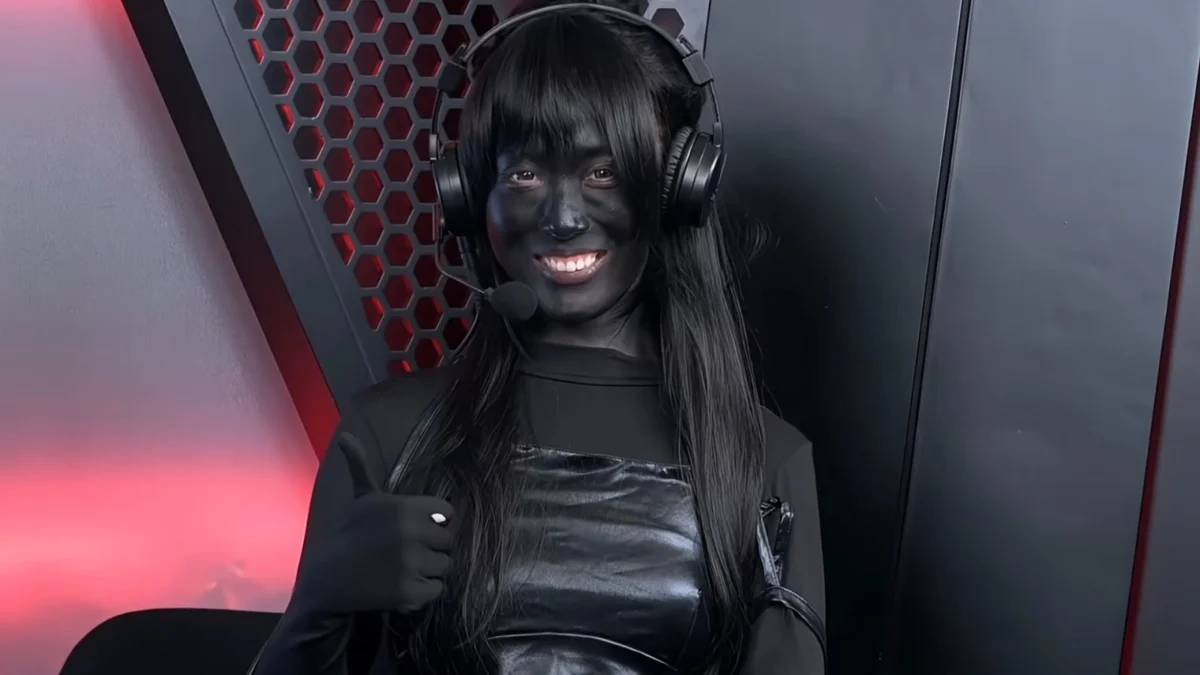
A prominent esports host in China, known by her online alias Zhazha, has become the subject of widespread online discussion and admiration after a bold and satirical response to criticism regarding her on-air attire. Zhazha, a commentator for the popular battle royale title Naraka: Bladepoint, faced scrutiny from a segment of the viewing audience who expressed disapproval of her wearing a short skirt during a recent broadcast. The ensuing online debate culminated in Zhazha appearing on a subsequent broadcast in a striking, full-coverage black outfit, complete with face paint, a visual statement that has since gone viral across social media platforms.
The controversy began following a broadcast where Zhazha, alongside her male co-hosts, appeared in attire that some viewers deemed inappropriate. The criticism, primarily voiced on Chinese social media platforms like Weibo, accused her of dressing in a manner intended to be provocative and attract undue attention, specifically from a male demographic. Some commentators went further, speculating that broadcast organizers might have encouraged or mandated such clothing choices to boost viewership numbers. These accusations touched upon a broader, often contentious, discussion within the esports community regarding the professional presentation of female talent.
Zhazha’s response was delivered not through a lengthy written statement initially, but through a powerful visual demonstration. For her next appearance, she eschewed her previous attire in favor of an ensemble that completely concealed her body, from her head to her ankles, rendered in a deep, uniform black. The addition of black face paint further amplified the statement, creating a stark and memorable image that immediately captured the attention of the online community. This deliberate sartorial choice was interpreted by many as a direct and powerful retort to the criticisms she had faced.
The Genesis of the Controversy and Zhazha’s Clarification
The initial backlash appears to have originated from a specific segment of the Naraka: Bladepoint esports viewership, a game known for its fast-paced combat and distinctive aesthetic, which often attracts a broad demographic. While Naraka: Bladepoint itself has a diverse player base, the esports scene, like many competitive online gaming environments, can sometimes be a focal point for discussions about gender representation and on-screen presentation.
In a subsequent translated statement shared on Weibo, Zhazha clarified her motivations and addressed the accusations directly. She firmly stated that her clothing choices were entirely her own and that she had not been subjected to any pressure from broadcast organizers to dress in a particular way. Her decision to adopt the all-black, face-painted look was explicitly described as an "extreme" response, intended as a form of satire to highlight the absurdity of the criticisms leveled against her.
"No one has ever arranged for me to wear a short skirt," Zhazha asserted in her statement, directly refuting claims of external influence on her wardrobe. "As a commentator, my outfits have always been chosen by myself." This statement aimed to reassert her professional autonomy and challenge the narrative that her clothing choices were dictated by others or solely for the purpose of garnering attention.
Furthermore, Zhazha addressed broader accusations that female casters are often pressured to dress provocatively. She pushed back against this generalization, emphasizing that she had never been forced to wear "inappropriate clothing on official broadcasts to appear in public." She explained her original choice of a short skirt by stating, "The reason I chose a short skirt was to present a better on-camera look for viewers." This statement suggests a desire to appear professional and visually appealing within the context of a broadcast, a common consideration for on-air personalities across various media.

The Satirical Statement: An "Extreme" Response
Zhazha elaborated on the rationale behind her dramatic all-black ensemble, characterizing it as a carefully considered, albeit extreme, act of satire. "I have never opposed so-called clothing freedom or the idea of women dressing more revealingly," she stated. "The outfit I wore on today’s broadcast was an extreme choice meant as a form of satire in response to those comments." This indicates that her intention was not to advocate for or against specific dress codes, but rather to use the situation to comment on the nature of the criticism she received. By adopting a look that was the polar opposite of what was criticized – fully covered and obscured – she effectively questioned the superficiality of judging a commentator’s professionalism based on their attire.
The use of face paint, in particular, served to further depersonalize her appearance and focus attention on the message rather than the individual. It created a sense of anonymity and could be interpreted as a symbolic shedding of the perceived expectations placed upon her as a female personality in the public eye. This approach resonated with many who felt that her response was both clever and effective in addressing the issue without resorting to a direct confrontation.
Impact and Broader Implications for Esports Broadcasting
The incident and Zhazha’s response have sparked a wider conversation within the esports community and beyond. Her actions have been praised by many for their bravery and intelligence, seen as a powerful stand against what they perceive as unfair scrutiny and sexism directed at women in the industry. The viral nature of her response suggests a significant portion of the audience supports her stance and believes that commentators should be judged on their professional abilities, not their clothing.
This event highlights a recurring challenge in the esports and broader entertainment industries: navigating the line between personal expression, professional presentation, and audience expectations, particularly concerning gender. While some viewers may hold traditional views on how female presenters should dress, there is a growing movement advocating for greater inclusivity and a focus on merit over appearance. Zhazha’s experience underscores the need for respectful dialogue and a recognition that individuals should have agency over their professional presentation.
The implications for esports broadcasting are potentially significant. Zhazha’s viral moment could encourage other female talent to speak out against similar criticisms and to find creative ways to assert their professionalism. It also puts pressure on broadcast organizers and platforms to foster environments where talent, regardless of gender, feels respected and empowered to perform their roles without undue scrutiny of their personal choices. The incident serves as a case study in how public figures can use their platforms to address societal issues, leveraging social media and visual communication to make a strong statement.
A Call for Rational Discourse and Professionalism
In the wake of the viral attention, Zhazha made a plea for a more measured and rational approach to online discourse. She urged her audience to avoid taking comments or clips out of context and to refrain from escalating the situation with unnecessary controversy. "I hope everyone can look at this rationally," she stated. "Please don’t take things out of context or stir up unnecessary controversy."
Her concluding remarks emphasized her primary focus as a professional: "I also hope comments remain reasonable. I am just a regular staff member who wants to focus on commentary and do my job well. Thank you all for your understanding." This reiterates her commitment to her role as an esports commentator and her desire to be recognized for her contributions to the broadcast rather than for her appearance.
The situation surrounding Zhazha’s outfit and her subsequent response is a complex issue that touches upon themes of gender, professionalism, online commentary, and the evolving landscape of esports. Her viral moment has not only brought attention to her personal situation but has also ignited a broader discussion about how female professionals are perceived and treated in the public sphere, particularly within the dynamic and rapidly growing world of competitive gaming. The incident serves as a reminder of the power of creative expression and the importance of fostering respectful and inclusive environments for all participants in the esports ecosystem.