


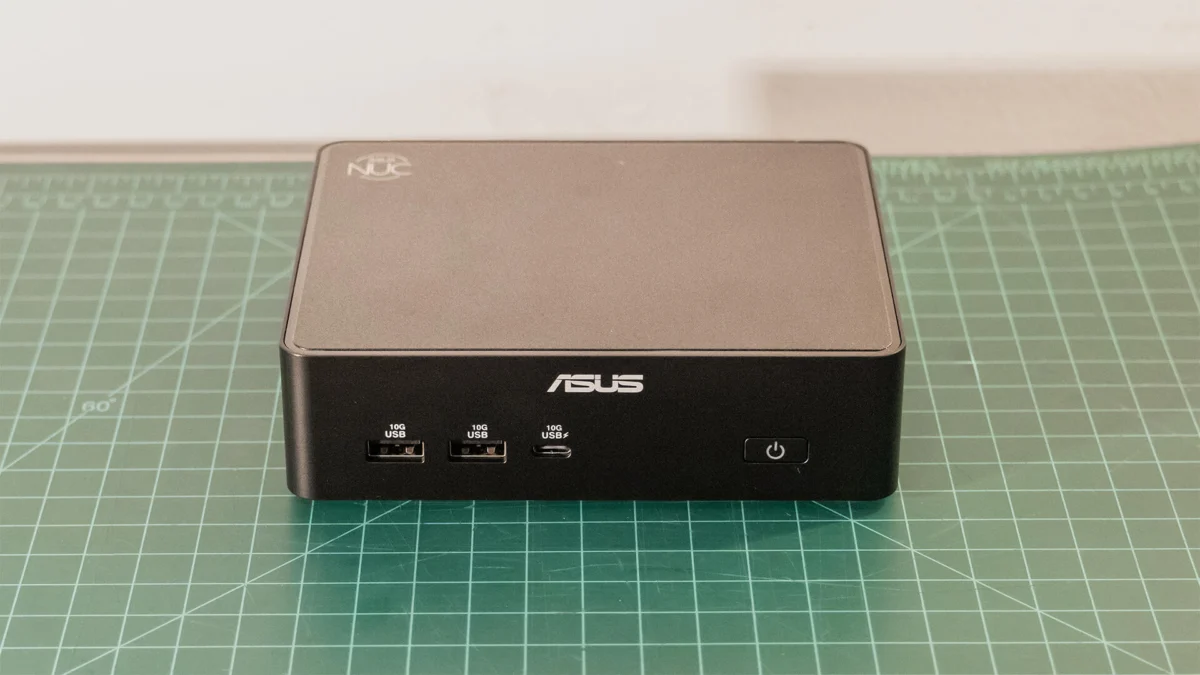
The Asus NUC 16 Pro emerges as a noteworthy contender in the burgeoning mini PC market, presenting an impressive amalgamation of compact design and potent computing capabilities. Measuring less than a liter in volume, this unassuming machine defies its diminutive stature by integrating high-performance hardware, specifically the Intel Core Ultra X7 358H processor and Intel Arc B390 graphics. This configuration positions it as a highly capable device for a wide array of demanding tasks, from intensive productivity applications to moderate gaming and emerging AI workloads.
Unpacking the Core: Performance and Architecture
At the heart of the Asus NUC 16 Pro lies the Intel Core Ultra X7 358H, a processor from Intel’s Meteor Lake family. This advanced mobile processor is central to Intel’s "AI PC" initiative, incorporating a dedicated Neural Processing Unit (NPU) alongside its traditional CPU cores and integrated graphics. The NPU is specifically designed to accelerate AI-driven tasks, offloading them from the CPU and GPU to enhance efficiency and reduce power consumption for applications like real-time language translation, advanced image processing, and smart assistant functions. The Core Ultra X7 358H features Intel’s hybrid architecture, combining performance cores (P-cores) for demanding tasks, efficient cores (E-cores) for background processes, and low-power efficient cores (LP E-cores) for ultralow-power operations, dynamically allocating workloads to optimize performance and battery life (though power consumption is less of a concern for a desktop mini PC, thermal management is key).
Performance benchmarks reveal the NUC 16 Pro’s CPU prowess. In testing, the Intel Core Ultra X7 358H demonstrated performance metrics in Geekbench 6 and Cinebench R24 that surprisingly outpaced even some larger desktop systems, including configurations featuring the AMD Ryzen 7 7800X3D processor, a chip often associated with high-end gaming desktops. This achievement underscores the efficiency and raw computational power Intel has managed to pack into its latest mobile-first architecture, allowing the NUC 16 Pro to handle complex calculations, multi-threaded applications, and heavy multitasking with remarkable fluidity. The thermal design, incorporating two fans within its cramped chassis, appears to manage heat effectively, enabling sustained high performance without significant throttling—a common challenge in compact form factors.
Beyond raw processing, the integrated Intel Arc B390 graphics are a significant differentiator. Unlike many mini PCs that rely on basic integrated graphics suitable only for display output and light media consumption, the Arc B390, with its Xe cores, offers a substantial leap in graphical capability. This integrated solution provides enough horsepower for casual gaming and demanding creative applications. For instance, it achieved an average of 73 frames per second (fps) in Shadow of the Tomb Raider at native 1080p resolution with the Highest graphical preset, demonstrating its capacity for smooth gameplay in modern titles. Furthermore, its stability was confirmed through a 20-run stress test of 3DMark’s Steel Nomad Light, maintaining 99.3% stability while operating remarkably quietly. This performance level challenges the traditional notion that mini PCs must compromise heavily on graphical fidelity, making the NUC 16 Pro a viable option for users who require more than basic visual output but are not necessarily seeking a dedicated gaming rig.
Design Philosophy: Compactness Meets Connectivity

The physical design of the Asus NUC 16 Pro is a testament to sophisticated engineering, packing substantial power into a chassis that measures just 0.71 liters in volume and weighs a mere 1.5 pounds. Its exterior, characterized by a utilitarian black plastic finish, prioritizes function over ostentatious aesthetics, allowing it to blend seamlessly into various environments, from corporate offices to home media centers. The challenge of integrating high-performance components and an effective cooling system within such confined dimensions is substantial, and Asus has navigated this by deploying a dual-fan setup to ensure thermal stability under load.
Despite its compact footprint, the NUC 16 Pro is remarkably generous with its port selection, offering a comprehensive suite of connectivity options that belie its size. The front panel features a USB 3.2 Gen 2 Type-C port and two USB 3.2 Gen 2 Type-A ports, all capable of 10Gbps data transfer rates for quick peripheral connections. The rear panel further expands connectivity with two additional USB 3.2 Gen 2 Type-A ports, two Thunderbolt 4 ports, and two HDMI 2.1 TMDS ports. The Thunderbolt 4 ports are particularly versatile, offering high-speed data transfer, power delivery, and support for DisplayPort 2.1 output, enabling connection to multiple high-resolution displays or eGPUs. The dual HDMI 2.1 ports further enhance its multi-display capabilities, making it suitable for complex workstation setups or digital signage applications.
Networking capabilities are equally robust, with two 2.5 Gigabit Ethernet (2.5GbE) ports providing high-speed wired network access, ideal for demanding data transfers or server applications. Wireless connectivity is handled by Intel Wi-Fi 7 BE211 (802.11be), offering cutting-edge wireless speeds and lower latency, alongside Bluetooth 6.0 for seamless peripheral pairing. A notable omission, however, is a built-in 3.5mm audio jack or internal speakers, necessitating the use of external audio solutions via USB, HDMI, or Bluetooth.
Upgradeability and Maintainability
Asus has incorporated a degree of user-friendliness regarding internal access, making the NUC 16 Pro one of the more accessible mini PCs on the market. A single latch mechanism secures the bottom cover, and the lid can be easily pried open, revealing key internal components. The system includes two M.2 slots, one supporting PCIe 4.0 x4 and the other offering the faster PCIe 5.0 x4 bandwidth, both readily accessible for storage upgrades. This allows users to expand storage capacity or upgrade to faster NVMe SSDs as needed.
However, memory upgradeability varies by configuration. While lower-tier, barebones models might feature CSO-DIMM modules that could be user-upgradable, the high-end configurations, such as the one reviewed, utilize LPDDR5x memory which is typically soldered directly onto the motherboard. This design choice, while contributing to the compact size and potentially lower power consumption, eliminates user memory upgrades. The internal heatsinks, despite the easy chassis access, remain somewhat inaccessible for direct cleaning, which could be a long-term maintenance consideration.
Security features include a lock slot, ingeniously designed to not only tether the device but also simultaneously secure the bottom cover, preventing unauthorized internal access—a thoughtful addition given the device’s portability and the ease of accessing its storage. One practical trade-off for its ultra-compact size is the reliance on an external 150-watt power brick. This external component adds to desk clutter and overall carry weight, contrasting with some competitors, like the Minisforum AI X1 Pro, which manage to integrate their power supplies internally. Furthermore, the NUC 16 Pro does not support USB power as a backup, a feature found in some other mini PCs that offers additional flexibility.

Market Positioning and Value Proposition
The Asus NUC 16 Pro is offered in several configurations, catering to a range of performance and budgetary requirements. Entry-level barebones models, starting at $559 for an Intel Core Ultra 5 325H or $790 for an Ultra 7 356H, require users to supply their own memory (CSO-DIMMs), storage, and operating system. The premium tier, featuring the Intel Core Ultra X7 or X9 processors with LPDDR5x memory and 12 Xe cores (enabling Intel Arc B390 graphics), commands a significantly higher price. The reviewed configuration, with 64GB of LPDDR5x memory, carries an MSRP of $2,799 for an otherwise identical 32GB memory version. This pricing reflects not only the advanced hardware but also the premium associated with miniaturization and cutting-edge technology. The current global "RAMaggedon," referring to ongoing supply chain issues and increased demand for high-speed memory driven by AI development, has also contributed to elevated memory costs, directly impacting the final price of pre-configured systems.
The NUC 16 Pro’s pricing strategy places it in direct competition with not only other mini PCs but also full-sized desktops. While it offers unparalleled space savings and portability for its performance class, users must weigh the value of this compactness against the potential for more powerful or equally capable systems at a lower cost, albeit in larger form factors.
Competitive Landscape Analysis
The mini PC market is vibrant and increasingly competitive, with several manufacturers pushing the boundaries of what’s possible in small form factors. The Asus NUC 16 Pro navigates a landscape populated by innovative alternatives:
- Minisforum AtomMan G7 Ti: This competitor presents a formidable challenge, offering comparable CPU performance but significantly greater GPU capabilities due to its inclusion of a discrete Nvidia GPU. While the G7 Ti might lack the dedicated NPU for low-power AI processing found in the Core Ultra, its Nvidia GPU is exceptionally adept at handling more intensive AI workloads. However, the AtomMan G7 Ti is considerably larger than the NUC 16 Pro, illustrating the trade-off between integrated power and physical footprint.
- Framework Desktop: Known for its modularity and repairability, the Framework Desktop offers a different value proposition. While it provides excellent user-upgradability and a unique approach to desktop computing, it is also larger than the NUC 16 Pro and generally caters to a user base prioritizing sustainability and long-term customizability over ultimate compactness. Its performance profile, depending on configuration, may lag behind the NUC 16 Pro in certain benchmarks, particularly integrated graphics and AI acceleration.
- Minisforum Ai X1 Pro: This device offers competitive CPU power and enhanced upgradability for certain components. However, it falls significantly behind the NUC 16 Pro in GPU performance and dedicated AI processing capabilities. Moreover, at 1.6 liters, it is substantially larger, further highlighting the NUC 16 Pro’s engineering feat in achieving its performance within a 0.7-liter chassis.
These comparisons underscore that while the NUC 16 Pro might not be the absolute performance king or the most budget-friendly option, it carves out a niche as an "absolute small-size champ" that doesn’t compromise significantly on overall performance. Its blend of CPU, GPU, and NPU capabilities in such a tiny package makes it unique.
The NUC Legacy and Asus’s Stewardship

The NUC (Next Unit of Computing) brand originated with Intel, which pioneered the concept of ultra-compact, barebones PCs designed for various applications, from home theater systems to business workstations and embedded solutions. Intel’s vision was to demonstrate the power and versatility of small form factor computing, often featuring their latest mobile processors and integrated graphics. Over more than a decade, NUCs gained a reputation for innovation, reliability, and performance in a miniature package.
In 2023, Intel made a strategic decision to divest its NUC business, transferring the design, manufacturing, and sales of its NUC systems to Asus. This move allowed Intel to focus on its core semiconductor business while ensuring the continued evolution and availability of the NUC product line. Asus, a global leader in computer hardware, was a natural fit, bringing its extensive experience in motherboard design, system integration, and global distribution channels to the NUC brand. The Asus NUC 16 Pro is a direct result of this transition, representing the next generation of Intel-powered mini PCs under Asus’s stewardship, carrying forward the legacy of compact innovation while integrating the latest technological advancements from Intel, such as the Core Ultra processors.
Strategic Implications and Future Outlook
The Asus NUC 16 Pro is more than just a powerful mini PC; it represents a significant step in the evolution of computing, particularly within the context of the emerging "AI PC" era. Its integrated NPU positions it as a front-runner for applications that leverage on-device AI acceleration, offering benefits in privacy, latency, and efficiency compared to cloud-based AI solutions. This makes it highly relevant for professional environments requiring local AI processing for data analysis, content creation, or specialized industry software.
Its robust connectivity, including Thunderbolt 4 and Wi-Fi 7, ensures it is future-proofed for high-speed peripherals and next-generation wireless networks, making it an excellent choice for a compact workstation, a powerful home theater PC capable of 4K/8K media playback, or an edge computing device in industrial or IoT settings. The ability to drive multiple high-resolution displays also makes it appealing for financial traders, developers, or graphic designers who require extensive screen real estate.
The NUC 16 Pro’s existence underscores a broader market trend: the increasing demand for high-performance computing in ever-smaller form factors. As office spaces shrink and users seek minimalist desk setups, the appeal of a powerful, discreet PC grows. While the price-to-performance ratio may still favor larger desktops for some, the premium for space-saving technology is becoming increasingly acceptable for specific user segments and professional applications where footprint, aesthetics, and quiet operation are paramount. The NUC 16 Pro effectively demonstrates that the future of computing can be both powerful and unobtrusive, setting a high bar for what mini PCs can achieve.
In conclusion, the Asus NUC 16 Pro stands out as an exceptionally well-engineered mini PC, offering a compelling blend of cutting-edge performance, robust connectivity, and a remarkably compact design. While its premium pricing, particularly for high-end configurations, necessitates a careful evaluation of individual needs and priorities, its ability to deliver desktop-class CPU performance, capable integrated graphics, and dedicated AI acceleration in a liter-sized package is a significant technical achievement. For users who prioritize space efficiency without compromising on computational power, the NUC 16 Pro represents a leading option, embodying the ongoing evolution towards more powerful and versatile compact computing solutions.