


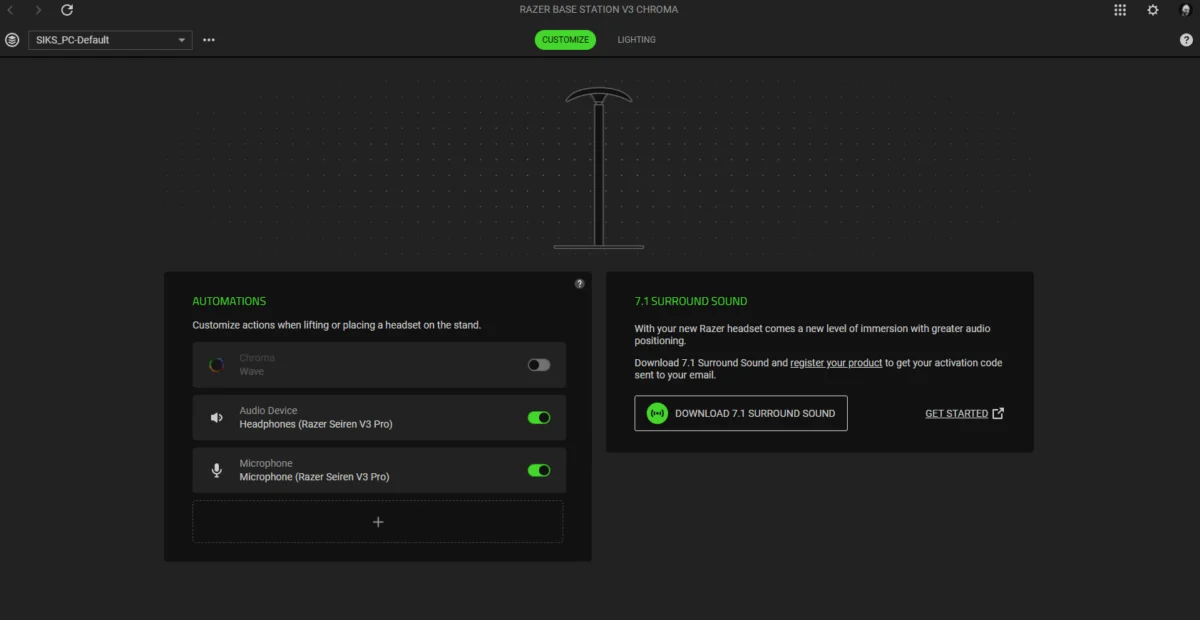
The Razer Base Station V3 Chroma represents the latest iteration in the evolution of desktop organization and peripheral integration, transitioning the humble headset stand from a passive accessory into an active component of the gaming ecosystem. While the core function of the device remains the safe storage of a gaming headset, the V3 Chroma introduces hardware-level sensors and software-driven automations designed to address long-standing frustrations in digital audio management, particularly within the Windows 11 environment. Built with a weighted, circular base and a tall, sleek support arm, the unit integrates two USB 3.1 SuperSpeed ports and an advanced lighting array, but its primary innovation lies in what the manufacturer terms "Seamless Headset Detection."
Technical Architecture and Design Specifications
The physical construction of the Razer Base Station V3 Chroma prioritizes stability and connectivity. The base is engineered with a significant internal weight and a non-slip rubber underside to ensure that even heavier, high-fidelity headsets do not cause the stand to topple. At the top of the vertical column is a soft, rubberized paddle designed to cradle the headband of a headset without causing indentations or wear on the padding. Embedded within this paddle is a specialized proximity or pressure sensor that serves as the trigger for the device’s automation suite.

In terms of connectivity, the inclusion of two USB 3.1 Gen 1 ports (formerly known as USB 3.0) provides a significant bandwidth upgrade over standard peripheral hubs. These ports support data transfer speeds of up to 5 Gbps, making them suitable not only for charging wireless headsets but also for connecting high-bandwidth devices such as external webcams, microphones, or high-polling-rate gaming mice. This design choice aims to reduce cable clutter on the desk by moving the primary connection points for head-mounted gear closer to the user.
The Evolution of the Razer Base Station Series
The release of the V3 Chroma marks a decade-long trend of peripheral manufacturers seeking to "smarten" every aspect of the desktop setup. To understand the position of the V3 in the current market, it is necessary to examine the chronology of the product line:
- Razer Base Station Chroma (Original): Introduced the concept of an RGB-lit stand with a 3-port USB hub. It focused primarily on aesthetics and basic utility.
- Razer Base Station V2 Chroma: Improved the build quality by moving to an all-aluminum construction and upgraded the audio capabilities by including a 3.5mm combo port with a built-in DAC for 7.1 surround sound virtualization.
- Razer Base Station V3 Chroma: While reverting to a hybrid material design, the V3 shifted the focus from passive audio output to active system management. The introduction of the "Seamless Headset Detection" sensor reflects a move toward the "Internet of Things" (IoT) philosophy, where hardware interaction triggers software responses.
This progression indicates a shift in Razer’s strategy, moving away from simple hardware extensions toward integrated workflow solutions for content creators and enthusiasts.

Software Integration and the Windows 11 Audio Challenge
The most significant functional advantage of the Base Station V3 Chroma is its integration with the Razer Synapse 3 software suite. This integration is positioned as a direct solution to the inconsistent audio device management found in modern operating systems. Since the launch of Windows 11, many users have reported difficulties with the OS’s handling of "Default Communication Devices" and the manual steps required to switch between desktop speakers and headsets.
The V3 Chroma addresses this by using the headset detection sensor as a macro trigger. Through the Synapse interface, users can program specific "Arrival" and "Departure" actions. When the sensor detects that a headset has been lifted from the stand, the system can automatically:
- Switch the Windows default playback device from external speakers to the headset.
- Change the default microphone input to the headset’s boom mic.
- Launch specific applications, such as a digital audio workstation (DAW), a streaming dashboard like OBS Studio, or a gaming platform like Steam.
Conversely, when the headset is replaced on the stand, the software can revert these settings, muting the headset and re-engaging desktop speakers. For podcasters and livestreamers, this automation eliminates the "pre-flight" checklist of audio settings, reducing the risk of technical errors during live broadcasts.

Impact on Content Creation and Professional Workflows
In the context of the burgeoning "creator economy," the utility of the Base Station V3 Chroma extends beyond gaming. Market data suggests that the demand for streamlined streaming setups has grown exponentially since 2020. Products that offer "one-touch" or "zero-touch" configuration are increasingly favored by professionals who manage multiple audio and video inputs.
The inclusion of a 7.1 Surround Sound software activation code further enhances the value proposition for users who do not own high-end headsets with native spatial audio. By offloading the spatial processing to the Razer software, the Base Station allows entry-level headsets to achieve a more immersive soundstage. This virtualization is particularly relevant for competitive gaming, where directional audio cues are a critical factor in performance.
Aesthetic Integration: The Chroma RGB Ecosystem
While the functional aspects of the V3 Chroma are paramount, its role in the "Chroma" ecosystem remains a key selling point for a specific demographic. The base features a multi-zone RGB lighting ring that can be synchronized with over 150 Chroma-integrated games and hundreds of other peripherals.

From a journalistic standpoint, the RGB implementation serves a dual purpose. Beyond mere decoration, the lighting can be programmed to act as a status indicator. For instance, the ring can be set to flash red if a microphone is muted or pulse in a specific color when a notification is received in a linked application. This transforms the lighting from a cosmetic feature into a peripheral heads-up display (HUD).
Market Context and Pricing Analysis
The Razer Base Station V3 Chroma enters the market at a premium price point compared to generic headset holders. Competitors such as the Corsair ST100 RGB Premium also offer aluminum construction and integrated audio ports, but they lack the physical sensor-based automation found in the Razer model.
Industry analysts suggest that the high MSRP of the V3 Chroma is reflective of its status as a "luxury utility" item. For the average user, a standard plastic hook may suffice; however, for the enthusiast who has invested thousands of dollars in a high-performance PC, the cost of the Base Station is often viewed as a "quality of life" tax. The value is found not in the materials themselves, but in the seconds of manual configuration saved every time the user begins a session.

Broader Implications for Gaming Peripherals
The introduction of the Base Station V3 Chroma signals a broader trend in the hardware industry: the transition from "dumb" furniture to "smart" hardware. As desks become more crowded with technology, manufacturers are looking for ways to consolidate functions. We are seeing a convergence where a single device acts as a stand, a high-speed data hub, an audio processor, and a software controller.
Future iterations of such devices may include integrated wireless charging (Qi) in the base for mobile phones or mice, further centralizing the power and data needs of the modern user. For now, the V3 Chroma stands as a specialized tool that identifies a specific friction point—Windows audio management—and provides a hardware-based solution.
Conclusion
The Razer Base Station V3 Chroma is more than an organizational tool; it is a sophisticated bridge between physical hardware and software automation. By addressing the specific needs of streamers and power users through its Seamless Headset Detection and USB 3.1 integration, it justifies its existence in a crowded market of desktop accessories. While the premium price remains a barrier for the casual consumer, the device’s ability to streamline complex digital workflows makes it a notable advancement in peripheral design. As operating systems continue to struggle with seamless hardware transitions, the burden of "intelligence" is increasingly falling on the peripherals themselves, a trend that the Base Station V3 Chroma exemplifies.