


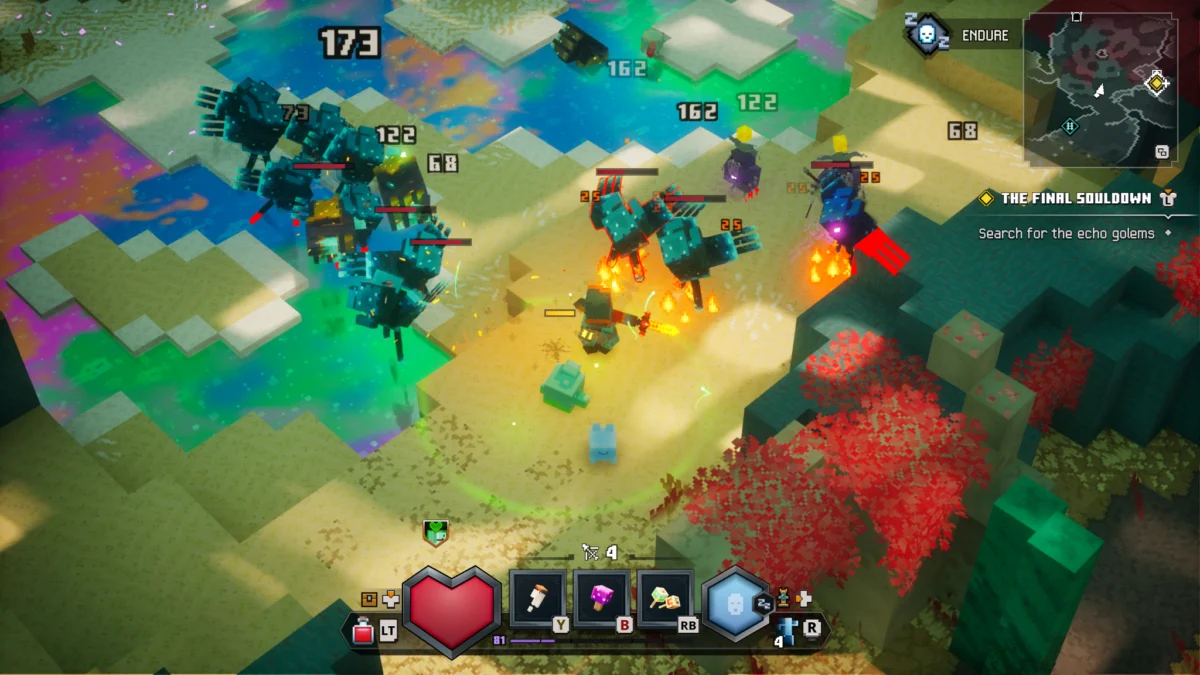
Minecraft Dungeons II marks a significant evolution in Mojang Studios’ foray into the dungeon-crawling genre, arriving approximately six years after the original title first attempted to synthesize the iconic survival-crafting aesthetics of Minecraft with the mechanical depth of an isometric action role-playing game (ARPG). While the 2020 predecessor was often characterized as a "proof of concept" or a "Diablo-lite" experience, this sequel aims to establish a more robust identity within the competitive ARPG landscape. Developed under the umbrella of Xbox Game Studios, the title seeks to address previous criticisms regarding campaign length and character complexity while introducing a structural shift from linear mission-based progression to a semi-open world environment.

Historical Context and Franchise Evolution
To understand the trajectory of Minecraft Dungeons II, one must look at the performance and reception of the original Minecraft Dungeons. Released in May 2020, the first game was praised for its accessibility and faithful recreation of the Minecraft universe but faced scrutiny for its brief five-hour core campaign and limited endgame variety. Despite these initial hurdles, the title maintained a strong player base, surpassing 25 million unique players by late 2023, bolstered by a steady cadence of premium downloadable content (DLC) such as Jungle Awakens and Echoing Void.

The development of the sequel reflects a strategic pivot. Where the first game functioned as an experimental spin-off, Minecraft Dungeons II is positioned as a foundational pillar of the Minecraft IP. Industry analysts note that this sequel arrives at a time when the ARPG market has seen a resurgence in popularity, following the high-profile releases of competitors like Diablo IV and the continued growth of Path of Exile. By expanding the scope of the base game, Mojang is signaling a commitment to long-term engagement that exceeds the "budget" feel of the 2020 entry.

Structural Shift: The Semi-Open Overworld
The most foundational change in Minecraft Dungeons II is the transition to a semi-open world. Rather than selecting isolated missions from a static map screen, players now navigate a cohesive, hand-crafted Overworld that serves as a connective tissue between traditional dungeon instances. This world is comprised of several distinct biomes, including the newly introduced "The Sift," a realm characterized by hyper-saturated, psychedelic visuals and a unique atmospheric design described as a "world of music."

The Overworld is designed to encourage exploration beyond the primary quest markers. Small-scale platforming challenges and hidden environmental puzzles are scattered throughout the map, often rewarding players with high-tier loot or side quests that unlock specialized weaponry. This design choice aligns the spin-off more closely with the exploratory roots of the core Minecraft experience. However, data from the initial launch reveals that the current world map remains approximately two-thirds empty. While the primary campaign offers roughly 20 hours of content—a fourfold increase over the original’s base game—the vast unmapped territories strongly suggest a pre-planned roadmap of post-launch expansions.

Combat Mechanics and Technical Refinements
Combat in Minecraft Dungeons II retains the responsive, "pick-up-and-play" nature of its predecessor while introducing several mobility-focused refinements. The foundational loop of melee attacks, ranged fire, and rolling is supplemented by a new dedicated jump button. This addition facilitates both environmental navigation and combat positioning, allowing for "area of effect" (AoE) slam moves that are essential for managing large enemy mobs.

The artifact system returns, providing three slots for active abilities such as defensive buffs or high-damage magical attacks. These artifacts remain independent of a traditional class system, allowing players to pivot their playstyle based on their current equipment. A significant quality-of-life improvement is the introduction of the "mini-inventory" during cooperative play. This feature allows individuals to adjust their loadouts in real-time without pausing the game for the entire party, addressing a major friction point in the original title’s multiplayer experience.

Character Progression and Customization Depth
The sequel significantly expands the depth of character builds by increasing the number of equipment slots. Players now manage four armor slots, a significant increase from the single slot available in the first game. This change allows for more complex synergy between passive bonuses and active enchantments. Enchantments remain the primary method of power scaling, offering stackable active and passive modifiers that can be applied to weapons and armor.

New to the sequel are "Talismans," upgradeable items that provide substantial, specialized buffs to specific playstyles. To support this expanded gear system, the in-game economy has been retooled. The Blacksmith, located in the central hub town, now allows players to upgrade existing gear to their current power level for a standardized resource cost. This system effectively mitigates the need for repetitive grinding, as players can maintain their favorite equipment throughout the leveling process. Conversely, early reports indicate that the Town Merchant’s inventory often becomes obsolete quickly, with enemy loot drops typically offering superior statistics.

Difficulty Scaling and Enemy Variety
In a move that may surprise casual audiences, Minecraft Dungeons II has increased the baseline difficulty compared to the 2020 original. The game frequently utilizes "one-shot" mechanics through elite enemies and bosses, requiring players to engage more deeply with the dodging and positioning systems. The health potion system remains on a strict cooldown, which, when combined with a demanding revival timer in cooperative modes, creates a high-stakes environment during major encounters.

Boss encounters have been scaled up in both visual size and mechanical complexity. These "screen-filling" fights require a balance of build optimization and tactical execution. While some "special" enemies—mini-bosses that appear within standard mobs—have been noted for frustrating difficulty spikes, the general consensus among early adopters is that the challenge provides a necessary sense of progression that was lacking in the first game.

Presentation and Technical Performance
Visually, Minecraft Dungeons II leverages the blocky aesthetic of its parent franchise while utilizing modern lighting and particle effects to create a more immersive atmosphere. The visual readability of the game remains high, though the increased density of magical effects and explosions can occasionally lead to "visual noise" during chaotic multiplayer sessions. The soundtrack continues the franchise tradition of blending tranquil, ambient melodies during exploration with high-energy orchestral arrangements during combat.

Technical performance at launch has been largely stable on the Xbox Series X, though some users have reported connectivity issues when attempting to access online multiplayer lobbies. To combat potential server instability, the game offers a distinct "Offline Character" mode. Offline characters are restricted to local play and single-player modes, shielding them from internet-related latency or server downtime. However, "Online Characters" are required for cross-play and matchmaking, and these characters remain susceptible to connection drops even when playing solo.

The Endgame and Post-Launch Outlook
The current state of the endgame is the primary area where Minecraft Dungeons II appears to be in a transitional phase. Upon completion of the 20-hour campaign, players are introduced to "Soul Storms"—hourly world events that increase enemy hostility and drop rates in existing dungeons. Currently, the sequel lacks a dedicated procedural mode similar to "The Tower" from the original game’s later updates.

The presence of large, unpopulated regions on the world map points toward a "Games as a Service" (GaaS) model. Mojang has confirmed that at least two major DLC expansions are in development, which are expected to fill these voids and introduce new endgame loops. While the base package is significantly more substantial than the first game’s launch version, veteran players may find the current post-game offerings somewhat limited until the first wave of updates arrives.

Implications for the Minecraft Ecosystem
Minecraft Dungeons II represents more than just a sequel; it is a test of the Minecraft brand’s versatility. By successfully deepening the mechanics of a spin-off, Mojang and Microsoft are demonstrating that the IP can sustain complex gameplay systems that appeal to older, more experienced gamers without alienating the younger demographic that defines the brand.

The decision to lean into higher difficulty and more intricate build-crafting suggests a desire to capture a segment of the "hardcore" ARPG market. If the post-launch support matches the longevity of the original title, Minecraft Dungeons II has the potential to become a staple of the genre, offering a unique middle ground between the extreme complexity of Path of Exile and the streamlined accessibility of mobile-first titles. As the servers stabilize and the first expansions take shape, the title is well-positioned to expand the reach of the Minecraft universe into new, more challenging territories.