


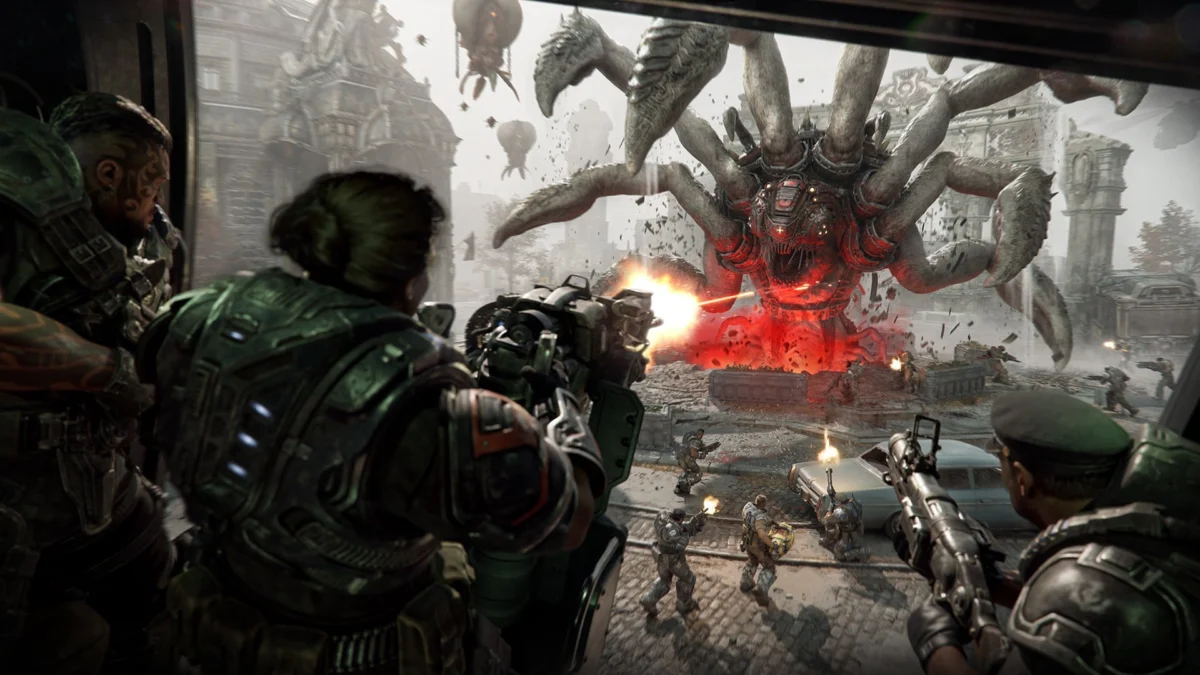
The Coalition’s recent rollout of the first Gears of War: E-Day multiplayer beta has provided the gaming community with its first hands-on look at the next generation of the storied franchise. Following a massive turnout on both Xbox Series X|S and the Xbox PC app, the Early Access Beta quickly ascended the charts, reaching the seventh position among the most-played titles on the Xbox platform. While players were busy sharing highlights of chainsaw duels and Gnasher battles, the technical experts at Digital Foundry conducted an exhaustive analysis of the software’s performance. Their findings offer a comprehensive look at how Unreal Engine 5 (UE5) is being leveraged to push console hardware, revealing a title that is visually ambitious yet still grappling with the optimization hurdles inherent in early-stage development.
The Evolution of Gears of War and the Shift to Unreal Engine 5
The Gears of War franchise has long been a flagship for Microsoft, serving as a showcase for the capabilities of the Unreal Engine since the original game’s debut in 2006. Developed by The Coalition—the studio that took over the reigns from Epic Games—Gears of War: E-Day represents a significant pivot for the series. Eschewing a direct sequel to Gears 5 for the time being, E-Day serves as a prequel, returning to the immediate aftermath of the Locust emergence.
This thematic return to the series’ roots is accompanied by a massive leap in underlying technology. Gears of War: E-Day is built from the ground up on Unreal Engine 5, utilizing the engine’s most advanced features, such as Lumen for dynamic global illumination and Nanite for highly detailed geometry. The Coalition has a history of technical excellence, having previously collaborated with Epic Games on "The Matrix Awakens" tech demo, which first showcased the potential of UE5 on consoles. Consequently, the industry has looked toward E-Day as the definitive benchmark for what Microsoft’s first-party studios can achieve with the new engine.
Xbox Series X: A Triple-Mode Approach to Performance
The Digital Foundry analysis confirms that the Xbox Series X version of the beta is designed to cater to various player preferences through three distinct graphical modes: Performance, Quality, and Balanced. This "triple-threat" configuration has become increasingly common in high-end console titles, particularly those utilizing 120Hz display capabilities.
In the Performance mode, the game targets a fluid 60 frames per second (FPS). To achieve this, the internal resolution fluctuates around the 1000p mark, relying on Unreal Engine 5’s Temporal Super Resolution (TSR) to upscale the image to a 4K output. The Quality mode, by contrast, targets 30 FPS, allowing the internal resolution to rise to approximately 1224p. This mode also introduces more refined lighting effects and increased shadow resolution.
The third option, Balanced mode, targets 40 FPS. This mode is specifically designed for users with 120Hz displays, as 40 divides evenly into 120, providing a much smoother experience than 30 FPS with lower input latency, while maintaining a higher visual fidelity than the 60 FPS Performance mode. In Balanced mode, the internal resolution sits at approximately 1080p.
Despite the impressive suite of modes, Digital Foundry noted several visual caveats. Both the Series X and Series S versions are currently impacted by persistent chromatic aberration and film grain. These post-processing effects, which cannot be disabled in the beta build, tend to soften the image and introduce a slight distortion that may obscure the fine details provided by the Nanite geometry.
Xbox Series S: Navigating Hardware Constraints
The Xbox Series S version of the Gears of War: E-Day beta offers a fascinating look at how UE5 scales down to less powerful hardware. Digital Foundry’s report indicates that while the Series S "mirrors" the feature set of the Series X, it does so with significant "necessary graphical concessions."
The most striking difference lies in the internal resolution. In Performance and Balanced modes, the Series S renders at approximately 576p, while Quality mode reaches roughly 720p. These figures might seem low by modern standards, but the use of UE5’s sophisticated upscaling techniques helps maintain a level of visual cohesion that belies the raw pixel count. However, the trade-offs extend beyond resolution. Digital Foundry observed "aggressive variable rate shading" (VRS) and lower-quality textures on the Series S.
Furthermore, the Series S version sees reductions in environmental details, such as simplified foliage animations and the replacement of ray-traced reflections with screen-space reflections. Despite these cuts, the performance profile remains largely consistent with the Series X, maintaining 60 FPS during standard Versus matches. However, both consoles exhibit "shaky performance" during the more demanding Horde Siege mode, where dense enemy counts and explosive effects can cause frame rates to dip into the 50s.
Unreal Engine 5 as the Foundation for Future Visuals
The consensus among technical analysts is that Gears of War: E-Day is shaping up to be a premier example of UE5’s capabilities. The synergy between the game’s "art style and lighting" and the engine’s strengths is particularly noteworthy. The "Gears" aesthetic—characterized by heavy, industrial architecture and dark, atmospheric environments—is perfectly suited for Lumen’s ability to handle complex light bounce and shadow depth.
Digital Foundry highlighted that while there are "jitters here and there," the "core foundation is solid." The transition to Nanite allows for nearly cinematic levels of detail on character models and environments, virtually eliminating the "pop-in" of assets that plagued previous generations of gaming. This level of detail is critical for E-Day, as the developers aim to capture the horror-centric, gritty atmosphere of the original 2006 title.
Chronology of the Beta and Path to Release
The E-Day Multiplayer Beta follows a specific timeline of events that began with the game’s reveal at the June 2024 Xbox Games Showcase.
- June 2024: Official reveal of Gears of War: E-Day with a cinematic trailer running in-engine.
- August 2024: The Coalition confirms that a multiplayer beta will be used to stress-test the UE5 infrastructure.
- Last Weekend: The first Early Access Beta goes live for Xbox Series X|S and PC, focusing on core Versus modes and a limited Horde Siege experience.
- Upcoming: A second beta phase is expected to occur, likely focusing on wider stress testing and balance adjustments based on data collected during the first window.
- October 6, 2026: Scheduled worldwide release date.
This two-year gap between the first beta and the final release is unusual in the modern industry, where betas often serve as "demos" released just weeks before launch. The Coalition’s decision to host a beta so early suggests a commitment to iterative development, using player feedback to refine the Unreal Engine 5 pipeline over a protracted period.
Official Responses and Community Reaction
While The Coalition has not issued a line-by-line response to the Digital Foundry analysis, the studio has been active on social media, acknowledging the feedback regarding visual clarity. Community managers have noted that the inability to toggle film grain and chromatic aberration is a frequent point of contention among the "pro" gaming community, who prefer a cleaner image for competitive play.
Player reactions have been largely positive regarding the "feel" of the game. The movement mechanics—long a staple of the Gears franchise—appear to have transitioned well to the new engine, with many players noting that the game feels "weightier" and more responsive than its predecessors. The massive turnout for the beta indicates that appetite for the franchise remains high, despite the long hiatus since the release of Gears 5 in 2019.
Broader Implications for the Xbox Ecosystem
The performance of Gears of War: E-Day has implications that reach beyond a single franchise. As Microsoft continues to integrate its various studio acquisitions, the success of E-Day serves as a litmus test for the company’s broader technical strategy. With many upcoming Xbox titles—including Fable and Perfect Dark—utilizing Unreal Engine 5, the optimizations discovered by The Coalition will likely be shared across the Xbox Game Studios network.
Moreover, the analysis of the Series S performance is a critical data point for the industry. There has been ongoing debate among developers regarding the viability of the Series S as a "next-gen" machine as engine complexity increases. The fact that The Coalition has managed to maintain 60 FPS on the Series S, even at lower resolutions, suggests that UE5 is flexible enough to support the entry-level console if handled by experienced engineers.
Conclusion: A Promising Foundation
The Digital Foundry analysis of the Gears of War: E-Day beta paints a picture of a project that is technically ambitious and visually striking, even in its unpolished state. The implementation of three distinct performance modes on the Series X demonstrates a commitment to player choice, while the Series S version shows the lengths to which the engine can be scaled to maintain performance.
As The Coalition continues to "tinker away" at the code, the focus will likely shift from foundational stability to fine-tuning the visual presentation and eliminating the performance hitches seen in dense combat scenarios. With a release date set for October 2026, the studio has ample time to address the concerns regarding image clarity and optimization. For now, Gears of War: E-Day stands as a compelling preview of the visual future of the Xbox platform, proving that the emergence of the Locust is just as technically demanding as it is narratively significant.