


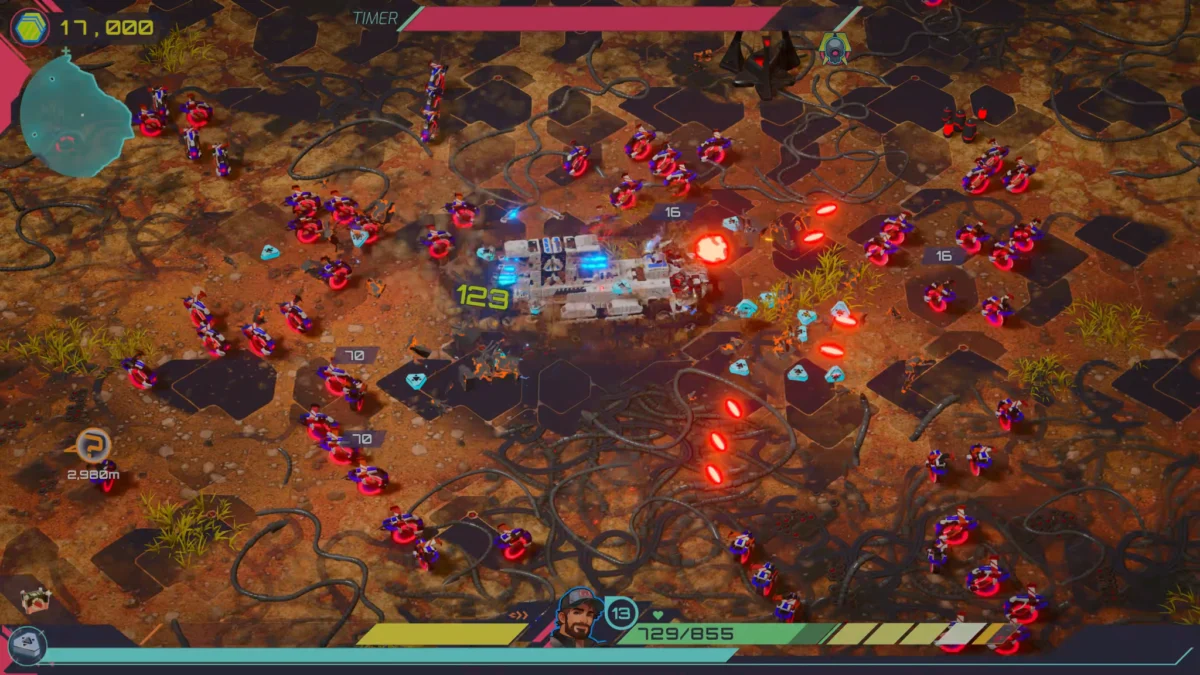
TerraTech Legion represents a significant pivot for the long-standing vehicle-construction franchise, transitioning from its open-world sandbox roots into the increasingly competitive "bullet heaven" or "survivors-like" subgenre. Developed by Mythwright and published as a strategic expansion of the TerraTech intellectual property, the title has launched simultaneously on the Xbox Game Pass service, positioning itself as a high-visibility entry in a genre currently dominated by hits such as Vampire Survivors and Deep Rock Galactic: Survivor. This evolution marks a trend in the gaming industry where established IPs are adapted into the roguelite format to leverage existing mechanics within a more structured, session-based gameplay loop.

The Evolution of the Bullet Heaven Genre
The "bullet heaven" genre, characterized by automated combat, high enemy density, and incremental power scaling, has seen a meteoric rise since the viral success of Vampire Survivors in late 2021. The formula typically involves a single character navigating a 2D or 3D space while weapons fire automatically at the nearest threats. Players focus on movement and strategic selection of upgrades upon leveling up.
TerraTech Legion enters this market at a time of saturation. To distinguish itself, the game integrates the core DNA of its predecessor: modular vehicle construction. While titles like Brotato focus on character stats and Deep Rock Galactic: Survivor emphasizes environmental destruction, TerraTech Legion centers its gameplay on the physical architecture of the player’s vehicle. This mechanic introduces a layer of spatial reasoning and physics-based strategy rarely seen in the genre.

Core Mechanics: Modular Construction and Physics-Based Combat
The primary differentiator in TerraTech Legion is the block-based building system. Unlike traditional survivors-likes where upgrades are purely statistical or visual overlays, every choice in TerraTech Legion has a physical manifestation. When a player levels up by collecting experience orbs dropped by defeated enemies, they are presented with airdropped crates containing various components.
These components include:

- Structural Blocks: Used to extend the chassis, allowing for more attachments.
- Locomotion Modules: Various wheels and treads that dictate speed, acceleration, and turn radius.
- Automated Weaponry: Turrets, machine guns, lasers, and mortars with specific firing arcs.
- Utility Parts: Shield generators, repair modules, and stat-boosting ornaments.
The game’s physics engine plays a critical role in vehicle viability. The center of mass, weight distribution, and ground clearance are all simulated. For example, placing heavy weaponry on a high-reaching tower without widening the wheelbase can lead to the vehicle tipping over during high-speed maneuvers. Similarly, adding too many blocks to one side can impede the vehicle’s ability to drive in a straight line. This creates a "design-test-iterate" loop within every 20-minute run, forcing players to balance raw firepower with mechanical stability.
Chronology of a Standard Gameplay Run
A typical session in TerraTech Legion follows a structured progression designed to escalate tension and complexity:

- Deployment: Players select one of four distinct characters, each offering different starting stats and unique skill trees.
- Initial Accumulation: The early minutes involve kiting small groups of enemies to gather experience. The player must quickly establish a stable base with basic weaponry and wheels.
- The Mid-Game Expansion: As enemy waves increase in density, players must use structural blocks to expand their vehicle’s "real estate." This phase requires careful placement of weapons to ensure 360-degree coverage, as parts of the vehicle can physically block the line of sight of certain turrets.
- Side Objectives: Maps contain secondary challenges, such as defending a specific point or reaching a location within a time limit. Completing these provides the "stars" necessary for meta-progression.
- Boss Encounters: Each level culminates in a battle against a "Triarch Warden" or similar massive mechanical entity. These bosses serve as gear checks, requiring high DPS (damage per second) and survivability.
- Extraction or Destruction: Upon defeating the boss, the run concludes, and players are rewarded with resources used for permanent upgrades.
Content Overview and Meta-Progression
At launch, TerraTech Legion features four distinct planetary environments, each representing classic video game biomes such as lush forests and volatile volcanic landscapes. These environments are not merely aesthetic; terrain types can affect vehicle handling, and environmental hazards (such as lava pools) necessitate specific movement strategies.
The meta-progression system is divided into two primary tiers:

- Character Skill Trees: Each of the four pilots (including the pathfinder Mikela Craft and the combat-focused Jean-Pierre) has a dedicated progression path. These trees offer permanent buffs to health, damage, and specialized abilities unique to that character.
- Global Unlocks: By achieving specific milestones or earning stars, players unlock new parts that enter the random pool for future runs. This ensures that the complexity of possible builds increases the more the game is played.
Industry data suggests that meta-progression is a key driver of retention in the roguelite genre. TerraTech Legion’s system is designed to provide a sense of steady growth, though some players may find the grind for later-tier skills to be substantial.
Balancing and Technical Performance
While the integration of physics and building is innovative, it introduces significant balancing challenges. Internal testing and early player feedback indicate that certain bosses can be "bullet sponges," requiring specific high-damage builds that may stifle creative freedom. There are also reports of "soft-locking" during boss fights, where a boss’s physical mass can pin a player’s vehicle against environmental geometry, leading to an unavoidable loss of health.

Character balance is another area of ongoing refinement. Initial analysis suggests that Jean-Pierre’s combat-oriented stats currently outperform the utility-focused builds of other characters, making him the "meta" choice for high-difficulty runs. However, the developer, Mythwright, has indicated a commitment to post-launch patches to address these discrepancies.
From a technical standpoint, the game performs admirably on modern hardware. Maintaining a stable frame rate is crucial for the "bullet heaven" genre, where hundreds of projectiles and enemies can occupy the screen simultaneously. The Xbox Series X version maintains a consistent performance profile, even when players have constructed massive, screen-filling vehicular monstrosities.

Industry Context and Market Implications
The release of TerraTech Legion on Game Pass is a calculated move by Payload Studios and Mythwright. For a genre that relies on "viral" word-of-mouth and a high volume of players to refine its balance, the low barrier to entry provided by a subscription service is an advantage.
This title also highlights a broader shift in IP management. By taking the "TerraTech" name—previously associated with a slower, more methodical sandbox experience—and applying it to a fast-paced action subgenre, the developers are attempting to capture two distinct audiences: long-time fans of the franchise and the massive "Survivors" player base.

Conclusion and Future Outlook
TerraTech Legion is a successful hybrid that brings genuine innovation to a genre that has occasionally struggled with formulaic releases. The building system is intuitive yet deep, providing a level of agency over "build variety" that few competitors can match. While the game faces hurdles in terms of boss balancing and character parity, the core gameplay loop is inherently addictive and well-suited for both short sessions and extended play.
As the genre continues to evolve, the success of TerraTech Legion will likely depend on the frequency of content updates and the developer’s ability to smooth out the difficulty spikes that currently hamper the late-game experience. For now, it stands as a mandatory experience for Game Pass subscribers and fans of mechanical customization, offering a fresh, physics-driven perspective on the survival roguelite.

The broader implication for the industry is clear: the "Survivors-like" is no longer a niche trend but a versatile framework that can be enriched by integrating complex mechanics from other genres. TerraTech Legion proves that even in a crowded market, a strong, original "hook" combined with established IP recognition can create a compelling and highly marketable product.