


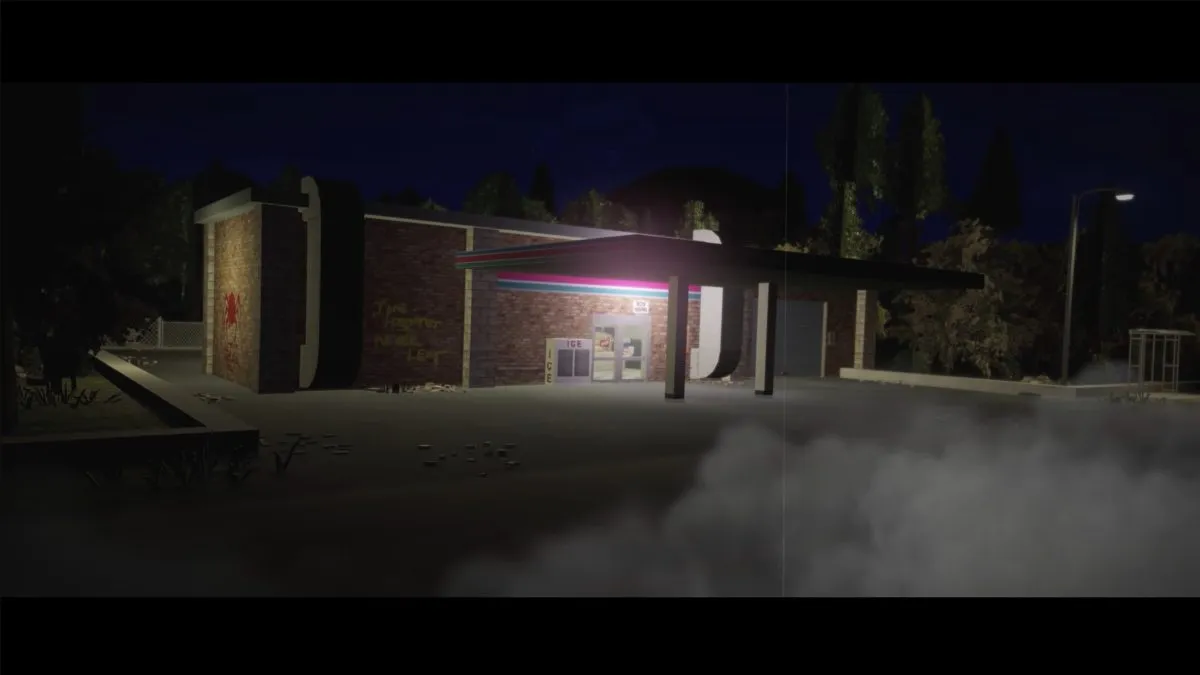
The unsettling reality of working the late shift at a mysterious convenience store in Shift at Midnight extends beyond the immediate financial pressures of pet medical bills and surgical expenses. A new layer of intrigue has been introduced with the disappearance of a canine companion named Guillermo, as highlighted by a prominently displayed missing dog poster within the game. This development, appearing during the tenth night of gameplay, prompts a deeper investigation into its narrative significance and practical implications for players.
The Enigma of Guillermo’s Disappearance
Guillermo, described as a brown Labrador sporting a distinctive yellow collar, is revealed to be missing as players navigate the tenth night of Shift at Midnight. His absence is marked by the appearance of a missing poster on the in-game notice board, a crucial hub for information dissemination within the game’s narrative. This notice board, alongside direct communications from the Store Manager via calls or notes, serves as the primary conduit for players to receive updates and directives.
However, the handling of Guillermo’s disappearance diverges significantly from the typical side quests encountered in the game’s Story Mode. Unlike urgent tasks that demand immediate player intervention, the missing dog scenario appears to operate under a different set of rules. While a $50 reward is attached to the poster, seemingly aligning with the bonuses players can earn by fulfilling the Store Manager’s requests, there is no apparent in-game mechanism to actively locate Guillermo. This absence of a tangible quest or interactive element has led many to speculate that Guillermo’s poster might function as a narrative red herring, a piece of lore designed to deepen the game’s atmosphere rather than a solvable puzzle with a direct in-game resolution.
Further complicating the situation is the distinction between Guillermo and Tofu, a service dog that players must interact with and serve during a specific in-game encounter. Shift at Midnight appears to intentionally create a moment of potential misdirection, where players might be tempted to perceive Tofu as the missing pet, even as the game subtly suggests a different narrative. The game’s developers may have designed this scenario to test players’ attention to detail and their ability to differentiate between distinct in-game characters and plot threads. Guillermo is not Tofu; he is presented as a distinct entity, a beloved pet whose owner’s identity remains ambiguous.
Speculation on Guillermo’s Fate and Narrative Role
The immediate inclination for many players, upon seeing the missing poster, would be to search the immediate in-game environment, such as the surrounding forest, for a stray dog. However, the game does not offer any dialogue options or interactive prompts that would allow players to actively investigate Guillermo’s whereabouts or inquire about him with other characters. This lack of direct engagement suggests that the poster’s inclusion is primarily for atmospheric and thematic purposes.
One prevailing theory posits that Guillermo’s disappearance is intrinsically linked to the overarching themes of doppelgangers and existential threats within Shift at Midnight. The narrative often hints at the presence of imposters, particularly among the store’s clientele, who may have been replaced by sinister duplicates. In this context, Guillermo’s owner could potentially be one of these replaced individuals, leaving the dog ownerless and vulnerable. The mention of "The Dentist," a character who might be involved in these unsettling transformations, further fuels this speculation. If Guillermo’s owner has been supplanted, it would explain the lack of an active search or a clear avenue for recovery within the game’s mechanics.
The poster’s existence could also serve as a potent reminder of the stakes involved in the player’s own precarious situation. Working the graveyard shift at midnight, in a potentially hostile environment, inherently puts the player’s well-being at risk. The plight of Guillermo, a lost pet whose owner is presumably distressed, might be intended to evoke empathy and reinforce the player’s own desire to protect their assets, including their own pet. The game’s overarching narrative often emphasizes the lengths to which characters will go to ensure their survival and the safety of their loved ones, and the missing dog poster could be a subtle, yet effective, way to underscore this theme. It’s a poignant reminder of what is at stake beyond the immediate gameplay objectives.
Community Consensus and In-Game Evidence
The Shift at Midnight community, particularly on dedicated platforms such as the game’s official Discord server, has actively engaged with the mystery of Guillermo’s disappearance. Extensive searching and discussion among players have yielded no concrete evidence of Guillermo being an actual findable entity within the game world. Newcomers are often informed by veteran players that there is no discoverable lost dog to be found. This collective experience strongly supports the notion that Guillermo’s poster is a narrative device rather than a functional quest objective.
The most compelling evidence for Guillermo’s unfindable status lies within the missing dog poster itself. Crucially, there is no in-game option to contact the owner by calling a listed number, nor is there any mechanism to initiate a search or investigation triggered by the poster. This absence of interactive elements directly linked to the poster strongly indicates that the developers did not intend for players to actively find Guillermo. Instead, the poster serves to enrich the game’s lore and enhance its immersive qualities, contributing to the pervasive sense of unease and mystery that defines Shift at Midnight.
Broader Implications for Game Design and Narrative
The inclusion of a seemingly unresolvable mystery like Guillermo’s disappearance can have several implications for player engagement and the overall narrative experience in Shift at Midnight.
Firstly, it contributes to the game’s atmosphere of pervasive dread and uncertainty. In a world where ordinary elements can become sources of anxiety, a missing pet poster, devoid of a clear resolution, amplifies this feeling. It suggests that not all problems within this universe have a straightforward solution, mirroring the player’s own potentially dire circumstances.
Secondly, it tests the boundaries of player agency. Unlike games that provide clear objectives and rewards, Shift at Midnight appears to be experimenting with narrative elements that exist purely for world-building and thematic resonance. This can lead to a more contemplative player experience, where understanding the narrative and its underlying themes becomes as important as completing tasks.
Thirdly, it fosters community interaction and collaborative problem-solving. Even if Guillermo cannot be found, the discussion and speculation surrounding his disappearance can become a significant part of the player experience. The collective effort to decipher the meaning behind the poster, even if it leads to the conclusion that there’s no in-game solution, strengthens the bond between players and their shared engagement with the game’s world.
The $50 reward, while seemingly tangible, might also be a deliberate misdirection, designed to pique player interest and encourage them to investigate further, only to be met with the realization that the reward is unobtainable in a practical sense. This can be a frustrating but ultimately rewarding aspect of the game’s design, pushing players to think critically about what constitutes a "reward" in the context of the game’s narrative.
Ultimately, Guillermo’s missing poster in Shift at Midnight stands as a testament to the game’s commitment to creating a rich, immersive, and often unsettling narrative experience. While players may not be able to reunite Guillermo with his owner, the poster serves as a powerful symbol of the game’s thematic explorations of loss, mystery, and the fragile nature of normalcy in a world teetering on the edge of the surreal. It encourages players to look beyond the immediate objectives and engage with the deeper layers of the game’s lore, making their time spent at midnight shifts all the more memorable and thought-provoking. The ambiguity surrounding Guillermo’s fate underscores the game’s unique approach to storytelling, where even seemingly minor details can hold significant weight in shaping the player’s perception of the game’s unfolding events.