


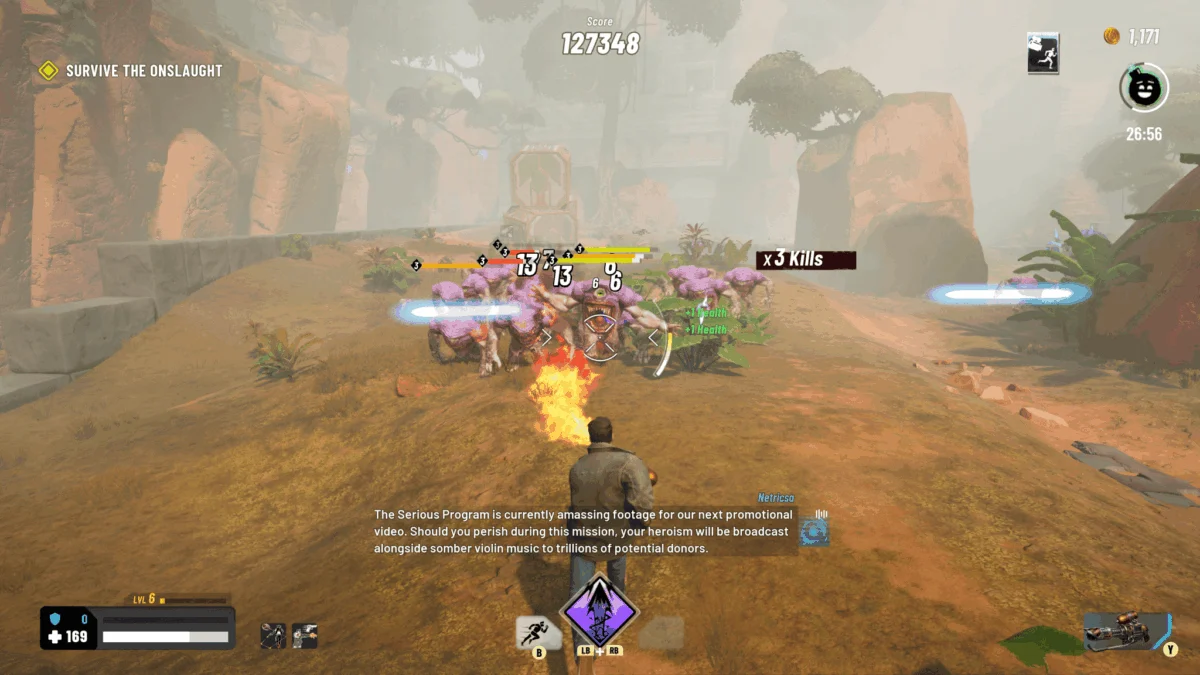
Serious Sam: Shatterverse represents a significant departure for one of the most enduring franchises in the first-person shooter (FPS) genre. As the series celebrates its 25th anniversary, Croteam and publisher Devolver Digital have opted for a transformative approach, handing the reins to Behaviour Interactive—the studio primarily recognized for the asymmetrical horror hit Dead by Daylight. This transition marks the first time a mainline or major spin-off entry has been developed by a team not specialized in traditional high-speed FPS mechanics, resulting in a product that blends the chaotic DNA of the original games with the modern, addictive loops of the roguelite genre. Tested on the Xbox Series X, the title serves as both a technical showcase for Unreal Engine 5 and a conceptual experiment that challenges the expectations of long-term fans.
The Evolution of a Macho Icon: 25 Years of Serious Sam
To understand the impact of Serious Sam: Shatterverse, one must look at the historical context of the franchise. Launched in 2001 with Serious Sam: The First Encounter, the series was Croteam’s answer to the "corridor shooters" of the era. While games like Half-Life were pushing for narrative-driven, scripted experiences, Serious Sam doubled down on the "arena shooter" philosophy. It utilized the proprietary Serious Engine to render hundreds of enemies simultaneously across vast, open vistas—a feat that was technologically revolutionary at the turn of the millennium.

Over the subsequent two and a half decades, the series saw four mainline entries, various "Encounters," and numerous indie-developed spin-offs ranging from side-scrollers to top-down shooters. However, the "feel" of the game remained remarkably consistent due to the continued use of the Serious Engine. Shatterverse breaks this tradition by migrating to Unreal Engine 5. This shift provides a significant visual upgrade, particularly in lighting and particle effects, but it also alters the fundamental physics and "muscle memory" that fans have developed over 25 years. The movement is weightier, and the projectile physics have been recalibrated to fit a more contemporary engine architecture.
A Multiverse of Madness: The Roguelite Structure
The narrative premise of Shatterverse leans into the popular contemporary trope of the multiverse, which serves as a functional justification for the game’s roguelite mechanics and expanded co-op capabilities. Players no longer follow a single linear path through a 10-hour campaign. Instead, the game is structured around "runs." Each run consists of nine randomly selected, though hand-crafted, levels. These stages are grouped into trios, with every third level culminating in a massive boss encounter.
The game supports up to five players in co-op, a slight increase from the standard four-player fare found in previous entries. To accommodate this, players can choose from various versions of Sam Stone from across the "Shatterverse." These include "Alien Sam," "Cartoony Sam," and other variants, each equipped with unique base statistics and a signature "Ultimate Skill." This character-driven approach introduces a layer of hero-shooter strategy to the proceedings, as players must coordinate their ultimate abilities to survive the escalating difficulty of the later stages.

Gameplay Mechanics and the Transition to Unreal Engine 5
The initial experience of Shatterverse may prove jarring for series veterans. The transition to Unreal Engine 5 brings a level of visual fidelity previously unseen in the franchise, but it comes at the cost of the specific "snappiness" associated with the Serious Engine. Aiming, in particular, feels different. Most weapons in Shatterverse lack an "Aim Down Sights" (ADS) mechanic, staying true to the series’ hip-fire roots, yet the projectile spread is notably wider than in previous iterations. This design choice necessitates a closer engagement range, which can feel counter-intuitive in the large, open arenas the series is known for.
However, the introduction of new movement mechanics, such as a dedicated dash and health-replenishing "finishers," brings a modern flow to the combat. These elements appear to take inspiration from the recent Doom reboots, encouraging aggressive, forward-moving playstyles. While the level design is more simplified compared to the sprawling, secret-filled maps of Serious Sam 4 or The Second Encounter, the density of enemies remains high. Iconic foes like the Screaming Headless Kamikaze, Sirian Werebulls, and Kleer Skeletons return with updated models and animations that take full advantage of Unreal Engine 5’s capabilities.
Deep Progression and the "Multiverse Anomaly" System
The true depth of Serious Sam: Shatterverse reveals itself only after several hours of play. As a roguelite, the game relies on a "meta-progression" system. Throughout each run, players collect coins and experience points used to unlock new weapons, perks, and "Trinkets." These Trinkets are vital for high-level play, allowing for the creation of specialized builds. A player might focus on a "Vampiric Build," emphasizing health regeneration through finishers, or a "Critical Build," which maximizes the damage output of high-rate-of-fire weapons like the minigun.

One of the most innovative additions is the "Multiverse Anomaly" system. These are optional modifiers that can be activated to increase the rewards of a stage at the cost of significant gameplay shifts. Anomalies can range from technical changes—such as forcing the game into a third-person perspective—to environmental hazards like moving laser grids or "Economy Anomalies" where enemies steal gold upon hitting the player. These modifiers ensure that even when players revisit the same environmental assets (such as the classic Egyptian deserts or the gothic architecture of the Kleer planet), the gameplay experience remains distinct.
Chronology of Development and Release
The development of Shatterverse follows a specific timeline that highlights the evolving relationship between Devolver Digital and the Serious Sam IP:
- 2021: Croteam releases Serious Sam 4, which receives mixed reviews for its technical performance on the aging Serious Engine.
- 2023: Devolver Digital begins discussions with Behaviour Interactive about a spin-off that would utilize a more modern engine to attract a broader audience.
- 2024: Development officially shifts to Unreal Engine 5, with Croteam acting in a consultancy role to ensure "lore accuracy" and character consistency.
- Late 2025: The Painkiller reboot is released by a different studio, setting a precedent for the "arena-roguelite" hybrid that Shatterverse would eventually refine.
- August 2026: Serious Sam: Shatterverse launches on PC and current-gen consoles, including the Xbox Series X.
Technical Performance on Xbox Series X
On the Xbox Series X, Serious Sam: Shatterverse aims for a consistent 60 frames per second (FPS) at a dynamic 4K resolution. The use of Unreal Engine 5’s Lumen and Nanite technologies is evident in the complex geometry of the Sirian ruins and the realistic lighting of the desert landscapes. Despite the high enemy count, the console maintains a stable frame rate, though minor hitches can occur during the activation of multiple Ultimate Skills in a five-player session.

Loading times are significantly reduced compared to previous entries, thanks to the Xbox Velocity Architecture. This is particularly important for a roguelite, where frequent restarts and level transitions are a core part of the experience. The haptic feedback on the controller is also utilized to differentiate the "feel" of the arsenal, from the heavy thud of the double-barrel shotgun to the rapid vibration of the XL2 Lasergun.
Broader Impact and Genre Implications
The release of Serious Sam: Shatterverse signifies a broader trend in the gaming industry where established FPS franchises are being reimagined through the lens of the roguelite. This shift addresses the modern player’s desire for high replayability and "bite-sized" gaming sessions, contrasted with the traditional long-form campaigns of the early 2000s.
Industry analysts suggest that by licensing the IP to Behaviour Interactive, Devolver Digital is testing the viability of Serious Sam as a "Live Service" or highly replayable co-op platform. If successful, Shatterverse could provide a template for future entries, potentially leading to a mainline Serious Sam 5 that incorporates these randomized elements into a more traditional narrative structure.

Furthermore, the game’s success in its later hours—where synergies and builds become paramount—indicates a growing appetite for "Action RPG" elements in pure shooters. The "incremental power creep" mentioned in early reviews suggests that the genre is moving away from static weapon pick-ups toward a more personalized, loot-driven experience.
Final Analysis of the Shatterverse Experience
While Serious Sam: Shatterverse initially presents as a simplified version of its predecessors, it ultimately reveals itself to be one of the most mechanically dense entries in the franchise. It sacrifices some of the "janky charm" and hidden easter eggs of the Croteam-developed titles in favor of a polished, addictive, and highly social experience. The game bridges the gap between the nostalgic "circle-strafing" gameplay of 2001 and the sophisticated progression systems of 2026. For fans of the series, it represents a bold step into a new dimension; for newcomers, it serves as an accessible entry point into the world of Sam "Serious" Stone. As the "endgame" bosses provide a challenge that is described as "mental," it is clear that while the engine and structure have changed, the spirit of the macho shooter hero remains as intense as ever.