


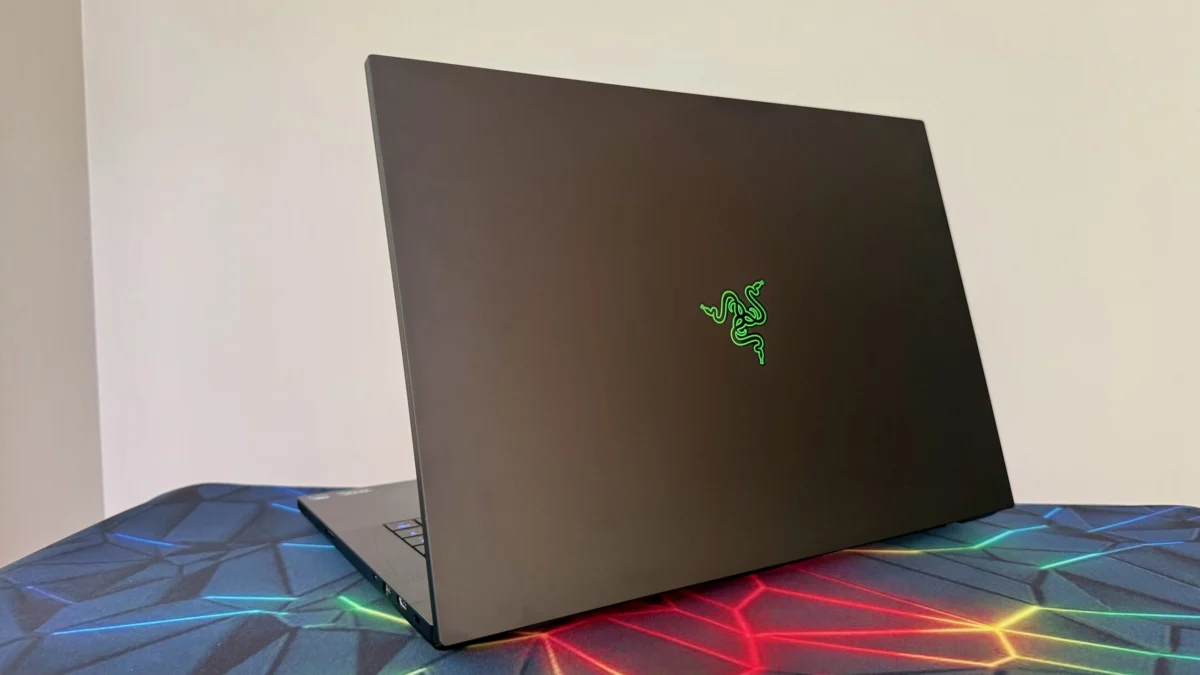
The landscape of high-performance gaming laptops continues to evolve, pushing the boundaries of what is considered portable. Razer, a prominent player in the enthusiast segment, has introduced its latest contender, the Razer Blade 18, which aims to reconcile the demand for expansive screen real estate with a relatively svelte form factor. While a truly "thin-and-light" 18-inch gaming laptop remains an engineering paradox, the Blade 18 makes significant strides in approaching this challenging ideal, positioning itself as a compelling option for gamers and creative professionals who prioritize a large display without fully committing to a desktop setup.
Weighing in at approximately 7 pounds (3.2 kilograms), the Razer Blade 18 achieves a notable weight advantage over its direct competitors in the 18-inch class. For instance, it is more than 2 pounds lighter than Dell’s Alienware 18 Area-51 and nearly a pound lighter than the Lenovo Legion 9i Gen 10. This reduction in mass, combined with thoughtful design, enhances its practical portability, making it conceivable to transport the device for occasional trips, albeit requiring a spacious laptop bag. This relative ease of movement helps to justify the premium investment in an 18-inch gaming laptop, offering a compelling alternative to a stationary desktop, which typically provides superior performance and upgradability at a comparable price point.
Unmatched Performance and Cutting-Edge Hardware

At the heart of the Razer Blade 18 lies a formidable array of components designed to deliver blistering performance. The reviewed configuration, priced at $5,400, features an Intel Core Ultra 9 290HX Plus CPU, a 24-core processor leveraging Intel’s latest architecture, which includes integrated AI acceleration capabilities. This CPU is paired with Nvidia’s flagship mobile graphics processing unit, the GeForce RTX 5090, equipped with a substantial 24GB of VRAM and operating at its full 175-watt thermal design power (TDP). This potent combination positions the Blade 18 at the apex of mobile gaming performance.
Benchmark testing revealed the Blade 18’s capacity for raw power. In multi-core and single-core synthetic CPU tests such as Geekbench 6 and Cinebench 2024, the laptop consistently delivered dominating scores, often leading the charts. While the Lenovo Legion 9i Gen 10, featuring the same Core Ultra 9 CPU but an RTX 5080 GPU, proved competitive, particularly in single-core performance, the Blade 18’s RTX 5090 distinguished it in graphical workloads.
In 3D gaming benchmarks, the Blade 18 achieved exceptional frame rates at 1080p resolution. It slightly surpassed the Alienware 18 Area-51 in titles like Shadow of the Tomb Raider, Guardians of the Galaxy, and The Riftbreaker. For newer, more demanding titles, the Blade 18 maintained its competitive edge, averaging 93 frames per second (fps) in Assassin’s Creed Shadows and an impressive 193 fps in F1 24. Crucially, the laptop sustained smooth gameplay at higher resolutions, achieving an average of 75 fps at 1440p and 58 fps at 4K in Assassin’s Creed Shadows with high-quality settings and without relying on frame generation technologies. F1 24 remained exceptionally fluid at 1440p, averaging 157 fps. This level of performance ensures that the Blade 18 can handle the most graphically intensive games at high settings, even on its native 4K resolution.
Innovative Dual-Mode Display for Versatile Gaming

A standout feature of the Razer Blade 18 is its unique dual-mode IPS display. This 18-inch panel offers unprecedented versatility, allowing users to switch between two distinct native resolutions and refresh rates, each optimized for different use cases. The primary mode delivers a stunning 4K resolution (3,840 x 2,400 pixels) with a brisk 240Hz refresh rate. This configuration is ideal for general productivity, content creation, and immersive single-player gaming where visual fidelity is paramount.
For competitive esports and fast-paced shooters where every frame matters, the display can be toggled to a lower 1,920 x 1,200 (1200p) resolution, which unlocks an astounding 440Hz refresh rate. This ultra-fast refresh rate provides a significant competitive advantage, reducing input lag and enhancing visual fluidity. The ability to transition between these two native resolutions without visual artifacting or blurring is a testament to Razer’s engineering. The switching process, managed through the Razer Synapse application, requires a system reboot and a manual adjustment of Windows scaling settings, which is a minor inconvenience that Razer could streamline in future iterations.
Beyond its dual-mode functionality, the display boasts impressive color accuracy and brightness. Tested with a Spyder X Elite colorimeter, it achieved a peak brightness of 682 nits, ensuring excellent visibility even in well-lit environments. Color coverage is robust, encompassing 100% of the sRGB gamut, 99% of the DCI-P3 gamut, and 87% of the AdobeRGB color space. This wide color fidelity makes the Blade 18 suitable not only for gaming but also for professional tasks requiring accurate color representation, such as photo and video editing. While it doesn’t offer the perfect black levels of an OLED panel, the IPS technology provides strong contrast and vibrant visuals.
Sophisticated Design and Enhanced Portability

Razer’s design philosophy for the Blade series emphasizes minimalism and premium build quality, and the Blade 18 is no exception. It features a unibody aluminum chassis, contributing to its robust feel and sleek aesthetic. The matte-black finish, while prone to fingerprints, exudes an understated elegance that contrasts with the more flamboyant designs often seen in gaming laptops. The only RGB lighting is found in the per-key customizable keyboard backlight and a subtly illuminated green Razer logo on the lid, which can be configured via the Razer Chroma app.
Despite its large 18-inch screen, the Blade 18 maintains relatively trim dimensions compared to its peers. Measuring 15.7 inches wide by 10.8 inches deep and slightly over an inch thick, it is more compact than the 15.9 by 11.7-inch Legion 9i and the expansive 16.1 by 12.6-inch Alienware 18 Area-51. This compactness is largely attributed to Razer’s innovative cooling system design, which avoids the large thermal shelf protruding behind the hinge, a common feature in high-performance gaming laptops. Instead, the Blade 18 incorporates a subtle bump-out on the bottom panel to house its cooling fans, effectively managing heat without increasing the laptop’s overall footprint. This design choice contributes significantly to its improved portability without compromising thermal efficiency or acoustic performance, as it runs no hotter or louder than its competitors.
The keyboard offers a comfortable typing experience with 1.5 millimeters of key travel, providing a more responsive feel than typical membrane laptop keyboards. The spacious keyboard deck accommodates a full number pad without feeling cramped. While it doesn’t feature the mechanical switches found in some competitor models like the Alienware 18 Area-51, its overall quality is solid. The touchpad is generously sized, leveraging the ample deck space, and functions as a standard mechanical touchpad. Given that most serious gamers will opt for an external mouse, Razer’s decision to forgo a more expensive haptic touchpad is understandable.
Comprehensive Connectivity and Upgrade Pathways

The Razer Blade 18 leverages its larger chassis to offer a comprehensive selection of ports, catering to a wide range of peripherals and external displays. It includes two USB-C ports (one Thunderbolt 5, one Thunderbolt 4), three USB-A ports, an HDMI 2.1 output, an Ethernet jack for stable wired networking, an SD card slot for content creators, and a combo audio jack. While the minimalist aesthetic is appreciated, the lack of labeling on the Thunderbolt ports is a minor oversight, requiring users to consult documentation or experiment to identify the Thunderbolt 5 port on the left and the Thunderbolt 4 port on the right.
Internal expandability is another significant advantage. The Blade 18 features two DIMM slots, each occupied by a 16GB stick of Samsung 6,400MHz DDR5 RAM in the reviewed configuration, totaling 32GB. Users can upgrade this to 64GB or even 128GB of RAM, though the latter option comes at a substantial premium, particularly in the current climate of "RAMageddon," where memory prices are experiencing significant upward pressure due to increased demand from AI workloads and manufacturing constraints. The laptop also provides two M.2 slots for storage, with the reviewed 2TB SSD occupying one, leaving a second slot free for an easy storage upgrade, which is a valuable feature given the ever-increasing size of modern game installations. Networking capabilities are also cutting-edge, with Wi-Fi 7 and Bluetooth 5.4 providing fast and reliable wireless connectivity.
Battery Life and Power Considerations
As expected for a high-powered gaming laptop with a large, high-refresh-rate display, battery life is not a primary strength. Such systems are typically used plugged in for optimal performance. The Razer Blade 18 managed approximately 4.5 hours on a YouTube streaming battery drain test. While this is a fraction of what ultraportable laptops can achieve, it is a respectable duration for an 18-inch gaming machine, outperforming the Alienware 18 Area-51 by about an hour and the Lenovo Legion 9i Gen 10 by half an hour. This suggests that while it’s not designed for extended unplugged use, it offers enough endurance for short periods away from a power outlet.

Pricing and Configuration Options
The Razer Blade 18 is available in various configurations, allowing buyers to balance performance and budget. The entry-level model starts at $3,500, featuring an Intel Core Ultra 9 275HX CPU, RTX 5070 Ti graphics, 32GB of RAM, and a 1TB SSD. Stepping up to $4,000 upgrades the CPU to the Core Ultra 9 290HX Plus while retaining other specifications. For $4,500, customers can acquire a system with the Core Ultra 9 290HX Plus and an RTX 5080 GPU. The reviewed configuration, priced at $5,400, includes the Core Ultra 9 290HX Plus, RTX 5090 graphics, 32GB of RAM, and a 2TB SSD. For those requiring even more memory, a 64GB RAM version is available for $6,000, and a fully maxed-out model with 128GB of RAM can reach an imposing $7,000, reflecting the current high cost of premium DDR5 memory.
Internationally, pricing varies, with the Blade 18 starting at approximately £3,700 in the UK. In Australia, only the smaller Blade 16 is currently available, starting at AU$6,000, indicating potential market segmentation or staggered release schedules for the 18-inch model.
Conclusion: A Premium Choice for Discerning Gamers

The Razer Blade 18 carves out a niche for itself as a top-tier 18-inch gaming laptop, striking a commendable balance between raw power, innovative display technology, and relative portability. While it cannot fully shed the inherent bulk of an 18-inch form factor, its superior design and lighter weight make it a more manageable proposition than many of its rivals. For gamers and professionals who demand the largest possible screen and uncompromising performance in a laptop, the Blade 18 presents a compelling option.
For most users, the extreme power of an RTX 5090 mobile GPU might be considered overkill. A more pragmatic choice within the Blade 18 lineup, offering excellent value and nearly equivalent performance for a significantly lower price, is the $4,500 configuration with an RTX 5080 GPU and a 1TB SSD. This option provides a substantial saving while still delivering exceptional gaming experiences, allowing for investment in a broader game library or accessories.
Ultimately, the Razer Blade 18 stands as a testament to advanced engineering, offering a premium gaming experience without the full immobility of a desktop. Its elegant design, powerful internal components, and groundbreaking dual-mode display collectively give it a distinct edge in the fiercely competitive high-end gaming laptop market, making it a worthy consideration for those seeking the ultimate in portable, large-screen gaming.
Testing Methodology

CNET’s comprehensive review process for computing devices, including laptops, encompasses a two-pronged approach. This involves rigorous performance testing conducted under controlled laboratory conditions at the CNET Labs, complemented by extensive real-world hands-on usage by expert reviewers. The evaluation process considers various aspects, including a device’s aesthetic appeal, ergonomic design, and feature set. The final review verdict integrates both objective benchmark data and subjective assessments. The suite of benchmarking software is continually updated to align with the evolving capabilities of modern hardware. Key performance benchmarks currently employed for compatible computers include Primate Labs Geekbench 6 for CPU performance, Cinebench 2024 for rendering capabilities, PCMark 10 for overall system performance, and 3DMark Fire Strike Ultra for graphics performance. This multi-faceted approach ensures a thorough and balanced assessment of each device.