


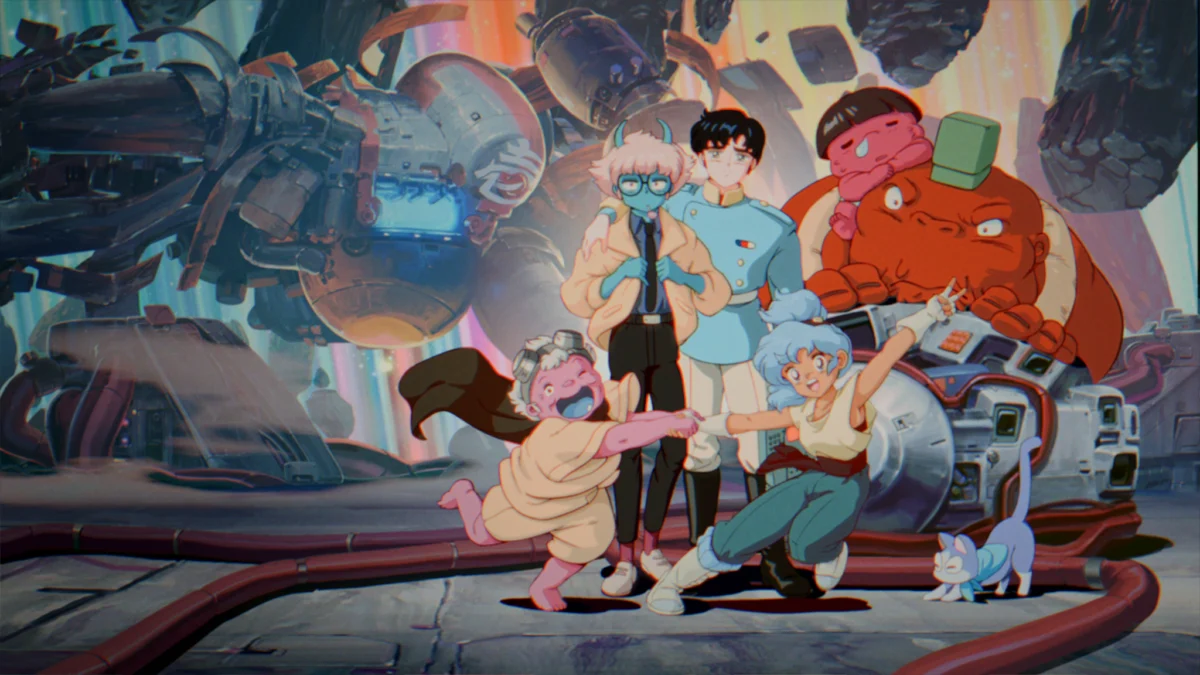
Orbitals represents a significant entry in the evolving landscape of dedicated two-player co-operative adventures, a genre that has seen a resurgence following the commercial and critical success of titles like It Takes Two. Developed by Shapefarm in collaboration with the animation specialists at Studio Massket, Orbitals attempts to merge a high-fidelity 1980s Saturday-morning cartoon aesthetic with complex, tool-based environmental puzzle-solving. While the title initially presents a dichotomy of striking visual polish and mechanical friction, the six-to-seven-hour campaign eventually transitions from a conventional genre exercise into an ambitious and imaginative spectacle. Available on the Nintendo Switch 2, the game leverages modern hardware to simulate a specific era of hand-drawn animation, even as it navigates the technical hurdles inherent in cloud-based and local-area network synchronization.

Narrative Framework and Character Dynamics
The core of Orbitals centers on two teenagers, Maki and Omura, who reside in a deteriorating settlement aboard a massive, dilapidated space station. The narrative arc is driven by an escalating environmental threat: a supernatural "cosmic storm" that is gradually consuming the surrounding sector. This provides a constant sense of urgency to the gameplay loop, which involves venturing into the station’s outlying reaches to secure essential resources for the settlement’s survival.

The character archetypes are designed to complement the co-operative nature of the game. Maki is characterized by an earnest and optimistic demeanor, serving as the emotional catalyst for the duo’s missions. Conversely, Omura is more reserved and cautious, providing a narrative foil that reflects the player’s own potential hesitations when facing the game’s more daunting environmental hazards. While the overarching plot follows established genre tropes—including a predictable antagonist—the strength of the storytelling lies in the incidental dialogue and the world-building found within the station’s various sub-sectors.

Visual Presentation and Animation Innovation
The most immediate differentiator for Orbitals is its commitment to a specific historical aesthetic. The game utilizes a visual language heavily inspired by 1980s and early 90s anime, characterized by a bright, "brash" color palette and a pulpy, synthesizer-heavy soundtrack. To achieve a level of authenticity that surpasses simple cel-shading, developer Shapefarm implemented a unique frame rate configuration. While the game engine itself targets 30 frames per second (FPS), the character and environmental animations are locked at 24 FPS. This disparity is intended to mimic the cinematic look of traditional cel animation, a technique recently seen in Compulsion Games’ South of Midnight.

This artistic choice is bolstered by the involvement of Studio Massket, whose hand-drawn cutscenes transition into the 3D engine with high levels of continuity. Small details, such as the integration of subtitles into the visual language of the game’s interface and a series of "pastiche" English voice performances, reinforce the feeling of playing through a localized era-accurate anime. However, the 24 FPS animation style is a permanent fixture of the experience; unlike other modern titles that offer a toggle for standard animation smoothing, Orbitals requires players to acclimate to its stylistic "jitter" to maintain its thematic integrity.

Mechanical Systems: Tools Over Scripted Sequences
Unlike the Hazelight school of design, which often introduces and discards mechanics on a per-level basis, Orbitals provides players with a consistent suite of tools that must be mastered and combined to overcome increasingly complex obstacles. At the start of the journey, players have access to three primary devices, with a fourth unlocked during the second act:

- The Kinetic Claw: A device used for the physical manipulation of objects, allowing players to push or pull elements of the environment.
- The Hydration Projector (Water Gun): Essential for extinguishing hazards, cooling heated surfaces, or interacting with the station’s biological flora.
- The Energy Beam: A precision tool for activating remote switches and powering dormant station technology.
- The Microwave Pulse: A "fly-by-wire" energy pulse that allows players to take temporary control of specific mechanical objects or drones.
A notable feature of this system is the agency granted to the players regarding loadout management. Partners must negotiate who carries which tool, adding a layer of meta-communication to the experience. The puzzles are designed to be "asymmetric," meaning the solution often requires one player to create a safe path for the other. For example, in lava-filled subterranean levels, one player must use the water gun to solidify a path while the other navigates the terrain using the kinetic claw to move obstacles.

Chronology of the Player Experience
The campaign of Orbitals follows a distinct trajectory of quality, moving from a troubled introduction to a sophisticated conclusion. Data from initial playthroughs suggests that the first two hours of the game are the most susceptible to player attrition.

- Phase 1: The Onboarding Friction (Hours 0–2): Initial impressions are often marred by what players describe as "unresponsive" controls. This may be attributed to the adjustment period required for the 30 FPS/24 FPS animation split or a lack of clear signposting in early tutorial areas. The early puzzles lean heavily on trial-and-error, which can lead to frustration when combined with the game’s slower-than-average movement speed.
- Phase 2: The Mechanical Shift (Hours 3–5): The game’s quality improves significantly following the first major boss encounter. This sequence introduces "NieR-style" perspective shifts and requires high-intensity communication between the pilot of the spaceship and the gunner. During this phase, the level design begins to embrace more imaginative concepts, such as using "exploding seed pods" to clear machinery clogged by sentient vines.
- Phase 3: The Spectacular Finale (Hours 6–7): The final act represents the developer "firing on all cylinders." The puzzles become more complex, often separating the two players into different parts of the level, forcing them to rely entirely on verbal coordination to progress. The spectacle increases, culminating in a final encounter that justifies the game’s ambitious visual style.
Technical Performance and Connectivity Analysis
While Orbitals thrives on the Nintendo Switch 2 hardware in terms of visual fidelity, it faces challenges regarding its online infrastructure. The game does not feature a traditional lobby system or an easily accessible "Join Game" function. Instead, it utilizes a system-level invitation process that has been described as "clunky."

Furthermore, stability remains a concern for remote play. Despite the use of high-speed fiber connections, frequent disconnections have been reported. These technical lapses are particularly problematic because the game’s checkpoint system often reverts players to the beginning of lengthy cutscenes or pre-boss sequences, forcing the repetition of content. This lack of a robust "re-join" feature can interrupt the flow of a game that is otherwise built entirely on the concept of uninterrupted synergy.

Market Context and Genre Implications
Orbitals enters a market where "Friends Pass" systems—which allow one person to buy the game and invite a friend for free—are becoming the industry standard for co-op titles. By adopting this model, Orbitals positions itself as a low-barrier entry for pairs looking for a weekend experience.

Industry analysts suggest that the game’s moderate length (6–7 hours) and the inclusion of unlockable versus mini-games provide a balanced value proposition. These mini-games remain playable after the credits roll, offering some replayability in an otherwise linear experience. The game also includes incidental interactions, such as the ability to "pet cats" within the settlement, which serves to humanize the high-concept sci-fi setting and has become a popular "fact-check" metric for modern community engagement.

Broader Impact and Conclusion
The success of Orbitals is likely to influence how developers approach the "playable movie" concept. By successfully bridging the gap between Studio Massket’s high-end animation and Shapefarm’s interactive environments, the title proves that retro aesthetics can be more than skin-deep. It serves as a testament to the idea that a game’s "feel" can evolve over the course of its duration; what begins as a sluggish and poorly signposted adventure eventually reveals itself to be one of the most creative co-op experiences of its release window.

Ultimately, Orbitals demonstrates that while first impressions are vital, the "landing" is what defines a specialized co-operative experience. It may not dethrone the established giants of the genre, but its unique visual identity and the clever implementation of its tool-based puzzles ensure it a place in the conversation regarding the future of shared-screen storytelling. For players willing to navigate the initial technical and mechanical hurdles, Orbitals offers a rewarding journey that captures the spirit of a bygone era of animation while utilizing modern design philosophies to foster genuine player connection.