

The recent launch of the Metal Gear Solid: Master Collection Vol.2 on Xbox Series X and Xbox Series S has marked a significant moment for fans of Hideo Kojima’s acclaimed stealth franchise, particularly for those who primarily game on Microsoft’s consoles. For the first time in its history, Metal Gear Solid 4: Guns of the Patriots, a title previously exclusive to the PlayStation 3, is now playable on an Xbox platform. This long-awaited port, available both as part of the comprehensive collection and as a standalone digital purchase for £26.98 / $29.99 on the Xbox Store, brings with it not only the full, critically lauded experience but also a subtle yet notable adaptation of one of the game’s most memorable fourth-wall-breaking jokes.
The Original Context: Metal Gear Solid 4 and the PS3 Era
To fully appreciate the updated humor, it is essential to revisit the original context of Metal Gear Solid 4: Guns of the Patriots. Released globally in June 2008, MGS4 was a monumental achievement for Konami and Kojima Productions, serving as the climactic chapter in Solid Snake’s saga. It was exclusively developed for the PlayStation 3, a console that, at the time, boasted the then-novel Blu-ray disc format as its primary storage medium. This format was a key differentiator from Microsoft’s Xbox 360, which relied on standard DVD-9 discs. While DVDs typically held around 8.5 GB of data, a single-layer Blu-ray disc could store 25 GB, and a dual-layer Blu-ray disc could accommodate 50 GB.
MGS4 was renowned for its cinematic scope, highly detailed environments, and extensive cutscenes, all of which demanded significant storage space. The game pushed the technical boundaries of the PS3, leveraging the console’s Cell Broadband Engine and RSX Reality Synthesizer GPU to deliver stunning graphics and intricate gameplay mechanics. The sheer volume of content led to speculation during its development about whether the game would require multiple Blu-ray discs, a common occurrence for large titles on the Xbox 360 due to its DVD limitations. It was within this technological landscape that the original "disc swap" joke was born.
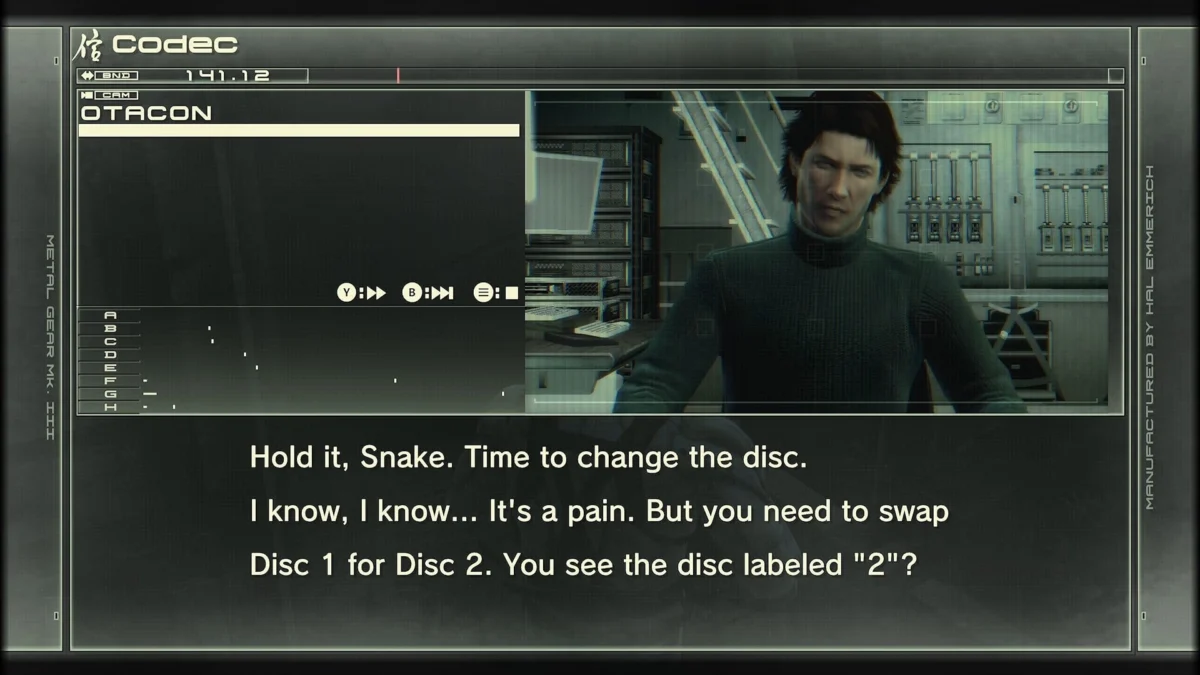
During a pivotal moment in the game, the character Otacon (Dr. Hal Emmerich), Snake’s trusted companion and technical expert, humorously instructs Snake to prepare for a disc change. This sequence plays on the historical precedent of multi-disc games, particularly those on DVD-based consoles or even earlier cartridge systems. However, Otacon quickly corrects himself, realizing that the PS3’s Blu-ray disc is, in fact, dual-layered, thus negating the need for a swap. His line, "No need to swap," became an iconic meta-commentary, not only on the game’s expansive content but also a subtle nod to the PS3’s superior storage technology compared to its contemporary rivals. This moment served as a testament to the PS3’s capabilities and a point of pride for its user base, effectively becoming an inside joke for PlayStation enthusiasts.
The Master Collection Vol.2: Bringing a Legend to Xbox
The release of Metal Gear Solid: Master Collection Vol.2 represents a strategic move by Konami to broaden the accessibility of its storied franchise. While the first volume brought earlier titles to modern platforms, Vol.2 was highly anticipated primarily for the inclusion of MGS4, a game many Xbox fans had never had the opportunity to play without resorting to purchasing a legacy PlayStation 3 console. Alongside Metal Gear Solid 4: Guns of the Patriots, the collection also features Metal Gear Solid 5: Ground Zeroes and Metal Gear Solid 5: The Phantom Pain, offering a comprehensive package for fans to experience the later chapters of the Metal Gear saga.
The decision to port MGS4 to Xbox Series X/S, nearly 16 years after its original release, underscores a broader industry trend towards multi-platform availability for previously exclusive titles. This strategy allows publishers to tap into new markets, revitalize interest in dormant franchises, and ensure the preservation of gaming history across a wider array of hardware. The technical challenges of porting a game optimized for the PS3’s unique architecture to modern Xbox systems were undoubtedly significant, requiring meticulous emulation or re-engineering to maintain fidelity and performance. Konami’s commitment to this endeavor reflects the enduring demand for MGS4 and the financial viability of such re-releases.
Platform Adaptation: A Joke Reimagined for Modern Hardware
With Metal Gear Solid 4 now running natively on Xbox Series X and Series S, Konami faced an interesting challenge: how to adapt the famous disc swap joke to accurately reflect the technical realities of its new platforms. The original joke, predicated on the PS3’s Blu-ray capacity, would lose its punch if directly translated. The developers at Konami Digital Entertainment opted for a clever and platform-specific revision.
In the Xbox Series X and Xbox Series S versions of the game, Otacon’s dialogue is altered to directly address the console being played. Instead of referencing the PS3’s Blu-ray, he now explicitly mentions "Xbox Series X" (or implicitly, given the shared media capabilities with Series S). The revised transcript provided within the game details this change:
"Hold it, Snake. Time to change the disc. I know, I know… It’s a pain. But you need to swap Disc 1 for Disc 2. You see the disc labeled "2"? Oh, wait. We’re on Xbox Series X. It uses high-capacity media, too. No need to swap."
"Yeah, what an age we live in, huh, Snake? Wonder what they’ll think of next!"
This updated dialogue masterfully preserves the spirit of the original joke while grounding it in the contemporary hardware. The phrase "high-capacity media, too" is a nod to the advanced storage solutions utilized by the Xbox Series X, which features a 4K UHD Blu-ray drive capable of reading discs up to 100 GB, significantly surpassing the PS3’s 50 GB dual-layer Blu-ray. Even the Xbox Series S, which is a digital-only console, benefits from the underlying principle of large data storage, as its digital games are downloaded and stored on a high-speed NVMe SSD, negating any physical disc swap requirements entirely. This subtle alteration demonstrates an attention to detail by the developers, ensuring that the meta-humor remains relevant and resonant for the new player base.
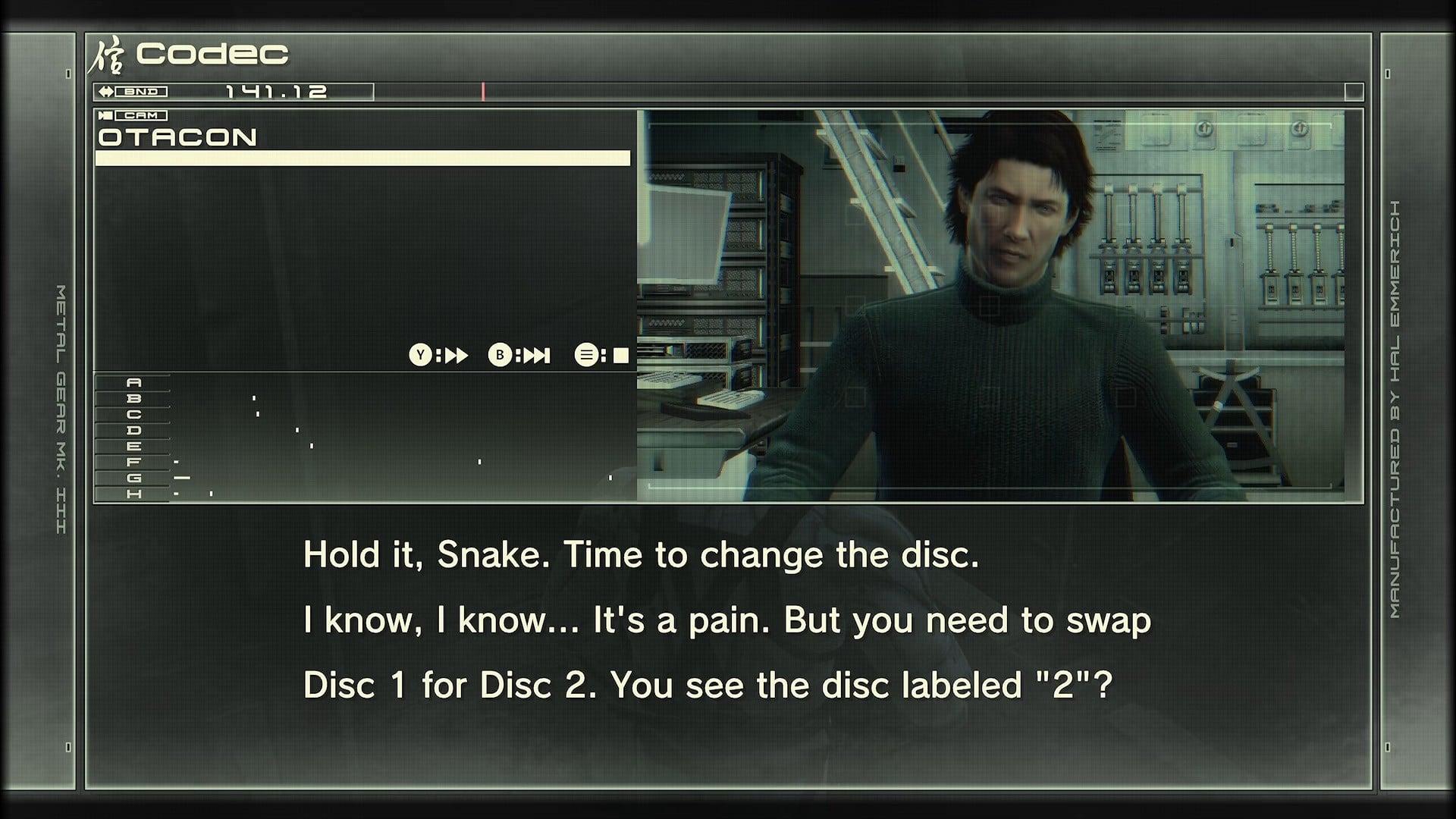
Further illustrating the developers’ commitment to platform-specific tailoring, the PC version of Metal Gear Solid 4 presents yet another variation of the joke. On PC, Otacon expresses surprise at the game being a "digital title" before concluding, "no need to swap." This adaptation acknowledges the predominant method of game distribution on personal computers, where physical media has largely been supplanted by digital downloads. Interestingly, the article posits that this "digital title" adaptation might have been equally, if not more, fitting for the Xbox Series S version, given its status as a disc-less console. This observation highlights the nuanced considerations involved in porting games to a diverse ecosystem of modern gaming platforms.
Technical Foundations: High-Capacity Media and Digital Distribution
The evolution of the disc swap joke is a direct reflection of advancements in storage technology and distribution models within the gaming industry. The original joke leveraged the PS3’s then-pioneering Blu-ray technology. Blu-ray discs, first commercialized in 2006, offered substantially greater storage capacity than the DVDs used by competing consoles like the Xbox 360. This allowed developers to create more expansive games with higher fidelity assets, longer cutscenes, and richer audio tracks, all on a single disc, a significant technical advantage at the time.
Fast forward to the current generation, the Xbox Series X employs a 4K UHD Blu-ray drive, which supports discs with capacities ranging from 50 GB (dual-layer) to 66 GB (triple-layer) and even 100 GB (quad-layer). This "high-capacity media" ensures that even the most graphically intensive and content-rich modern games can typically fit on a single physical disc. The Xbox Series S, conversely, is entirely digital, relying on downloads to its internal 512 GB or 1 TB NVMe Solid State Drive (SSD). SSDs offer not only vast storage but also incredibly fast data retrieval speeds, which minimize loading times and streamline the gaming experience. The PC platform has largely mirrored this shift, with digital storefronts like Steam, Epic Games Store, and GOG dominating game distribution, making physical media an increasingly niche option. These technological leaps are precisely what Otacon’s updated dialogue acknowledges, emphasizing that the days of mid-game disc swaps are largely a relic of the past for high-capacity and digital platforms.
Fan Reception and Critical Acclaim on Xbox
The reception of Metal Gear Solid 4 on Xbox Series X/S has been overwhelmingly positive, particularly among the Xbox community. This is evidenced by its impressive 4.9 out of 5-star rating based on over 150 reviews on the Xbox Store. This high rating not only signifies the game’s enduring quality but also reflects the enthusiasm of a player base that has, until now, been excluded from experiencing a cornerstone of gaming history.
The positive feedback highlights several key aspects:
- Accessibility: Many players are simply grateful for the opportunity to finally play MGS4 on their preferred console.
- Performance: Reports suggest the port runs smoothly on Xbox Series X/S, delivering a stable and enjoyable experience, which is crucial for a graphically intensive game from a previous generation.
- Nostalgia and Preservation: For returning fans, the collection offers a chance to revisit a beloved classic with modern conveniences, while for newcomers, it’s an opportunity to engage with a seminal title that shaped the stealth genre.
The strong sales and critical reception of Metal Gear Solid: Master Collection Vol.2 on Xbox platforms serve as compelling data for Konami, reinforcing the demand for well-executed ports of classic titles. It demonstrates that there is a significant market for bringing legacy exclusives to broader audiences, potentially encouraging similar initiatives for other long-standing franchises.
Konami’s Multi-Platform Strategy and Game Preservation
Konami’s decision to release the Metal Gear Solid: Master Collection Vol.2, including MGS4, on Xbox platforms is indicative of a broader strategic shift within the company. For years, Konami, like many Japanese publishers, maintained close ties with specific console manufacturers, leading to platform exclusives. However, the modern gaming landscape increasingly favors multi-platform releases to maximize reach and revenue. By bringing MGS4 to Xbox, Konami is not only catering to a new audience but also actively participating in the crucial effort of game preservation.
Many classic titles are at risk of being lost to time or becoming inaccessible due to aging hardware or defunct digital storefronts. Releasing Metal Gear Solid 4 on current-generation consoles ensures that the game remains playable and available for new generations of players, fostering a continued appreciation for its artistic and technical merits. This move aligns with a growing industry movement to make gaming history more accessible, preventing beloved titles from fading into obscurity. The success of this collection provides a clear business case for continued investment in high-quality remasters and ports.
Anticipating Vol.3: The Future of Metal Gear Solid Collections
With the resounding success of Metal Gear Solid: Master Collection Vol.2, speculation is naturally turning towards the potential for a Metal Gear Solid: Master Collection Vol.3. The article concludes with the rhetorical question, "Surely it’s just a matter of time!", reflecting the widespread expectation among fans. Given Konami’s recent renewed interest in the franchise, evidenced by the upcoming Metal Gear Solid Delta: Snake Eater remake and these master collections, a third volume seems highly probable.
Potential titles for a Vol.3 could include:
- Metal Gear Solid: Peace Walker: Originally released on the PlayStation Portable (PSP) and later re-released in HD on PS3 and Xbox 360, Peace Walker is a crucial entry in the Metal Gear lore, bridging the gap between MGS3 and MGS5.
- Metal Gear Solid V: Ground Zeroes and The Phantom Pain: While Ground Zeroes and The Phantom Pain are included in Vol.2, there’s a possibility of a standalone collection of these titles or an extended edition, depending on future plans.
- Metal Gear Solid: Portable Ops: Another PSP title that delves into Big Boss’s early exploits, though its canonicity is debated, its inclusion would complete the collection of mainline narrative titles.
- Metal Gear Rising: Revengeance: While a spin-off, its popularity and unique gameplay could make it a strong candidate for inclusion in a future collection aimed at broadening appeal.
The success of Vol.2 provides Konami with robust data to inform future decisions, particularly regarding the demand for specific titles and the viability of multi-platform releases. The enthusiastic reception from Xbox players, in particular, demonstrates a clear appetite for further historical titles from the Metal Gear saga to be made available on their platform.
Conclusion
The arrival of Metal Gear Solid 4: Guns of the Patriots on Xbox Series X/S, as part of the Master Collection Vol.2, is more than just a port; it’s a cultural event that bridges a significant gap in gaming history. The clever adaptation of its iconic disc swap joke highlights the developers’ attention to detail and understanding of modern gaming hardware and distribution. The overwhelming positive reception, evidenced by high user ratings, underscores the enduring legacy of the Metal Gear Solid franchise and the immense value players place on game preservation and multi-platform accessibility. As the gaming community celebrates this release, all eyes are now on Konami for what the future holds for the legendary series, with a Master Collection Vol.3 seeming increasingly inevitable in an age where high-capacity media and digital distribution make disc swaps a humorous relic of the past.