


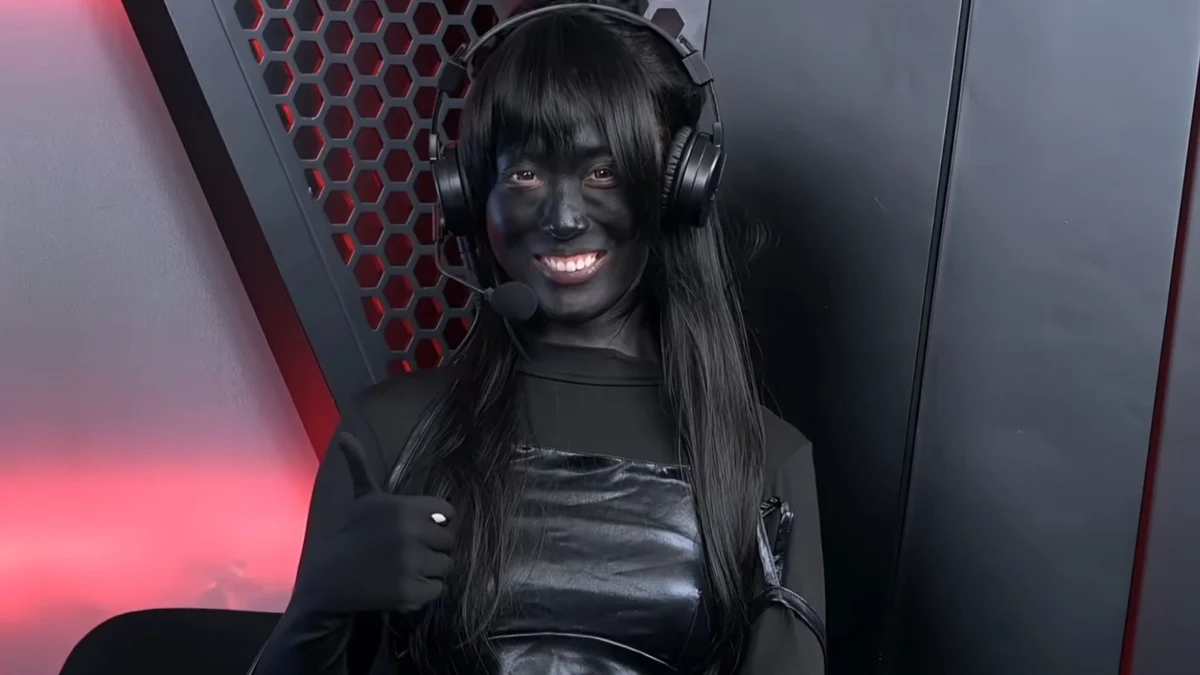
A prominent esports host in China, known by her online handle Zhazha, has captivated the online world and sparked widespread discussion after a striking visual protest against viewer criticism regarding her on-air attire. Zhazha, a commentator for the popular battle royale title Naraka: Bladepoint, appeared on a recent broadcast clad in an all-black, full-coverage outfit complemented by face paint, a dramatic departure from her previous on-screen appearances and a direct, albeit satirical, response to backlash she received over a short skirt.
The controversy ignited following a broadcast where Zhazha wore a short skirt, an outfit that unfortunately drew sharp criticism from a segment of the viewership. Accusations ranged from her supposedly dressing to solicit male attention to speculation that broadcast organizers had mandated such attire to boost viewership numbers. These claims, amplified across social media platforms, placed Zhazha under intense scrutiny, prompting her to address the situation in a manner that has since gone viral, resonating far beyond the immediate esports community.
Timeline of Events: From Criticism to Satirical Statement
The incident unfolded over a period that appears to have spanned at least one broadcast and the subsequent response. While the exact date of the initial broadcast featuring the short skirt is not explicitly stated, the online discourse and Zhazha’s response suggest it occurred relatively recently, leading to the widely publicized all-black ensemble.
- Initial Broadcast and Outfit Choice: Zhazha, known for her professional commentary on Naraka: Bladepoint, appeared on air in a short skirt. This choice, intended by her to present a "better on-camera look for viewers," unfortunately became the focal point of negative commentary.
- Viewer Backlash and Accusations: A subset of the audience voiced their disapproval, leveling accusations of unprofessionalism and suggestive dressing. Some viewers questioned her motives, implying she was attempting to pander to a male demographic, while others theorized about external pressures from the broadcast production team.
- Zhazha’s Public Statement: In response to the mounting criticism, Zhazha took to Weibo, a major Chinese social media platform, to issue a translated statement. This statement clarified her personal autonomy in selecting her on-air wardrobe and articulated her intentions behind the controversial outfit.
- The Viral All-Black Broadcast: The climax of this narrative arrived when Zhazha appeared on a subsequent broadcast alongside her male co-hosts, fully covered from head to toe in black attire, with her face also painted black. This visual statement was designed as a form of satire, a stark and memorable response intended to address the criticism she had faced.
- Continued Dialogue and Appeal for Reason: Following the viral broadcast, Zhazha reiterated her stance, urging viewers to approach the situation with rationality and avoid misinterpreting her actions or escalating unnecessary conflict.
Background Context: Esports Broadcasting and Viewer Expectations
The esports industry, while rapidly maturing, often finds itself navigating the complex intersection of professional competition and public perception. Casters and hosts are not only expected to possess in-depth knowledge of the games they cover but also to maintain a professional and engaging on-screen presence. However, the visual presentation of individuals, particularly women in the industry, can sometimes become a subject of undue scrutiny and debate.
In China, the broadcast landscape for esports is robust, with platforms like Bilibili playing a significant role in its dissemination and monetization. As viewership grows, so too does the diversity of opinions and expectations from the audience. This can create a challenging environment for on-air talent, who must balance professional obligations with the need to navigate public opinion. The Naraka: Bladepoint scene, known for its competitive nature and engaged community, is no exception. Critiques of attire, especially in a field where visual presentation is part of the broadcast package, can quickly escalate if not handled with sensitivity and clear communication.

Zhazha’s Statement: Asserting Autonomy and Employing Satire
Zhazha’s defense of her choices, articulated through her Weibo statement, provides crucial insight into her perspective. She emphatically denied any external pressure regarding her attire, stating, "No one has ever arranged for me to wear a short skirt. As a commentator, my outfits have always been chosen by myself." This assertion directly challenges the speculation that broadcast organizers were dictating her clothing for viewership purposes.
Furthermore, she addressed the broader implications for female casters, emphasizing her agency: "No one has ever forced me to wear inappropriate clothing on official broadcasts to appear in public. The reason I chose a short skirt was to present a better on-camera look for viewers." This highlights a common practice in broadcast media, where on-camera talent often selects attire to enhance their visual presentation, a choice she believed was being misconstrued.
The decision to adopt the all-black ensemble with face paint was explicitly framed as a "satirical" response. Zhazha explained, "I have never opposed so-called clothing freedom or the idea of women dressing more revealingly. The outfit I wore on today’s broadcast was an extreme choice meant as a form of satire in response to those comments." This indicates her intention was not to advocate for or against specific dress codes but rather to use an extreme visual to draw attention to the perceived irrationality or unfairness of the criticism she received. The juxtaposition of her previous, conventionally attractive on-screen attire with the deliberately austere and almost anonymizing black outfit served as a powerful symbolic statement against the judgment.
Broader Impact and Implications: The Discourse on Professionalism and Representation
Zhazha’s viral response has ignited a broader conversation within and beyond the esports community regarding professionalism, viewer expectations, and the representation of women in the industry.
- Challenging Objectification: By choosing to cover herself completely, Zhazha implicitly questioned the focus on her physical appearance over her professional commentary skills. Her action suggests that if her attire was the primary point of contention, then a complete negation of visible attire would render that criticism moot. This serves as a powerful commentary on the tendency to objectify women in public-facing roles, including esports.
- The Role of Satire in Social Commentary: Zhazha’s use of satire highlights a potent tool for dissent and commentary. Her extreme outfit, while visually striking, was a calculated move to provoke thought and discussion about the nature of the criticism she faced. It pushed viewers to consider whether the focus on her skirt was indeed about professionalism or a reflection of pre-existing biases.
- Empowerment and Agency: Her firm stance on personal choice and autonomy in selecting her wardrobe is a significant aspect of her response. It empowers other women in the industry who may face similar pressures and judgments. By speaking out and taking a decisive action, she asserts her right to professional conduct without succumbing to unwarranted scrutiny of her personal style.
- Viewer Responsibility in Online Discourse: Zhazha’s plea for viewers to engage rationally and avoid taking content out of context underscores the responsibility that audiences have in shaping online discourse. The ease with which criticism can spread and escalate on social media necessitates a more mindful and considerate approach from viewers. Her call for "reasonable comments" is a direct appeal for a more constructive and respectful online environment.
- Industry Standards and Evolution: This incident also raises questions about the evolving standards of professionalism in esports broadcasting. As the industry matures, there is a continuous dialogue about what constitutes appropriate attire and presentation for on-air talent. Zhazha’s situation suggests that a nuanced approach is required, one that respects individual expression while maintaining professional integrity, rather than resorting to simplistic judgments based on attire. The emphasis should ideally remain on the quality of commentary, game analysis, and the overall broadcast experience.
Zhazha’s bold and memorable response has transformed a localized controversy into a significant moment for discussion about gender, professionalism, and online behavior within the global esports landscape. Her ability to leverage a visually arresting satirical statement has not only garnered widespread attention but has also provided a platform for a more profound conversation about the challenges faced by women in the public eye. As she continues her work as a commentator, her actions will likely be remembered as a powerful assertion of agency and a catalyst for more respectful and discerning online engagement within the gaming community.