


The Narrative Framework and World-Building
The premise of the game is rooted in a satirical take on corporate environmental catastrophes. The story unfolds in a world where an experimental attempt to harness the Earth’s core for clean energy—led by the eccentric billionaire scientist Leon Dorsey—has resulted in a global disaster. This "unmitigated disaster" did not merely result in seismic instability but unleashed an eldritch entity known as the "Sludge God." This being, having been dormant deep within the crust, has begun a process of terraforming the planet, sprouting massive tendrils and reanimating the dead into a biological army of monsters.

Players assume the roles of the "Toxic Commandos," a group of mercenaries who were initially hired to deliver a package to Dorsey but ended up infected by the Sludge God’s influence. Dorsey, utilizing proprietary technology and specialized vests, manages to stabilize the infection in the squad, granting them supernatural offensive and defensive capabilities. This narrative device serves as the mechanical justification for the game’s class-based power systems, turning the protagonists into "toxic" anti-heroes tasked with reversing the apocalypse Dorsey himself initiated.

Technical Foundation: The Swarm Engine and Terrain Deformation
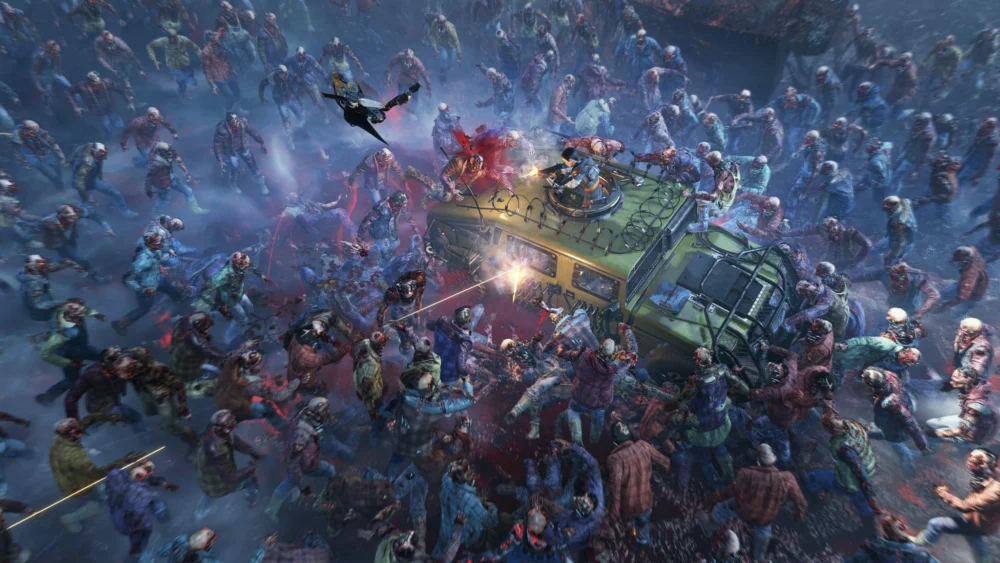
At the core of the experience is Saber Interactive’s Swarm Engine, which has been refined over several iterations to handle hundreds of individual AI units simultaneously without compromising performance. This technology allows for the "stupid number of enemies" that define the game’s combat encounters. Unlike many of its peers in the genre, which rely on spawning enemies in small waves, this title utilizes the engine’s ability to create literal mountains of infected, mimicking the "zombie pyramids" seen in the World War Z film and game.

A significant point of differentiation for this title is the inclusion of advanced terrain deformation. Drawing directly from the physics engine used in Mudrunner and SnowRunner, the environments in the game are dynamic. The Sludge God’s influence turns the ground into thick, viscous mud and "sludge" that actively impedes movement. This introduces a tactical layer rarely seen in first-person shooters: environmental navigation. Players cannot simply sprint through levels; they must contend with shifting ground, deep swamps, and obstacles that require more than just ballistic solutions.

Vehicular Integration and Tactical Navigation
To address the challenges posed by the terraformed environment, the game introduces a robust vehicular system. Vehicles are not merely tools for faster travel but serve as mobile bases of operation and essential mission objectives. The inclusion of these machines expands the scope of the typical "Left 4 Dead" style corridor shooter into larger, more open-ended playgrounds.

The vehicle roster includes several specialized units:

- The Ambulance: A mobile medical unit capable of healing the entire squad when they are positioned within or near the vehicle.
- The Pick-up with Flamethrower: A dedicated offensive vehicle designed for clearing paths through dense swarms.
- The Military Vehicle: Equipped with a heavy machine gun and, crucially, a winch system.
The winch is a vital mechanic inherited from Saber’s simulation titles. It is used to pull vehicles out of thick mud, navigate steep inclines, and interact with the environment. For example, the winch can be used to force open heavy-duty doors or retrieve containers that are otherwise inaccessible. This vehicular focus requires squads to balance their time between on-foot combat and protecting their transport, as losing a vehicle in a sludge-filled swamp can lead to a total mission failure.

Class Architecture and Combat Systems
The game features four distinct classes, each designed to fulfill a specific role within the four-player squad. These classes are empowered by the controlled infection provided by Leon Dorsey’s technology:

- The Strike: An offensive-focused build capable of channeling energy directly into melee and ranged attacks, functioning as the primary damage dealer.
- The Defender: A tank-like class that can deploy protective barriers. These barriers do more than block damage; they can be upgraded to zap enemies with lightning, providing both protection and area denial.
- The Operator: A tactical specialist focusing on reconnaissance and drone technology to manage the battlefield.
- The Medic: Essential for squad longevity, providing direct healing and buffs to counteract the high damage output of the Sludge God’s minions.
Combat is described as responsive and visceral, though it notably lacks some modern movement mechanics such as a slide function—a choice that aligns more with the "stiff" action heroes of 80s B-movies than modern tactical shooters. The enemy variety includes standard infected and "Special" variants that clearly pay homage to the genre’s roots, such as "Tank-like" monsters, "Smoker" variants that separate players from the group, and "Nukers" that explode upon death.

The Sludgite Economy and Progression
Long-term engagement is facilitated through a deep progression system centered on a hub-style base. Between the eight primary missions, players return to Leon Dorsey’s camp to upgrade their gear and abilities. The primary currency for this progression is "Sludgite," a crystal-like substance found during missions.

The progression system is divided into several tiers:

- Weapon Customization: Players can spend Sludgite on a wide array of attachments that alter weapon handling, damage, and accuracy. The game also features a "Prestige" system for weapons, allowing dedicated players to push their gear stats beyond standard limits.
- Skill Trees: Skill points accrued through gameplay are spent on class-specific trees, enhancing the "toxic" powers of the commandos.
- Cosmetics: Higher tiers of Sludgite are used to unlock character costumes, weapon skins, and vehicle paint jobs.
The missions themselves are designed for replayability, featuring randomized objective locations and events. While the core loop generally involves gearing up, completing objectives, and surviving a "last stand" finale, the randomization of enemy spawns and special infected ensures that no two runs are identical, particularly on higher difficulty settings where the Swarm Engine is pushed to its limits.

Development Context and Chronology
The development of John Carpenter’s Toxic Commando was officially announced during the Summer Game Fest in June 2023. The project was introduced as a collaboration that would leverage John Carpenter’s legendary status in the horror and action genres to inform the game’s tone and music. Carpenter, known for The Thing and Escape from New York, reportedly provided input on the game’s atmosphere to ensure it captured the specific "grit" of 1980s cinema.

Throughout 2024 and 2025, Saber Interactive released technical trailers highlighting the evolution of the Swarm Engine. These updates showcased the improvements in liquid physics and the interaction between the player’s vehicles and the deformed terrain. Following a series of closed beta tests in late 2025, the game moved toward its final release, with developers focusing on optimizing the engine to prevent the crashes and stability issues that sometimes plague high-unit-count titles during their launch windows.

Industry Impact and Market Position
In the current gaming landscape, John Carpenter’s Toxic Commando occupies a niche that balances the accessibility of "dumb fun" with the technical complexity of a physics-heavy simulation. While its narrative and dialogue are intentionally dated and campy—mimicking the "B-movie" style—the underlying systems are sophisticated.

The game enters a market crowded with cooperative shooters like Helldivers 2 and Warhammer 40,000: Darktide. However, its unique selling point remains the integration of Mudrunner-style environmental challenges. By forcing players to think about the ground beneath their feet as much as the enemies in front of them, Saber Interactive has added a new dimension to the cooperative survival formula.

The broader implications of this release suggest a continued trend of "AA" and "AAA" developers embracing specialized genre hybrids. By utilizing a legendary name like John Carpenter and pairing it with proven proprietary tech, Focus Entertainment has produced a title that prioritizes mechanical spectacle and emergent gameplay moments over narrative depth. For the industry, it serves as a case study in how to effectively repurpose physics technology across seemingly unrelated genres to create a unique player experience.