


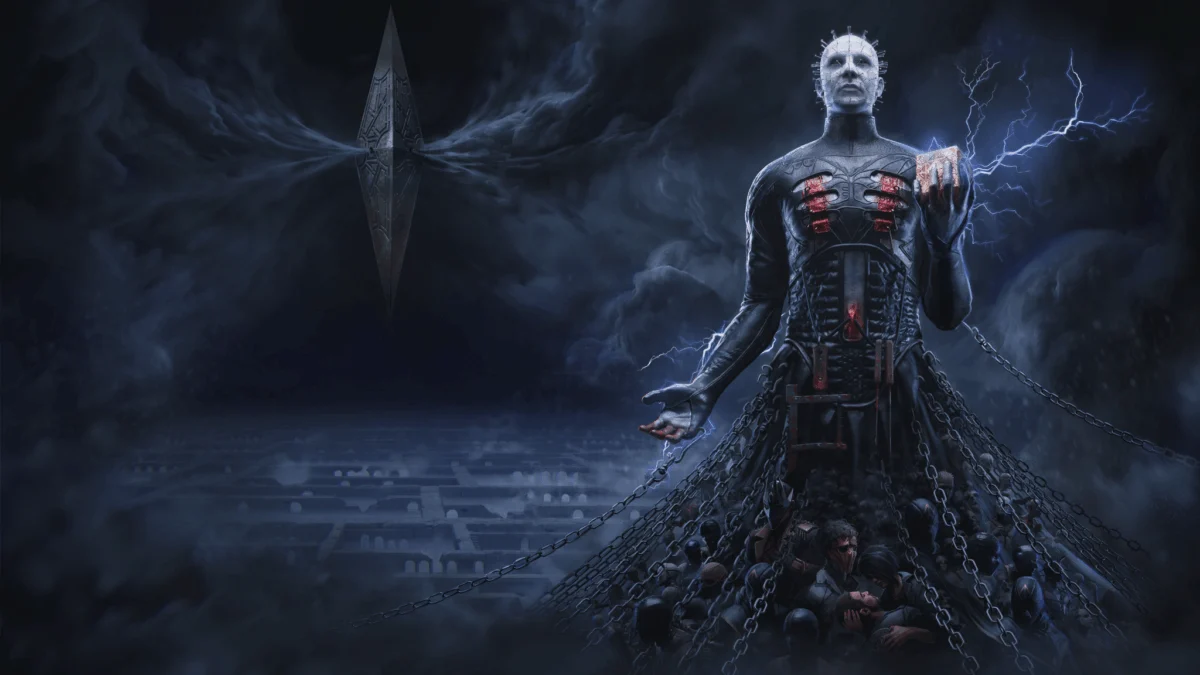
Narrative Overview and Character Dynamics
The plot of Clive Barker’s Hellraiser: Revival centers on protagonist Aidan Lynch, a character whose descent into the Labyrinth is precipitated by a personal tragedy rooted in the occult. The narrative begins with an explicit sequence involving Aidan and his partner, Sunny, who discover the Genesis Configuration—a variation of the iconic Lemarchand’s box. In a departure from the more heroic or "final girl" tropes often found in the genre, Lynch and Sunny are depicted as morally ambiguous figures whose pursuit of extreme sensory experiences inadvertently triggers the arrival of the Cenobites.

The inciting incident occurs when Sunny is violently abducted by the Order of the Gash, the theological faction of the Cenobites. Following her disappearance, Aidan enters into a Faustian pact with the franchise’s most recognizable figure, Pinhead. This iteration of Pinhead is voiced by Doug Bradley, whose return to the role provides a level of continuity and gravitas that has been absent from several recent film entries. The narrative focuses on an eight-hour campaign through the Labyrinth, a shifting, non-Euclidean space where the laws of physics are superseded by the mandates of the Cenobites. Unlike many contemporary horror titles that emphasize the protection of innocents, Revival leans into the grimdark reality of Barker’s universe, where every character is complicit in their own suffering.

Chronology of Development and Franchise Context
The road to Clive Barker’s Hellraiser: Revival has been marked by a broader trend of "legacy sequels" and IP revivals within the gaming industry. Following the success of titles like RoboCop: Rogue City and Evil Dead: The Game, Saber Interactive identified the Hellraiser IP as a candidate for a high-budget, "Adults Only" (AO) style experience.

- Initial Announcement: The project was teased as a collaborative effort between Saber Interactive and Clive Barker’s production team to ensure the "aesthetic of the grotesque" remained central to the experience.
- Summer Game Fest Preview: A closed-door demo showcased the early iterations of the Labyrinth and the updated character models for the Cenobites, including The Chatterer and the Female Cenobite.
- Gold Status and Rating Controversy: Months before launch, reports surfaced regarding the game’s explicit nature. The decision to include uncensored depictions of nudity, gore, and sexualized violence led to speculation regarding its availability on certain storefronts, though it ultimately secured a release on Steam and major consoles under a "Mature" or "Adults Only" designation depending on the region.
- Launch Phase: The game was released at a mid-tier price point of $40, reflecting its focused eight-hour campaign length rather than an open-world structure.
Core Gameplay Mechanics and the Suffering System
Clive Barker’s Hellraiser: Revival utilizes a hybrid gameplay loop that oscillates between stealth-based puzzle solving and high-intensity combat. The developer has implemented several distinct systems to differentiate the title from standard survival horror games.

The Genesis Configuration
The puzzle box is not merely a plot device but a functional tool within the game. As players progress, the box gains telekinetic and banishing properties. These abilities allow Aidan to manipulate the environment, hurl projectiles, and interact with the complex machinery of the Labyrinth. The use of the Genesis Configuration is tied to a resource known as "Suffering."

The Suffering Resource
In a mechanical reflection of the franchise’s themes, players must harvest "Suffering" to power their supernatural abilities. This resource is generated by inflicting pain on enemies through melee combat or environmental traps. While ranged weapons (such as pistols, revolvers, and shotguns) provide safety, they generate significantly less "Suffering" than close-quarters combat. This forces a tactical trade-off: players must risk physical proximity to enemies to maintain their supernatural offensive capabilities.

Inventory and Crafting
The game employs a grid-based inventory system reminiscent of the Resident Evil series. Players must manage limited space, deciding between carrying essential crafting materials, ammunition, or healing kits. A vendor system is available at specific checkpoints, allowing players to trade found currency (coins) for weapon upgrades and recipes. However, the scarcity of currency ensures that players cannot fully upgrade all weapons in a single playthrough, necessitating a specialized build.

Technical Analysis and Performance
Developed on Unreal Engine 5, Hellraiser: Revival aims for a "photorealistic" depiction of body horror. On high-end PC hardware, specifically systems utilizing the NVIDIA GeForce RTX 5080, the game demonstrates advanced lighting and texture work. With DLSS (Deep Learning Super Sampling) enabled, the title maintains a frame rate exceeding 100 FPS at 4K resolution with "Ultra" settings.

However, technical reports from the console sector indicate a disparity in performance. Early reviews of the PlayStation 5 version noted inconsistencies in frame pacing and haptic feedback implementation. While Xbox versions were reported to be more stable, the consensus among technical analysts is that the PC remains the definitive platform for the title at launch. Saber Interactive has indicated that post-launch patches are in development to address these optimization hurdles.

The art design is a standout feature, successfully modernizing the leather-and-flesh aesthetic of the 1980s films. The Cenobite models have been praised for their intricate detail, utilizing Nanite geometry to render the various piercings, scars, and mechanical implants that define the characters.

Industry Impact and Thematic Implications
The release of Clive Barker’s Hellraiser: Revival highlights a growing niche in the gaming market for "extreme" horror. For years, major publishers avoided the explicit sexual and sadomasochistic themes inherent to the Hellraiser brand to maximize market reach. Saber Interactive’s decision to embrace these elements suggests a shift in how licensed IP is handled, prioritizing "brand authenticity" over broad-spectrum appeal.

Critical Reception and Analysis
Initial critical response has highlighted the game’s uncompromising vision. Analysts note that while the melee combat and "one-hit kill" environmental hazards can lead to player frustration, the atmosphere and voice acting—particularly from Doug Bradley—elevate the experience above standard horror fare. The absence of a "New Game Plus" mode at launch has been cited as a drawback for replayability, though the $40 price point is seen as a fair valuation for the content provided.

Broader Implications
The success or failure of Revival may dictate the future of mature-themed licensed games. If the title performs well despite its restrictive rating, it could pave the way for other dormant horror franchises—such as Candyman or Phantasm—to receive similar high-budget interactive adaptations. Furthermore, the game’s integration of "Suffering" as a core mechanic represents an interesting evolution in how narrative themes are translated into gameplay systems.

Conclusion and Official Stance
Saber Interactive has positioned Hellraiser: Revival as a "love letter" to the fans of the original Barker mythos. By securing the involvement of original cast members and adhering closely to the visual language of the source material, the studio has created a product that serves as a stark contrast to the more "sanitized" horror titles of the last decade. While technical issues on consoles and the extreme nature of the content may limit its audience, the title stands as a definitive realization of the Hellraiser universe in the digital age. As the industry continues to monitor its performance, Revival remains a bold experiment in pushing the boundaries of what is permissible in mainstream interactive entertainment.