


Sony Interactive Entertainment has officially announced the introduction of a new artificial intelligence-driven upscaling technology designed specifically for the standard PlayStation 5 hardware. Known as Quasi-Spectral Super Resolution (QSSR), this technology represents a significant software-side evolution for the base console, aiming to bridge the visual gap between current-generation hardware and the more powerful PlayStation 5 Pro. The move follows the successful deployment of PlayStation Spectral Super Resolution (PSSR) on the PS5 Pro, marking a strategic pivot by Sony to maximize the longevity and performance of its existing hardware ecosystem through advanced machine learning algorithms.
The announcement, which was first detailed through technical briefings and confirmed by industry analysts, indicates that QSSR will debut alongside two of the platform’s most anticipated titles: Sucker Punch Productions’ Ghost of Yotei and Insomniac Games’ Marvel’s Wolverine. By analyzing game images on a pixel-by-pixel basis, QSSR aims to inject clarity into textures and environmental details that would otherwise suffer from blurring or aliasing when rendered at sub-native resolutions. This development is particularly noteworthy for the broader gaming industry, as it signals a shift where software-driven image reconstruction becomes as critical as raw hardware specifications in determining visual quality.
The Evolution of Console Upscaling: From Checkerboarding to AI
To understand the significance of QSSR, it is necessary to examine the chronology of image reconstruction in the console space. During the previous generation, the PlayStation 4 Pro popularized "checkerboard rendering," a technique that used a specific pixel pattern to simulate higher resolutions without the massive computational cost of native 4K. While effective, checkerboarding often resulted in visual artifacts and a lack of stability in fast-moving scenes.
With the advent of the current generation in 2020, both Sony and Microsoft initially relied on spatial upscalers and eventually moved toward temporal solutions like AMD’s FidelityFX Super Resolution (FSR). However, as NVIDIA’s Deep Learning Super Sampling (DLSS) proved on the PC platform, AI-driven temporal upscaling offers a superior balance of performance and image quality. Sony’s launch of the PS5 Pro in late 2024 introduced PSSR, a proprietary AI upscaler that utilized the Pro’s enhanced GPU and dedicated machine learning hardware.
The challenge for Sony engineers was whether a similar experience could be replicated on the standard PS5, which lacks the specialized AI hardware found in the Pro model. The development of QSSR appears to be the answer to this challenge. According to official statements from Sony, while the computational demands of PSSR were initially deemed too high for the base PS5, a "refined and optimized" version of the algorithm has been developed to run within the constraints of the original 2020 hardware architecture.
Technical Specifications and Performance Expectations
QSSR functions by utilizing a trained neural network to compare low-resolution inputs with high-resolution reference data. In real-time, the algorithm predicts what a higher-detail frame should look like, effectively "filling in" missing information. This process is designed to improve edge stability, reduce shimmering in fine details like foliage or hair, and provide a more cohesive image during high-motion sequences.
However, industry experts at Digital Foundry have cautioned that while QSSR is a notable upgrade over traditional upscaling methods, it does not transform the base PS5 into a PS5 Pro. Initial hands-on reports suggest that there remains a "big divide" between the two tiers of hardware. The PS5 Pro’s PSSR benefits from significantly higher bandwidth and more robust compute units, allowing for a more complex AI pass. In contrast, QSSR on the base PS5 must share resources with the game’s primary rendering pipeline, meaning the improvements, while visible, are more subtle.
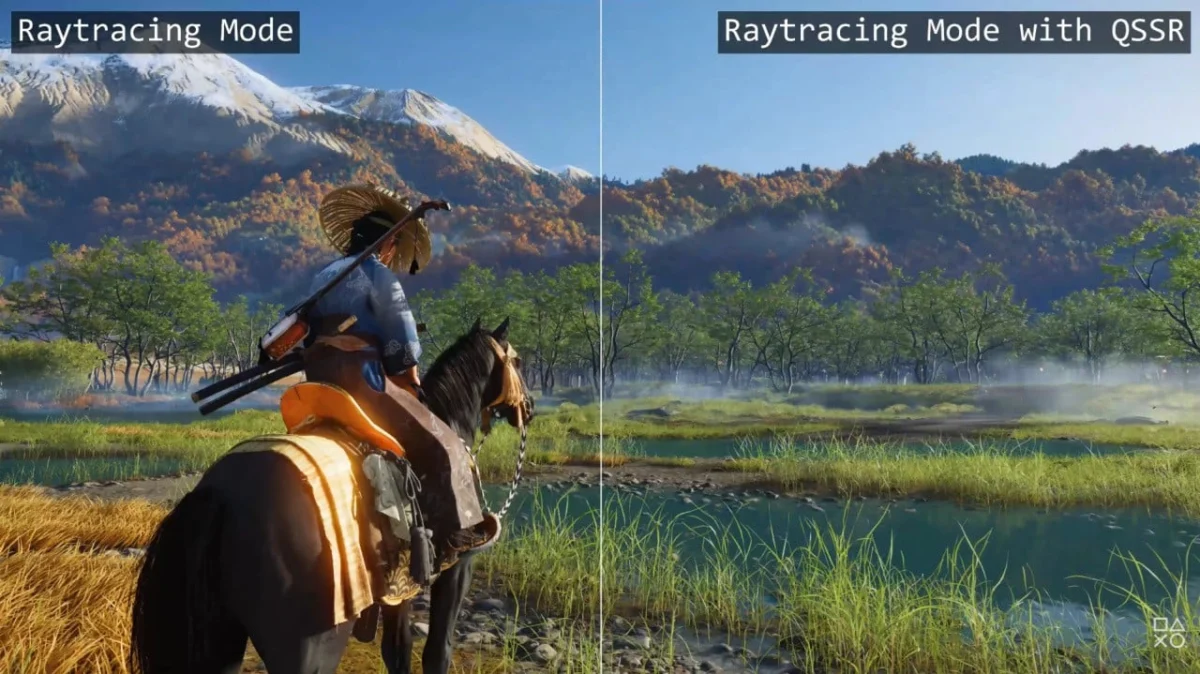
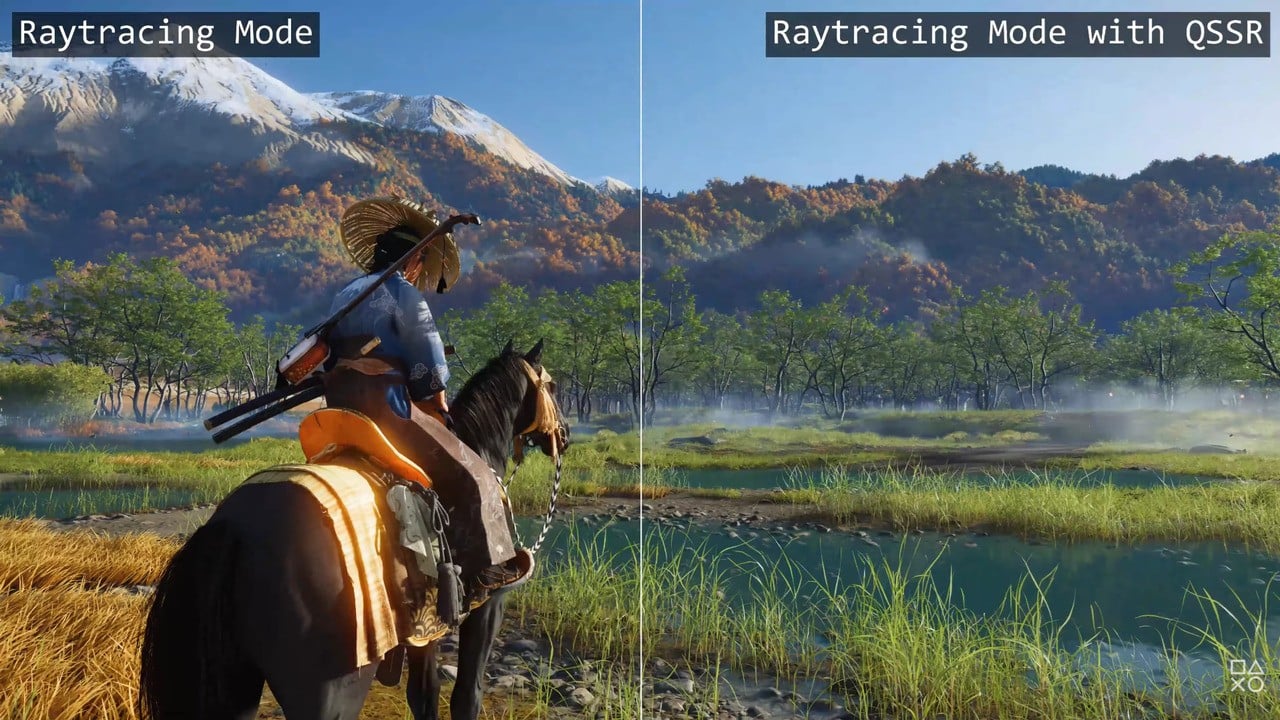
In side-by-side comparisons of Ghost of Yotei, QSSR-enabled footage showed a marked improvement in the sharpness of distant landscapes and the intricate patterns of traditional Japanese attire. Nevertheless, when viewed from a standard viewing distance, the difference may not be immediately jarring to the average consumer. The primary goal of QSSR is not to reinvent the console’s output but to ensure that base PS5 users are not left behind as developers begin to target the higher specifications of the Pro model.
Implications for the Multi-Platform Landscape and Xbox
The introduction of QSSR has immediate implications for the competitive landscape between Sony and Microsoft. Sony has confirmed that the technology will be "offered broadly to all PlayStation developers," including third-party studios. This opens the door for multi-platform titles—such as those from Electronic Arts, Ubisoft, and Activision—to feature distinct visual profiles on the PS5 compared to the Xbox Series X.
Historically, the Xbox Series X has held a slight raw power advantage in terms of Teraflops and memory bandwidth. However, if Sony’s proprietary AI upscaler proves more effective than the industry-standard AMD FSR used by Xbox, the PS5 could theoretically produce a cleaner, more stable image despite having lower raw compute power. This creates a scenario where comparison footage between the two consoles becomes more nuanced, focusing less on native resolution and more on the "intelligence" of the upscaling solution.
From an Xbox perspective, this move by Sony places increased pressure on Microsoft to accelerate its own AI initiatives. Microsoft has already begun integrating "Auto SR" (Automatic Super Resolution) into its Windows ecosystem for Copilot+ PCs, and there is significant speculation that a similar feature will be a cornerstone of the next Xbox hardware.
Project Helix and the Future of Xbox Hardware
Microsoft’s roadmap, currently referred to in industry circles under the umbrella of "Project Helix," is expected to lean heavily into AI and machine learning. Statements from Xbox leadership, including President Sarah Bond and Corporate Vice President Asha Sharma, have emphasized that "efficiency and affordability" are top-of-mind for the next generation of Xbox.
Asha Sharma recently noted that the goal for future hardware is to deliver a "massive technical leap," and the consensus among analysts is that this leap will be achieved through AI-driven software rather than just larger, more expensive GPUs. Sony’s deployment of QSSR on the base PS5 serves as a proof of concept that AI upscaling can be retrofitted or optimized for older silicon, potentially giving Microsoft a blueprint for how to handle its own mid-gen or next-gen transitions.
If QSSR becomes a standard feature for third-party developers on PlayStation, Xbox owners may experience a period of "feature FOMO" (fear of missing out) if Microsoft does not provide a comparable system-level solution for the Series X and Series S. While the Xbox Series X remains a highly capable machine, the industry is clearly moving toward a software-defined future where AI does the heavy lifting for 4K reconstruction.
Developer Adoption and Industry Reactions
The success of QSSR will ultimately depend on its ease of integration. Sony’s statement that the tech is available to "all developers" suggests a streamlined API that can be toggled on with minimal adjustment to the existing game engine. For developers, this is an attractive proposition; it allows them to target lower internal resolutions to maintain high frame rates (such as 60 or 120 FPS) while relying on QSSR to maintain visual "perceived" quality.
Early reactions from the development community have been cautiously optimistic. Studios working on cross-generation titles or those trying to push the limits of the base PS5 see this as a vital tool. By reducing the overhead required for native 4K rendering, developers can reallocate those hardware resources toward improved ray tracing, higher NPC counts, or more complex physics simulations.
However, some critics argue that the proliferation of upscaling technologies—DLSS, FSR, PSSR, and now QSSR—creates a fragmented environment for developers who must now optimize for multiple different AI pipelines. Despite this, the trend toward AI reconstruction appears irreversible, as the cost of manufacturing smaller, more powerful transistors continues to rise, making software solutions the most cost-effective way to improve performance.
Conclusion: A New Frontier in the Console War
Sony’s announcement of QSSR for the base PlayStation 5 is more than just a technical patch; it is a strategic maneuver designed to protect its market share and extend the relevance of its primary hardware. By bringing AI upscaling to the masses, Sony is setting a new baseline for what players should expect from a home console.
For the gaming public, the message is clear: the "Resolution Wars" of the past decade are being replaced by the "AI Wars." No longer is it enough to have the most Teraflops; a console must now have the most sophisticated algorithms to interpret and enhance those Teraflops. As we look toward the end of the current console cycle and the beginning of the next, the lessons learned from QSSR and PSSR will undoubtedly shape the development of both the next PlayStation and the next Xbox.
While the immediate impact on the Xbox Series X might be minimal in terms of raw sales, the long-term pressure on Microsoft to deliver a competitive AI upscaling solution has never been higher. As third-party comparisons begin to surface in late 2024 and 2025, the industry will get its first real look at whether software intelligence can truly overcome hardware limitations. For now, PlayStation 5 owners can look forward to a slightly sharper future, while the rest of the industry watches closely to see how the competition responds to this latest volley in the ongoing battle for visual supremacy.