


In the meticulously crafted world of Manor Lords, a game celebrated for its historical realism and complex city-building mechanics, the foundational challenge for any aspiring lord begins not with grand fortifications or sprawling trade networks, but with the humble task of attracting and sustaining a viable population. Players are initially granted a meager five families, a number that swiftly underscores the profound necessity for rapid and strategic demographic expansion to transform a nascent encampment into a thriving medieval settlement. This process, while seemingly straightforward, is governed by intricate systems of approval, housing, resource management, and economic stability, demanding a nuanced understanding from the outset.
The core of population growth in Manor Lords hinges primarily on two interdependent factors: Settlement Approval and the availability of Living Space. These elements dictate the influx of new families, serving as the very pulse of a burgeoning village. Understanding and meticulously managing these mechanics is paramount for any lord aiming for prosperity and influence.
Understanding Settlement Approval: The Barometer of Prosperity
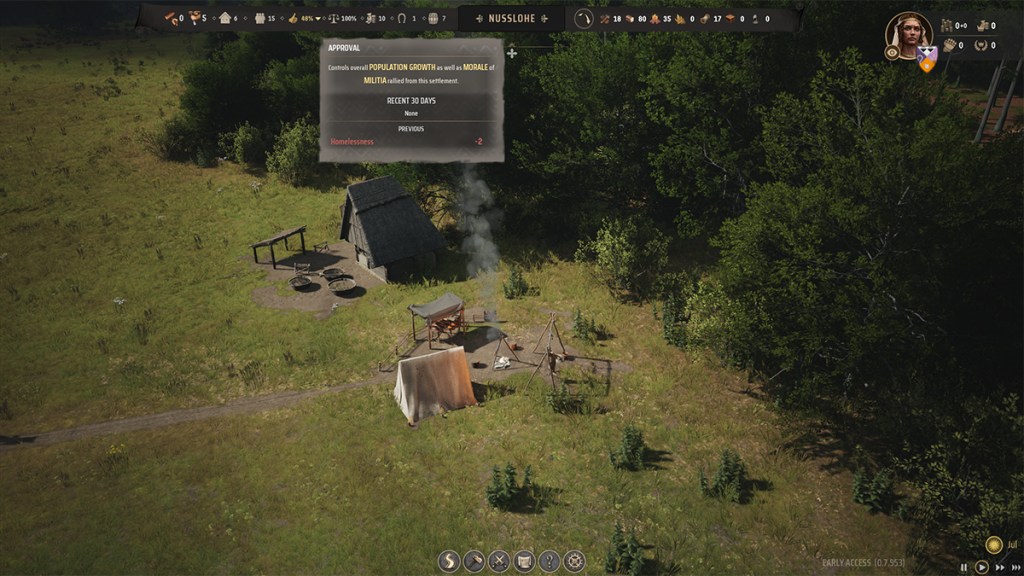
Settlement Approval acts as the primary driver for attracting new families. This crucial metric is visibly tracked via a dedicated bar at the top-left of the user interface, providing players with an immediate visual indicator of their populace’s contentment. The thresholds for this metric are critical:
- Below 25% Approval: This is a critical state, signaling widespread discontent. Should approval drop to this level, existing families will begin to abandon the settlement, seeking more favorable conditions elsewhere. This outflow can quickly cripple a village, leading to labor shortages and economic decline.
- 50% Approval or Higher: Reaching and maintaining this benchmark allows new families to arrive at a steady rate of approximately one per month. This provides a baseline for consistent, albeit measured, growth.
- 75% Approval or Higher: Achieving this elevated level of satisfaction accelerates population growth significantly, drawing in two new families monthly. This faster influx is crucial for rapid expansion, enabling the construction of larger infrastructure and the establishment of more complex industries.
The implication is clear: a thriving settlement is a popular one. Lords must prioritize the happiness and well-being of their villagers to ensure a continuous supply of labor and taxpayers.
The Foundation of Growth: Providing Adequate Living Space
Beyond mere approval, new families require a place to live. This is where Burgage Plots become indispensable. These plots represent the fundamental residential units in Manor Lords and must be constructed in anticipation of population growth. It is not enough to simply have existing housing; there must be vacant Burgage Plots available to accommodate incoming families immediately upon their arrival. Failing to provide adequate housing results in homelessness, which severely impacts overall settlement approval and can deter future migration.
Burgage Plots themselves are dynamic, capable of being upgraded through three distinct levels, each demanding increasing amenities and market access. These upgrades are not merely aesthetic; they provide additional housing capacity, unlock backyard extensions for production (e.g., vegetable gardens, chicken coops, workshops), and significantly contribute to overall settlement approval.
Chronology of Population Growth: From Hamlet to Town
The journey of population growth in Manor Lords can be segmented into distinct phases, each presenting unique challenges and requiring specific strategic responses.
Phase 1: The Initial Scramble (Early Game)
Upon starting, players are confronted with the immediate need to expand beyond the initial five families. The early game is characterized by a delicate balance of survival and foundational construction.
-
Establishing Food Security and Variety: The most pressing concern is often food. Villagers require not just sustenance, but variety in their diet to maintain high approval.
- Hunting Camp: One of the first buildings, providing a steady supply of meat (hides for leather are a valuable byproduct).
- Forager Hut: Essential for gathering berries, mushrooms, and other forest resources, adding a second vital food type.
- Well Construction: A nearby well is a fundamental amenity for Level 1 Burgage Plots, providing clean water and boosting hygiene, which indirectly contributes to approval.
- Early Housing: Constructing several Burgage Plots, even if they remain initially empty, is a proactive measure to ensure housing for the first wave of new families. Prioritizing their placement near a well and future market area is advisable.
-
Fuel Provision: Winter survival is contingent on an adequate supply of firewood.
- Woodcutter’s Lodge: Crucial for logging timber and processing it into firewood. A consistent supply prevents villagers from freezing, a scenario that would drastically plummet approval.
-
Basic Services:
- Church: A small wooden church is a requirement for Level 1 Burgage Plots, fulfilling the spiritual needs of the populace and offering a significant boost to approval. Its early construction is non-negotiable for sustained growth.
The goal in this phase is to rapidly achieve and maintain at least 50% approval by ensuring basic needs (food variety, shelter, water, warmth, spiritual comfort) are met. This sets the stage for the first influx of new families.
Phase 2: Stabilizing and Expanding (Mid-Game)
As the population begins to grow, the demands on resources and infrastructure escalate. This phase is about establishing stable production chains and diversifying the economy.
-
Advanced Food Production: Relying solely on hunting and foraging becomes unsustainable.
- Farming: The introduction of farming (fields, Farmhouses, an Ox, and a Plough) provides a scalable food source, primarily grain, which can be processed into flour and then bread (via a Windmill and Communal Oven). Bread is a highly valued food type, boosting approval further. Players must consider soil fertility and crop rotation for long-term sustainability.
- Animal Husbandry: Sheep farms for wool (leading to clothing production) and meat, or goat farms for meat and milk, add further food variety and resource generation.
-
Marketplace Establishment: A Marketplace is crucial for distributing goods efficiently. Villagers will automatically set up stalls to sell their backyard produce or goods from workshops. A well-supplied market, offering a variety of food, clothing, and other necessities, is a major driver of approval and a requirement for upgrading Burgage Plots beyond Level 1.
-
Diversifying Amenities and Production:
- Tavern: Once barley is farmed, it can be processed into malt (Malt House) and then ale (Brewery). Ale, served at a Tavern, provides a substantial approval boost and is a key luxury good.
- Clothing Production: Processing hides into leather (Tannery) or wool into yarn (Weaver Workshop) and then into clothing (Tailor’s Shop) provides another essential good for the market, satisfying Burgage Plot upgrade requirements and increasing approval.
- Upgrading Burgage Plots: As amenities and market supply improve, upgrading Burgage Plots to Level 2 and eventually Level 3 becomes possible. These upgrades increase the housing capacity per plot and often unlock backyard extensions that can convert a family into a specialized workforce (e.g., a fletcher, cobbler, blacksmith).
This phase emphasizes creating robust production chains, ensuring consistent supply to the market, and progressively improving living standards to push approval towards the 75% threshold, thereby accelerating population growth.
Phase 3: Optimization and Prosperity (Late Game)
With a substantial population and established industries, the late game focuses on optimizing logistics, expanding trade, and fortifying the settlement.
- Advanced Infrastructure: Efficient road networks, multiple Granaries and Storehouses, and specialized storage for specific goods become vital to prevent bottlenecks and ensure smooth distribution.
- Specialized Industries: Mining operations for iron ore and clay, advanced smithing, and potentially regional trade hubs further enhance the settlement’s economic power.
- Taxation and Treasury: A larger, wealthier population generates more tax revenue (Regional Wealth and Royal Tax), which can be invested back into further expansion, military development, or trade.
Sustained high approval in this phase requires not just meeting basic needs but providing a wide array of luxury goods, robust services, and a secure environment.
Deep Dive into Supporting Data and Mechanics
The success of population growth is deeply intertwined with several underlying game mechanics:
- Food Categories and Approval: The game tracks distinct food categories (e.g., Meat, Berries, Bread, Vegetables, Eggs, Apples). Providing at least two or three types consistently yields a significant approval bonus. Each additional type further enhances this. This encourages diversification beyond a single food source.
- Homelessness Penalty: A family without a home experiences a severe negative impact on approval. This penalty is global, affecting the entire settlement’s approval rating, not just the homeless family. Proactive housing construction is therefore a critical preventative measure.
- Market Supply and Variety: The Market Stall system is passive; villagers will staff stalls if there is a surplus of goods. A vibrant market with stalls offering diverse food, clothing, and fuel is crucial for satisfying Burgage Plot upgrade requirements and maintaining high approval. The proximity of Burgage Plots to market stalls also affects satisfaction.
- Amenity Requirements for Burgage Plots:
- Level 1: Requires proximity to a Well and a Church.
- Level 2: Typically requires additional amenities like a Tavern with Ale supply, and a consistent supply of clothing and other basic goods at the marketplace.
- Level 3: Demands even more advanced amenities, potentially including a more developed church, a tailor, or other specialized services, alongside a wider array of luxury goods.
- Fuel Consumption: Each family consumes firewood, especially during colder months. Failure to provide sufficient fuel leads to cold homes, illness, and a sharp drop in approval. A dedicated Woodcutter’s Lodge and potentially a Sawmill for efficient timber processing are essential.
- Unemployment: While not directly mentioned as an approval modifier in the original text, a high rate of unemployment can indirectly impact approval by leading to dissatisfaction and hindering the production of goods that do affect approval. Each family represents a labor unit, and assigning them to productive work is key to economic output.
Developer Intent and Player Strategies
While no direct developer statements are provided, the design of Manor Lords strongly suggests a philosophy centered on organic, interconnected growth. The intricate web of dependencies—food leading to approval, approval leading to population, population providing labor for more food and amenities, which in turn boosts approval—is clearly an intentional design choice to simulate the complex dynamics of medieval settlement management.
The initial limitation of five families forces players to immediately engage with these core systems, preventing unchecked expansion and encouraging thoughtful, sustainable development. The gradual increase in approval requirements for faster growth incentivizes players to continually improve living conditions, rather than simply meeting a one-time threshold.
Player communities frequently highlight the importance of:
- Prioritizing Food Diversity: Many new players initially struggle by focusing on only one food source. Diversifying early with a Hunting Camp and Forager Hut, then rapidly transitioning to farming for bread, is a common and effective strategy.
- Building Ahead on Housing: Constructing several empty Burgage Plots before they are immediately needed prevents homelessness and ensures a smooth transition for new arrivals.
- Balanced Development: Neglecting any one aspect (food, fuel, housing, amenities) can create bottlenecks that stall population growth. A holistic approach is crucial.
- Strategic Marketplace Placement: Centralizing the marketplace to maximize its reach to Burgage Plots ensures efficient distribution of goods and high satisfaction.
Broader Impact and Implications of Population Growth
The successful management of population growth in Manor Lords extends far beyond merely increasing a number; it profoundly impacts every facet of the player’s domain.
-
Economic Prosperity: A larger population directly translates to a larger workforce. More families mean more hands available for resource extraction (logging, mining), agriculture, crafting, and trade. This increased labor pool allows for the establishment of more diverse and complex production chains, from processing raw timber into planks to weaving wool into elaborate garments. This economic output generates greater Regional Wealth through trade and allows for higher Royal Tax contributions, both vital for the lord’s treasury and for funding further expansion or military endeavors. Without sufficient population, advanced industries remain inaccessible, limiting economic potential.
-
Military Strength and Defense: Each family contributes potential recruits to the Militia. As the settlement grows, the available pool of able-bodied men increases, allowing the lord to raise larger and more formidable military units. This is critical for defending against bandit raids, rival lords, or engaging in territorial expansion. A stagnant or declining population directly undermines the settlement’s defensive capabilities, leaving it vulnerable. The ability to field a strong militia is a direct consequence of a healthy and growing populace.
-
Settlement Evolution and Specialization: Sustained population growth is the prerequisite for upgrading the settlement’s status from a "Small Village" to a "Medium Village," "Large Village," and eventually a "Town" or "Large Town." Each status upgrade unlocks new building options, technologies, and administrative capabilities, allowing for greater specialization and efficiency. For example, specific production buildings might only become available at higher settlement levels, which are intrinsically tied to population thresholds. This allows for the transition from basic survival to a sophisticated medieval economy.
-
Sustainability Challenges: While growth is desirable, it introduces new challenges. A larger population places increasing demands on finite resources. Deforestation for timber and firewood, depletion of hunting grounds, and the need for more extensive farmlands (potentially impacting soil fertility) become significant concerns. Managing these resources sustainably through reforestation, crop rotation, and efficient resource allocation becomes paramount to avoid ecological collapse and subsequent population decline.
-
Strategic Depth and Decision-Making: Population management in Manor Lords is not a passive mechanic but a dynamic strategic lever. Decisions about what to build, what resources to prioritize, and how to allocate labor directly influence approval and, consequently, population growth. This interconnectedness forces players to think holistically, considering the long-term implications of their choices on their settlement’s demographic trajectory and overall prosperity.
In conclusion, the initial challenge of attracting more families in Manor Lords serves as a microcosm of the game’s broader strategic depth. It compels players to engage deeply with the intricate systems of resource production, social welfare, and economic development. By mastering the delicate balance of maintaining high approval through diverse food, ample housing, and essential amenities, players can transform a humble starting point into a bustling medieval metropolis, ensuring both the survival and the flourishing legacy of their dominion. The journey from five families to a thriving town is a testament to careful planning, adaptability, and a profound understanding of the medieval world’s delicate social and economic ecosystems.