


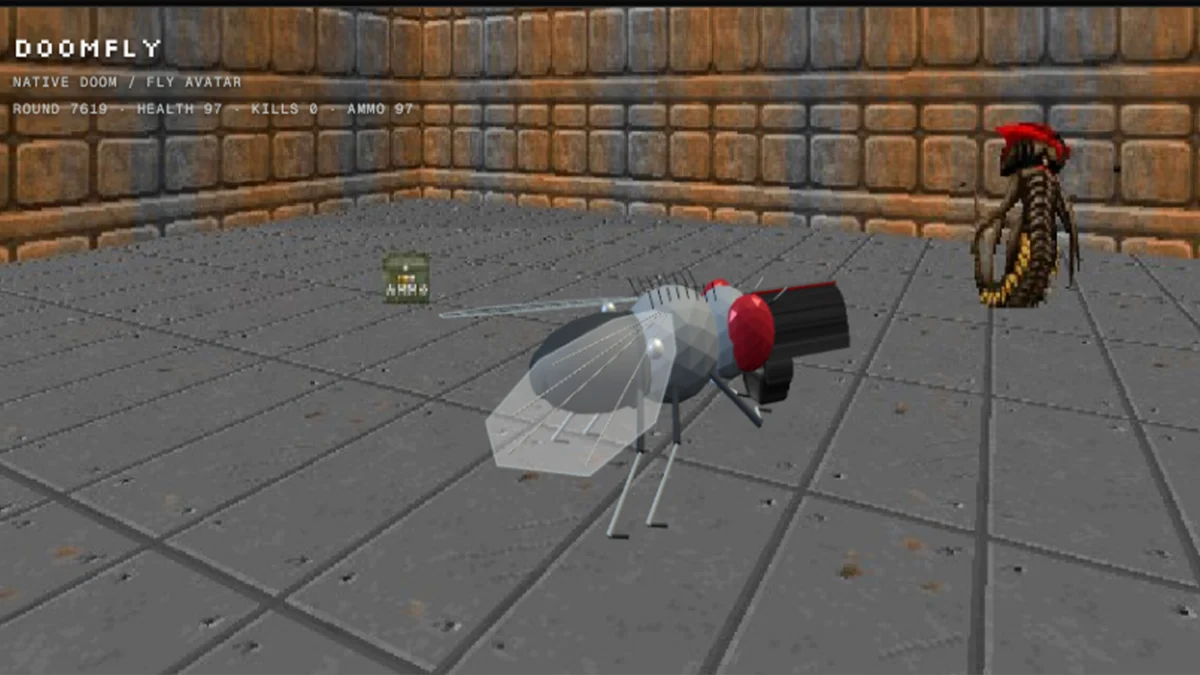
The iconic 1993 first-person shooter, Doom, renowned for its elegant design and adaptability, has once again found itself running on an unconventional platform, pushing the boundaries of what constitutes a "computer." Following a long history of being ported to everything from pregnancy tests to potatoes, the classic game is now being played by a simulated map of a fruit fly’s brain, a feat that marries cutting-edge neuroscientific research with the creative ingenuity of the tech community. This remarkable development, stemming from a comprehensive brain mapping project, has not only captured public imagination but also opened new avenues for exploring the functional capabilities of biological neural networks in a digital environment.
The Genesis of the Digital Fly Brain: A Landmark in Connectomics
This extraordinary endeavor began with a monumental scientific undertaking by Google, in collaboration with HHMI Janelia Research and other esteemed partners. Their collective effort culminated in the creation of the most intricate neuron mapping ever achieved: a complete connectome of a male fruit fly’s brain and central nervous system. Published recently, this detailed anatomical blueprint is far more than just a pretty picture; it represents an unprecedented level of understanding of a complex biological system. The map encompasses an astounding 11,700 distinct types of neurons and a total of 166,000 individual neurons, providing a granular view of the brain’s structural architecture.
The methodology behind this mapping project was as sophisticated as its outcome. Researchers meticulously took extremely thin slices of a fly’s brain and body, each no thicker than a human hair. These slices were then imaged using advanced electron microscopy, generating millions of two-dimensional images. Artificial intelligence algorithms were subsequently employed to meticulously combine these vast datasets, reconstructing them into precise three-dimensional neural shapes. This painstaking process allowed scientists to trace every single neuron and synapse, revealing the intricate web of connections that underpins the fruit fly’s cognitive and motor functions. Google emphasized the profound scientific implication of this work, stating that "knowing the structure of the brain allows neuroscientists to understand the mechanisms behind brain function." This foundational research provides a critical framework for deciphering how information is processed, memories are formed, and behaviors are initiated within a living organism.
The choice of Drosophila melanogaster, the common fruit fly, as the subject for this pioneering connectome mapping is far from arbitrary. For decades, Drosophila has served as a pivotal model organism in neuroscience due to its genetic tractability, relatively short life cycle, and a brain that, while small, exhibits remarkable complexity in its behavioral repertoire. Its neural circuitry, though simpler than that of mammals, is sufficiently intricate to allow for studies of learning, memory, sleep, aggression, and even neurodegenerative diseases. The ability to precisely map its entire brain at a synaptic level provides an unparalleled opportunity to correlate structure with function, offering insights that can be extrapolated, in part, to more complex brains.
From Neurons to Nighmares: How Doom Was Conquered by a Fly Brain
Just a few days after Google unveiled its groundbreaking fruit fly brain research, the digital world witnessed an astonishing application of this data. Software engineer Alex Wormuth took the initiative to create a simulated fruit fly brain, leveraging the newly published Google map. His goal was audacious: to teach this virtual brain to navigate and play the pioneering 1993 first-person shooter, Doom. The project, dubbed "Doomfly," rapidly became a viral sensation, demonstrating the immediate, unexpected utility and public fascination with such detailed neuroscientific data.
The process through which the simulated fly brain interacts with Doom is a testament to the sophistication of both the original game’s design and Wormuth’s simulation. Each frame of the game serves as a sensory input for the virtual brain. Specifically, the simulation generates 3,335 brightness inputs and 811 R8 color inputs per frame. These raw visual data points are then fed directly into the simulated fruit fly brain, which boasts an impressive 25.6 million connections mirroring the biological connectome. The inputs trigger specific neurons based on the visual information presented in the game frame. The subsequent neural activity within the simulated brain then determines which game controls – such as moving forward, turning, or firing – the "fly" will activate. This intricate process of sensory input, neural processing, and motor output repeats for every single frame the game runs, creating a continuous loop of perception and action.

Adding another layer of biological realism, Wormuth incorporated a simulated "pain" mechanism. When the player character in Doom sustains nonfatal damage, specific PPL101 dopamine receptors within the simulated fly brain are targeted. In real fruit flies, these receptors are known to control critical survival behaviors such as hunger and aggression. By linking game damage to these receptors, the simulation attempts to mimic a rudimentary form of aversive learning or response, where negative stimuli influence subsequent behavioral choices. This detail not only enhances the fidelity of the simulation but also offers a simplified model for observing how biological systems might process and react to detrimental environmental cues. The ongoing progress of the "Doomfly" project is openly accessible on Wormuth’s website, where enthusiasts can observe sensory input, real-time neural activity, and other metrics, providing a fascinating window into the simulated brain’s operational mechanics. A 3D view even allows spectators to watch the fly shoot virtual demons.
A Timeline of Digital Evolution: Beyond Doom
The success of "Doomfly" ignited a rapid and widespread wave of creativity within the tech community, transforming the fruit fly brain map into a versatile platform for various digital experiments. The immediate aftermath of Wormuth’s achievement saw a flurry of developers and researchers adapting the simulated neural network to master an array of other virtual tasks and games. This rapid adoption underscored the potential for the fruit fly connectome to serve as a foundation for diverse computational models.
Within days of the "Doomfly" revelation, developer Jessica Paquette configured a similar neural network based on the fly’s brain to learn how to play the classic Nintendo 64 title, Super Mario 64. This endeavor showcased the simulated brain’s ability to navigate more complex 3D environments and interact with different game mechanics, such as jumping and collecting items. Shortly thereafter, mechanistic interpretability researcher Lyra Bubbles pushed the boundaries further, successfully teaching another iteration of the simulated fly brain to play Beat Saber, a virtual reality rhythm game. This demonstrated its capacity for processing spatial information and reacting to timed cues, a more dynamic challenge than the comparatively slower pace of Doom.
The community’s enthusiasm continued to snowball. X user David embarked on teaching the simulated brain to solve an escape room puzzle, requiring problem-solving, environmental interaction, and sequential decision-making. Simultaneously, Shashank Jain programmed the fly brain to play soccer, a task demanding dynamic spatial reasoning, object tracking, and strategic movement. Not content with purely gaming applications, Alex Wormuth revisited his creation a couple of days later, introducing a novel challenge: he gave the fly brain $100 worth of Bitcoin and tasked it with trading, exploring its decision-making capabilities in a simulated financial market. Further pushing the envelope, X user Simba programmed the fly brain to deploy its own cryptocurrency token on Robinhood, an exercise in automated digital asset management. This rapid diversification of applications within a span of weeks highlighted the unexpected versatility and computational power that could be derived from modeling a biological brain, even one as seemingly simple as a fruit fly’s.
The Science Behind the Spectacle: What it Means for Neuroscience
While the spectacle of a fruit fly brain playing video games might seem like an amusing novelty, the underlying scientific implications are profound, particularly for the field of neuroscience. The successful implementation of the fruit fly connectome in a functional, interactive simulation provides critical validation for the meticulous and arduous work of brain mapping. Neuroscientists, who have invested decades in understanding the structure of neural networks, can now see their anatomical data brought to life in a dynamic model. This allows for direct, empirical testing of hypotheses regarding neural pathway function.
Experts in connectomics would likely view these simulations as powerful tools for bridging the gap between structure and function. Knowing the precise connections between neurons is one thing; understanding how those connections give rise to behavior is another. The "Doomfly" and subsequent projects offer a simplified yet effective platform to observe how sensory inputs translate into motor outputs via a known neural architecture. This could lead to a deeper understanding of fundamental processes like learning, memory formation, and decision-making within a biological context. For instance, by manipulating specific neural pathways within the simulation, researchers could potentially identify which circuits are critical for navigating complex environments or reacting to threats, insights that are often challenging to obtain in living organisms without invasive procedures.
Moreover, the simulated fruit fly brain can serve as a computational testbed for theories about brain function. By introducing virtual "lesions" or stimulating specific neuron groups, researchers could predict the behavioral outcomes, then compare these predictions with observations from actual flies. This iterative process could accelerate our understanding of neurological disorders, potentially leading to new avenues for therapeutic intervention. For example, simulating the effects of certain drugs on dopamine receptors (like the PPL101 receptors involved in "pain") could provide insights into addiction or mood disorders, albeit in a highly simplified model. The ability to observe neural activity in real-time within a controlled environment, as offered by projects like Doomfly, provides an unparalleled window into the "mind" of a simple organism.

Broader Horizons: Impact on AI and Future Research
Beyond pure neuroscience, the fruit fly brain simulations hold significant implications for the fields of artificial intelligence and machine learning. This project demonstrates a compelling example of biologically-inspired AI, where the architecture and connectivity of a real biological brain directly inform the design of a computational model. Unlike purely artificial neural networks that are often designed from scratch based on mathematical principles, the "Doomfly" project leverages a natural blueprint that has evolved over millions of years to enable complex behaviors in a living organism.
AI researchers might see this as a powerful proof-of-concept for developing more efficient and robust AI systems. By understanding how a relatively small biological brain can process vast amounts of sensory data and generate adaptive behaviors, developers could derive new principles for designing more energy-efficient and capable AI. It highlights the potential for emergent intelligence from complex but constrained neural networks, offering an alternative paradigm to the large, data-hungry deep learning models prevalent today. The fruit fly brain, despite its limited neuron count compared to modern AI models, exhibits a remarkable capacity for processing and reacting to its environment, suggesting that architectural efficiency and specific connectivity patterns play a crucial role.
Looking ahead, this pioneering work with the fruit fly could pave the way for simulating more complex brains. While mapping a human brain is still decades away due to its astronomical complexity (approximately 86 billion neurons and trillions of connections), the success with Drosophila sets a precedent. Researchers are already working on connectomes for other model organisms like the nematode C. elegans (just 302 neurons) and eventually, perhaps, the mouse brain. Each step up in complexity offers new challenges and opportunities. The lessons learned from simulating the fruit fly brain – in terms of data processing, neural modeling, and behavioral output – will be invaluable for future endeavors to simulate larger, more intricate biological neural networks. This convergence of biology, computing, and AI promises to unlock unprecedented insights into intelligence, consciousness, and the very mechanisms of life.
The Cultural Phenomenon: "It Runs Doom" Redefined
The cultural impact of the fruit fly brain playing Doom extends far beyond the scientific community. It has reinvigorated the long-standing "It runs Doom" meme, transforming it from a mere technical challenge into a fascinating intersection of biology and pop culture. Doom, with its open-source code and simple yet robust engine, has historically been the go-to benchmark for demonstrating the computational capabilities of unconventional devices. From calculators and smart refrigerators to touchscreens on tractors, the game’s presence signifies that a device possesses a certain level of processing power and display capability.
The fruit fly brain, however, redefines this meme entirely. It’s not merely a device running Doom; it’s a simulated biological system learning to interact with the game. This brings a philosophical and scientific dimension to the meme, highlighting how the principles of neural processing can be applied in a virtual context. For the gaming community, it’s a source of both amusement and wonder, showcasing the incredible ingenuity of modders and developers who constantly push the boundaries of what’s possible with classic games. For the general public, it serves as an accessible and engaging entry point into understanding complex neuroscientific research, making the abstract concepts of connectomes and neural networks tangible and relatable.
In the coming weeks and months, it would not be surprising to see an even wider array of headlines proclaiming new, random feats achieved by the simulated fruit fly brain. From creating real, downloadable fonts to being integrated into music videos and programmed to dance, the possibilities seem limited only by the imagination of the global tech community. This phenomenon underscores the increasing convergence of scientific discovery, open-source collaboration, and creative application, demonstrating how foundational research can inspire unexpected and entertaining innovations that resonate with a broad audience. The fruit fly brain, once confined to the microscopic world of biology labs, has now firmly established its place in the digital realm, challenging our perceptions of intelligence and computational ability.