


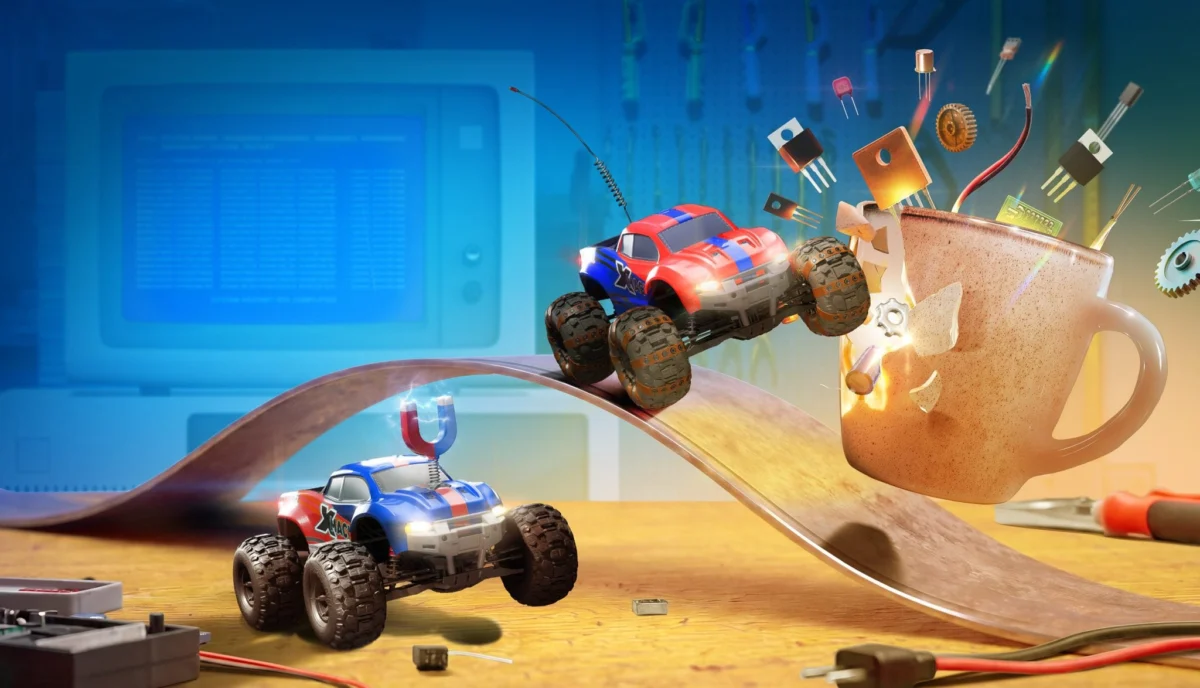
The landscape of co-operative gaming has seen a significant resurgence in recent years, driven by a growing demand for titles that prioritize shared experiences over competitive solo play. WheelMates, a newly released entry into this genre, attempts to carve out a niche by blending the high-speed, "twitchy" physics of remote-controlled (RC) cars with the intricate design of a puzzle-platformer. Set within a domestic environment that has been creatively repurposed into a series of miniature obstacle courses, the title offers a unique perspective on the "tiny heroes in a big world" trope. Published at a competitive price point of £15.99, WheelMates introduces a focused experience that emphasizes mechanical mastery and environmental exploration, supported by a "Friend’s Pass" system designed to lower the barrier to entry for duo-based gameplay.

Narrative Framework and the Digital Synchronicity Premise
The narrative foundation of WheelMates serves as a functional, if secondary, catalyst for the gameplay. The story centers on a character described as a "crazy scientist" who finds himself trapped within a digital realm. To facilitate his rescue, the scientist enlists the help of two players, who are instructed to don specialized helmets that synchronize their consciousness with two miniature RC cars. This premise allows the game to transition from a standard reality into a stylized, modified version of a typical household.
The setting is divided into several distinct locales, including the garage, the garden, and the kitchen. Each area has been transformed into a playground through the addition of ramps, jumps, and industrial-sized modifications that suit the scale of the vehicles. Beyond these domestic settings, the game introduces a "Void" dimension—an abstract, surreal space that departs from the grounded realism of the house to offer more bizarre and visually experimental challenges. While the narrative provides the necessary momentum to move players from one zone to the next, it has been noted by early players that the plot remains largely secondary to the mechanical experience. The voice acting for the central scientist character is a recurring element of the narrative delivery, though its frequency and tone have met with mixed reactions from the community.

Analyzing the Physics-Driven Gameplay and Vehicle Dynamics
At the core of WheelMates is a physics engine specifically tuned to replicate the behavior of lightweight RC vehicles. Unlike traditional racing games that prioritize weight and traction, WheelMates leans into the "twitchy" and hyper-responsive nature of remote-controlled toys. The cars are capable of rapid acceleration and can turn with high precision, allowing for a level of maneuverability that is essential for navigating the game’s more precarious platforms.
The implementation of aerial physics is particularly noteworthy. When launching off ramps, the vehicles behave with a sense of realistic momentum, allowing for flips and rotations that feel both satisfying and weight-appropriate. This mechanical polish suggests that the development team prioritized the "feel" of the driving experience above all else. However, the game distinguishes itself from titles like It Takes Two or Split Fiction by maintaining a more consistent focus on car-based movement rather than cycling through disparate gameplay genres. While the physics remain the highlight, the gameplay loop is firmly rooted in platforming and puzzle-solving rather than high-speed racing.

Tools of the Trade: Progression and Environmental Interaction
To maintain engagement across its various levels, WheelMates utilizes a progression system inspired by the Metroidvania subgenre. Players do not have access to the full suite of vehicle capabilities at the start; instead, they must unlock specific tools that grant access to previously unreachable areas of the house. This design choice encourages backtracking and rewards players for revisiting earlier stages with new equipment.
The arsenal of tools includes:

- The Contextual Grapple: This device allows vehicles to swing across specific gaps or interact with environmental triggers such as levers and pull-switches.
- The Magnet: A versatile tool that enables players to pick up and transport various objects. Curiously, the magnet’s functionality extends beyond metallic items, serving as a general-purpose "grab" mechanic for puzzle resolution.
- Anti-Gravity Wheels: These specialized tires allow the RC cars to adhere to specific tracks, enabling vertical and inverted navigation. This mechanic is central to the game’s more complex 3D puzzles.
- The Phase Shift: A late-game ability that allows vehicles to teleport through blue forcefields. This tool is primarily used to reach hidden collectibles and bypass specific environmental barriers.
These tools are essential for the co-operative puzzles that define the experience. While many of the puzzles involve standard "press button A to open door B" logic, the inclusion of these specialized tools adds a layer of coordination between the two players.
Level Design: From Domestic Realism to Abstract Voids
The environmental design of WheelMates is a study in contrasts. The domestic levels—the kitchen, garden, and garage—are filled with recognizable objects repurposed as obstacles. A jar of pasta sauce might serve as a landmark, while industrial pipes and cardboard boxes form the infrastructure of the racing tracks. This "micro-scale" aesthetic is a popular choice in the genre, providing a sense of wonder by recontextualizing the mundane.

In contrast, the "Void" areas represent a more abstract approach to level design. These sections often feature floating geometric shapes and neon lighting, creating a liminal space that feels detached from the rest of the game. Some critics have pointed out that these areas occasionally feel less curated than the domestic levels, utilizing assets that lack the specific thematic cohesion found in the garage or kitchen. Despite this, the variety in environmental themes prevents the gameplay from becoming visually stagnant.
Collectibles and the Completionist Mind-Map
WheelMates is heavily oriented toward exploration and collection. Each level is populated with three primary types of collectibles:

- Neuro-cores: The primary currency of the game, functioning similarly to coins in traditional platformers.
- Cogs and Gears: These items are used to unlock various customization options, allowing players to personalize their RC vehicles.
- Objects of Interest: Scattered throughout the environment are specific items that can be scanned to provide additional lore and background information.
To assist players in tracking their progress, the game features an integrated "mind-map." This system acts as a visual checklist, detailing how many items remain in each sector of the house and providing a narrative web that expands as players discover more about the world. For completionists, this system provides a clear roadmap for 100% completion, significantly extending the game’s replay value.
Multiplayer Functionality and the Friend’s Pass Model
Recognizing that WheelMates is built specifically for two-player interaction, the developers have implemented a "Friend’s Pass." This allows a single purchaser of the game to invite a second player to join them for free, a consumer-friendly move that has become a hallmark of successful co-op titles. The game supports both online multiplayer and local split-screen play on the PC platform.

The multiplayer experience is designed around mutual reliance. While the game does not feature the constant perspective-shifting found in some high-budget co-op titles, it requires constant communication to solve puzzles and navigate the environment. In addition to the main campaign, the game includes hidden mini-games such as "Tag" (a bomb-passing mode) and "Coin-Hunt" (a timed collection challenge). While these modes are simpler than the core campaign, they offer a brief diversion from the puzzle-platforming loop.
Critical Evaluation of Puzzle Logic and Sound Design
While the mechanical foundation of WheelMates is strong, certain aspects of its design have faced scrutiny. The puzzles, while functional, occasionally suffer from a lack of clarity. In some instances, players may find themselves "brute-forcing" a solution due to a lack of intuitive signposting. A specific example frequently cited involves a pipe-routing puzzle that spans multiple rooms; while not inherently difficult, the logic governing the flow was described by some as nonsensical, leading to moments of frustration rather than a "eureka" moment.

Furthermore, the audio-visual presentation is a point of contention. While the game performs well on a technical level, the voice acting for the scientist character has been described as repetitive. In a game that requires concentration for puzzle-solving, an overly talkative and "irritating" NPC can detract from the immersion.
Market Positioning and the Future of Miniature Simulation
At its price point of £15.99, WheelMates positions itself as a high-value indie title. By including the Friend’s Pass, the cost per player is effectively halved, making it an attractive option for friends looking for a weekend project. The game’s focus on realistic RC physics is its greatest strength, and many in the industry believe this mechanic could serve as the foundation for a more expansive sequel or a series of DLC expansions.

The broader implication of WheelMates’ release is the continued viability of the "niche co-op" market. As AAA titles become increasingly expensive and live-service-oriented, small-to-mid-sized games that offer a complete, focused experience for a fixed price continue to find a dedicated audience. WheelMates proves that a solid mechanical hook—in this case, the feel of a twitchy RC car—can sustain a full game, even if the narrative and puzzle design have room for further refinement.
In conclusion, WheelMates represents a commendable effort to merge niche hobbyist physics with mainstream co-operative gameplay. While it may not reach the cinematic heights of the genre’s leaders, its dedication to mechanical authenticity and its generous multiplayer model make it a noteworthy addition to the library of any co-op enthusiast. The title stands as a testament to the potential of miniature-scale adventures, leaving players hopeful for a future iteration that fully capitalizes on the unique driving systems established here.