


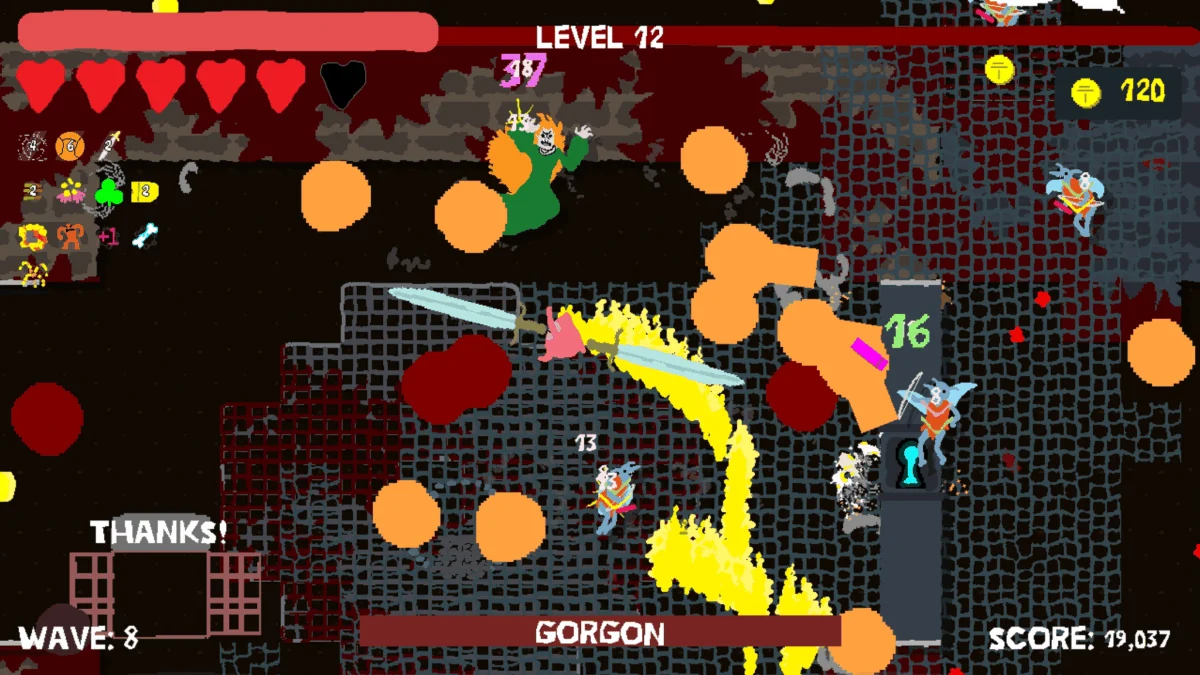
The independent gaming landscape has witnessed a significant shift in recent years, characterized by the meteoric rise of the "bullet-heaven" or "Survivors-like" subgenre. Messhof, the development studio widely recognized for the minimalist yet mechanically deep fencing title Nidhogg, has entered this crowded arena with Blood Dungeon. This title attempts a high-wire act of genre-blending, fusing the relentless enemy density and auto-battling progression of a bullet-heaven game with the tactile, gravity-defying requirements of a precision platformer. The result is a project that challenges conventional pacing while doubling down on the lo-fi, idiosyncratic aesthetic that has become a hallmark of the Messhof brand.

Core Gameplay Mechanics and Hybrid Systems
At its fundamental level, Blood Dungeon functions as a 2D side-scrolling platformer. However, unlike traditional entries in the genre where combat is often secondary to environmental navigation, Blood Dungeon saturates the screen with an ungodly volume of adversaries. Players are required to leap, climb, and dodge through various subterranean environments while their character automatically or semi-automatically unleashes a barrage of projectiles.
The progression loop follows the established blueprint of the bullet-heaven genre: defeating enemies yields "blood," which serves as the primary experience currency. Upon filling a dedicated experience meter located at the top of the user interface, the player is presented with a choice of three randomized upgrades. These enhancements are categorized into weapons, charms, and spells. The mechanical synergy—or lack thereof—between these choices determines the viability of a given run. As players advance, they encounter bosses that serve as gatekeepers to new content, necessitating a mastery of both the movement physics and the specific offensive build currently in use.

The Chronology of Player Progression
The progression in Blood Dungeon is bifurcated into two distinct tracks: the immediate power ramp within a single run and the overarching meta-progression across the entire save file. Analysis of the gameplay reveals a deliberate, albeit polarizing, pacing structure.
- The Early Hours: The initial three to four hours of the experience are characterized by a "glacial" progression rate. Players begin with limited mobility and a single weapon slot, making the early levels feel sluggish. During this phase, the difficulty curve is steep, as the player lacks the offensive output required to clear the screen effectively.
- The Mid-Game and the Bone Shop: After each run, regardless of success or failure, players accumulate "bones." These are spent in a persistent meta-progression hub known as the Bone Shop. This system is the primary vehicle for meaningful power increases. It is here that players can unlock fundamental upgrades, such as a third and fourth weapon slot, increased heart containers for health, and enhanced jump height.
- The Late-Game Power Spike: Once the meta-progression reaches a critical mass, the gameplay undergoes a transformative shift. The "sweet spot" of the experience occurs when the player’s character becomes a vessel for catastrophic damage. Late-game runs often feature a chaotic symphony of exploding basketballs, piercing multi-directional lasers, and high-velocity bullet volleys that extend with every kill.
Character Archetypes and Movement Philosophy
A significant portion of Blood Dungeon’s variety is derived from its roster of unlockable characters. Each character is defined by a unique starting weapon and a specific movement style, which fundamentally alters the player’s approach to the platforming challenges.

One of the more notable entries is "Leggy," a four-legged spider-like entity. Leggy’s starting weapon allows the player to generate webs that serve as makeshift platforms and climbing surfaces. This mechanical advantage significantly eases the navigation of vertical environments, making it a preferred choice for many players. In contrast, characters like "Baby" possess a restricted jump height, requiring a more cautious and ground-based strategy. "Fly" offers a flight mechanic that, while powerful, introduces a different set of physics that can be difficult to master amidst the screen-filling chaos of enemy projectiles.
This diversity encourages experimentation, though internal balancing data suggests that certain characters and weapon combinations are significantly more effective than others. This lack of parity can lead to "doomed runs" where the RNG (random number generation) fails to provide a viable path to victory, a common point of contention in the rogue-lite community.

Environmental Design and Level Gimmicks
Blood Dungeon features a variety of levels, each incorporating unique environmental twists to prevent the gameplay from becoming a repetitive slog. The game includes a percentage counter in the main menu to track total content discovery, providing transparency regarding the player’s progress.
- The Pit: A vertical loop design that allows players to fall through the bottom and reappear at the top, or climb infinitely upward. This creates a disorienting but strategically rich space for dodging swarms.
- The Corridor: A horizontal equivalent to The Pit, focusing on relentless forward momentum and screen-clearing efficiency.
- The Tombs: Perhaps the most interactive environment, the Tombs feature destructible blocks. Players must use their weaponry to carve out new paths, discover hidden coins, and manage the terrain to their advantage.
Defeating the three bosses within a specific level rewards the player with a crown for that stage and unlocks a new variant of the character used during the run, providing a tangible incentive for replayability.

Aesthetic and Auditory Analysis
The visual presentation of Blood Dungeon is intentionally crude, utilizing a style that evokes early digital illustration software such as MS Paint. This "low-fidelity" approach is augmented by a suite of optional CRT filters and scanline effects designed to simulate an old-school, analog television experience. While these stylistic choices contribute to a unique identity, they can also impact visual clarity during the game’s most intense moments.
The soundtrack is equally polarizing. Characterized by a frantic drum-and-bass aesthetic, the music aims to mirror the high-octane nature of the combat. However, the compositions lack the melodic hooks found in genre contemporaries like Vampire Survivors. Many players may find the auditory experience overwhelming, leading to the use of external music or silent play sessions. Despite this, the soundtrack is undeniably cohesive with the game’s overall "grunge-digital" vibe.

Market Context and Broader Implications
The release of Blood Dungeon by a developer of Messhof’s caliber highlights a growing trend of established indie creators pivoting toward the bullet-heaven genre. By integrating precision platforming, Messhof is attempting to solve one of the genre’s most persistent criticisms: the lack of active player engagement beyond basic positioning.
However, the implementation of this hybrid model reveals the inherent friction between the two styles. Platforming requires precision and careful observation of the environment, while bullet-heavens thrive on sensory overload and overwhelming the player’s ability to track individual threats. Blood Dungeon’s insistence on a slow progression ramp suggests a design philosophy that values the "earned" nature of power, though it risks alienating a modern audience accustomed to the more immediate gratification found in other titles in the space.

Conclusion and Official Outlook
Blood Dungeon is a title that demands patience. Its primary weakness lies in its pacing; the initial hours can feel like a chore as the player struggles against the limitations of an un-upgraded character. Yet, for those who persevere through the "glacial" early stages, the game eventually delivers on the promise of its premise.
The publisher has provided review codes to various outlets, signaling confidence in the game’s niche appeal. While it may not reach the broad mainstream success of Nidhogg, it stands as a bold experiment in genre fusion. As the bullet-heaven genre continues to evolve, Blood Dungeon will likely be remembered as a polarizing but mechanically interesting attempt to elevate the subgenre through the inclusion of traditional platforming depth. The game’s success will ultimately be measured by its ability to maintain a dedicated player base willing to navigate its crude aesthetics and demanding early-game difficulty in exchange for the eventual reward of becoming an unstoppable force of nature within its digital dungeons.