


Conceptual Origins and Narrative Framework
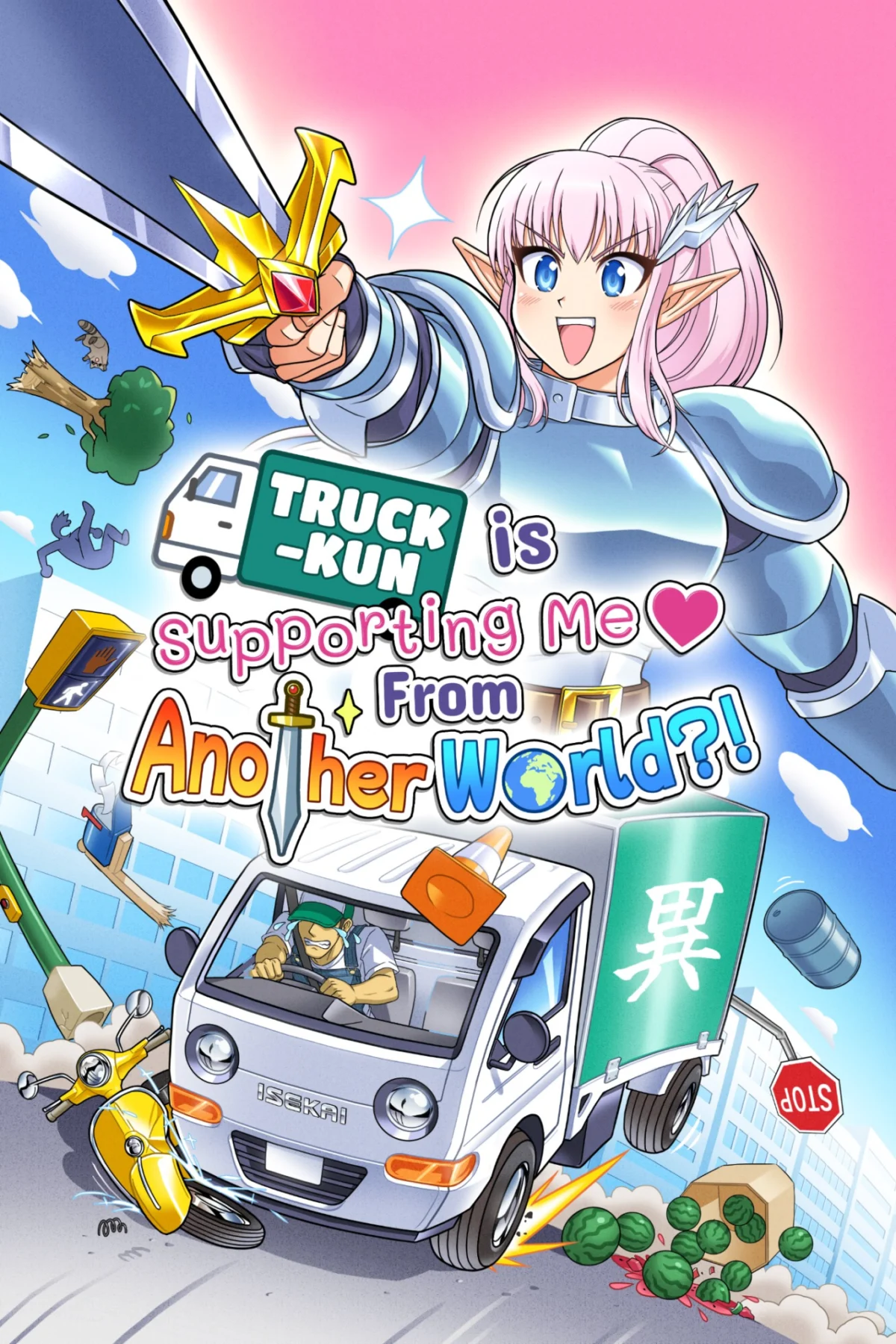
The premise of Truck-kun is Supporting Me from Another World?! centers on Carissa Ward, a character whose life trajectory serves as a parody of modern corporate achievement. Ward is introduced as a highly successful Marketing Vice President who, after years of sacrificing her personal interests—specifically her collection of anime figurines—finally reaches a career pinnacle on a Friday. Her transition into the supernatural occurs on the following Monday when she is struck by a delivery truck.
In a departure from standard isekai narratives where the vehicle’s role ends at the moment of impact, this title establishes a persistent connection between the driver and the victim. While Carissa is reincarnated as a muscular warrior in a traditional role-playing game (RPG) setting, the truck driver remains in the urban reality, tasked with performing stunts and destruction to provide metaphysical support to Carissa. The narrative is delivered through unvoiced dialogue boxes, utilizing a sharp, satirical tone that emphasizes the absurdity of the situation. The plot culminates in a confrontation with the "Skeleton King," a milestone reached after approximately three to four hours of gameplay.

Core Gameplay Mechanics and the Dual-World Interface
The gameplay of Truck-kun is Supporting Me from Another World?! is heavily influenced by Sega’s classic Crazy Taxi series, utilizing a vibrant, polygonal art style and high-energy musical accompaniment. However, it introduces a unique dual-screen mechanic that defines its identity. While the primary view is an open-ended, colorful 3D city, a secondary 2D window at the bottom of the interface tracks Carissa’s progress in the fantasy world.
The actions performed in the city have a direct, quantifiable impact on Carissa’s combat effectiveness:
- Destruction and Combat Synergy: Smashing environmental objects like fences, beach chairs, and parked cars allows Carissa to charge devastating attacks against magical creatures.
- Pedestrian Interaction: In a darkly comedic twist, running over pedestrians transports their souls to the fantasy world, where they manifest as enemies for Carissa to defeat.
- Environmental Navigation: Performing drifts, jumps, and navigating through stunt rings provides health and attack bonuses to the fantasy-world protagonist.
The game operates on a time-limit system, where runs can last up to ten minutes. Players must balance the pursuit of specific objectives—such as smashing a set number of billboards or drifting a certain distance—with the need to collect regenerating time power-ups scattered throughout the map. While delivery missions are available, they serve primarily as a method for leveling up and are often secondary to the objective-based destruction required to progress the narrative.

Technical Performance and Xbox Series X Integration
Tested on the Xbox Series X, the title maintains a high level of visual fidelity consistent with its "old-school" aesthetic. The hardware allows for rapid loading times and a stable frame rate, which is essential given the high-speed nature of the gameplay. However, the experience is noted for a degree of "physics jank" that appears to be a deliberate, if occasionally frustrating, design choice.
The collision detection system can be inconsistent, leading to unpredictable bounces off level geometry. Reversing and drifting mechanics lack the surgical precision found in modern racing simulators, leaning instead into a chaotic, arcade-centric feel. To mitigate potential issues with the physics engine, the developers included a "manual unstuck" option in the main menu, allowing players to reset their position without abandoning their current run.
Chronology of Progression and Milestones
Progression in Truck-kun is Supporting Me from Another World?! is tied to global milestones rather than a linear level structure. The game’s timeline is defined by the following stages:

- Initial Adjustment: Players familiarize themselves with the city map, identifying key areas for specific objectives, such as the beach for chair destruction or parking lots for vehicle smashing.
- Objective Saturation: As players complete random objectives, they trigger unique dialogue sequences between Carissa and the driver, revealing character quirks and advancing the lore.
- The Skeleton King Summoning: Once all primary milestones—including cumulative pedestrian hits and total object destruction—are met, the final boss encounter is initiated.
- Endgame and Post-Launch Content: The credits roll after roughly three hours, though a "Free Roam" mode remains available for completionists.
A notable aspect of the game’s release schedule is the "Week 1 Patch," which is slated to unlock a garage feature. This addition will allow for the customization of the truck, providing a layer of personalization that was absent at the initial launch.
Supporting Data and Market Positioning
The game enters the market with a launch price of $19.99 USD/EUR. While the campaign length is relatively short compared to AAA titles, the developers have positioned it as a "short burst" experience intended for high-replayability and immediate satisfaction.
The city environment is packed with interactive elements designed to facilitate various playstyles:

- Stunt Rings: Strategically placed in groups to allow for rapid objective completion.
- Police Pursuit: Law enforcement vehicles act as dynamic obstacles. Unlike traditional racing games where police represent a "game over" state, here they are treated as additional objects to be side-swiped for points.
- Leveling System: Although simplified, the delivery mechanic provides a pathway for players to increase their stats, making the fantasy-world segments more manageable.
Despite these features, the game currently lacks online leaderboards or multiplayer functionality, which may limit its long-term appeal for competitive arcade enthusiasts.
Official Responses and Developer Intent
While formal press releases have focused on the "insane" premise, the involvement of Strange Scaffold suggests a deeper intent. The studio, led by Xalavier Nelson Jr., is known for titles like El Paso, Elsewhere and Space Warlord Organ Trading Simulator, which prioritize strong narrative hooks and experimental mechanics.
The developer’s philosophy with Truck-kun appears to be the democratization of the isekai genre through an accessible, albeit eccentric, arcade format. By focusing on the "support" role of the vehicle—a character usually discarded after the first chapter of an anime—the developers have created a metacommentary on the tropes that dominate modern Japanese pop culture.

Broader Impact and Industry Implications
Truck-kun is Supporting Me from Another World?! arrives at a time when indie developers are increasingly finding success by leaning into "meme-literate" concepts. The game’s success or failure will likely serve as a case study for the viability of short-form, high-concept titles in a market often obsessed with 100-hour playtimes.
Furthermore, the title highlights a growing trend of "genre-blending." By combining a 3D driving simulator with a 2D RPG progression system, Strange Scaffold and Frosty Pop have demonstrated that disparate gameplay styles can coexist within a single interface to create a cohesive narrative experience. While the physics and depth may not rival established franchises, the game’s infectious humor and addictive loop suggest a shift toward prioritized "fun" and conceptual novelty over traditional polish.
As the industry moves forward, the reception of Truck-kun may encourage more developers to explore the "middle ground" of gaming—titles that are larger than simple mobile distractions but more focused and experimental than traditional retail releases. For now, it stands as a unique, if janky, tribute to the arcade classics of the late 90s, updated with the sensibilities of the modern internet era.