


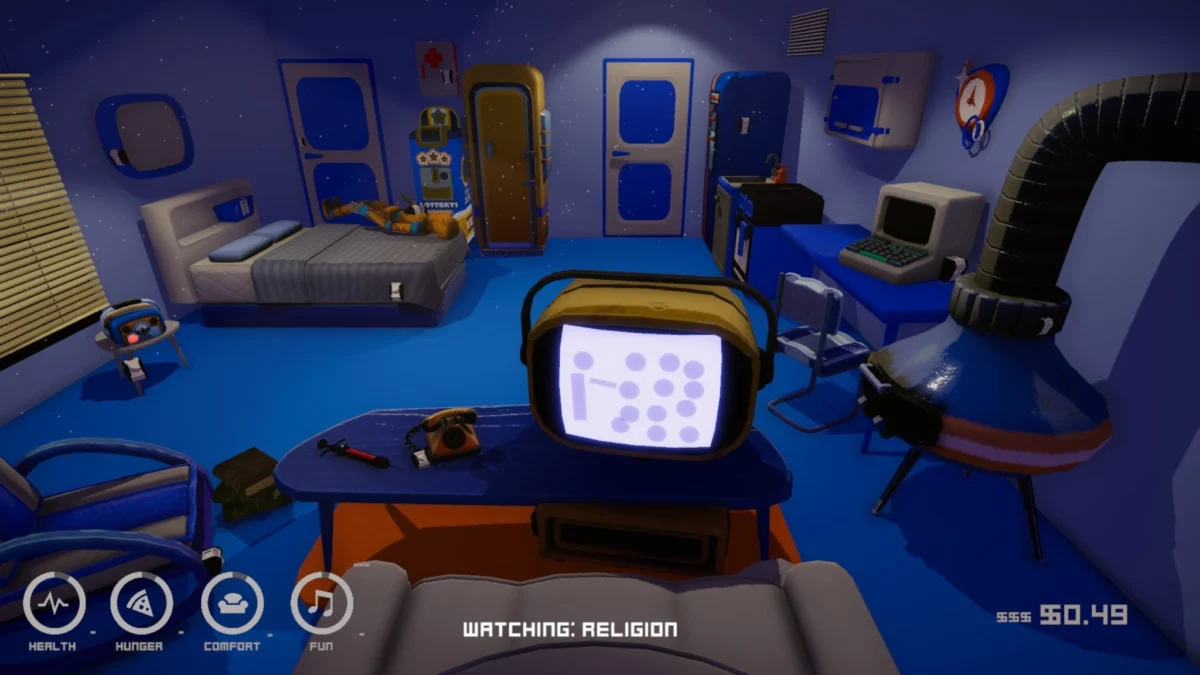
The independent gaming landscape has frequently explored the intersection of bureaucratic horror and resource management, but few titles approach the concept with the singular, caustic focus found in Palitroque’s latest release, Dystopicon. Published in mid-2024, the title presents a clicking simulation that functions as both a mechanical survival game and a biting satire of state-mandated consumption. Set within a world overseen by a nebulous governing body known as "The Trinity," the game tasks players with a singular, paradoxical objective: generate income by watching television while navigating a hyper-monetized domestic environment where every basic human necessity carries a literal price tag.

The Mechanics of State-Mandated Consumption
At its core, Dystopicon is a resource management simulation built around the "gig economy" pushed to its most logical and lethal extreme. The player occupies the role of a "numerically-registered citizen" living within approved spaces provided by the Ministry of The Trinity. Unlike traditional survival games where resources are gathered through exploration or crafting, the primary economic engine in Dystopicon is the act of visual consumption. Turning on the television set generates currency by the second, effectively commodifying the player’s attention.
However, this income stream is constantly threatened by the high cost of existence. The game’s world is one of absolute privatization; opening a refrigerator to eat, using a sink to wash hands, or utilizing any basic amenity deducts funds from the player’s balance. The satirical edge of the game is sharpest here, suggesting a world where even the air one breathes might eventually be metered. This creates a high-pressure feedback loop: the player must watch TV to afford the amenities required to stay alive long enough to watch more TV.

Resource Management and the Survival Loop
Survival in Dystopicon is governed by four primary physiological and psychological metrics: Health, Hunger, Comfort, and Fun. This quaternary system requires constant monitoring, as the depletion of any single meter results in a "game over" state. Upon failure, players are returned to the start of their last major story checkpoint, emphasizing the precarious nature of the citizen’s life under The Trinity.
A standard "run" in the game’s narrative mode encompasses approximately twenty-eight in-game days. During this period, players must balance their immediate physical needs against the requirement to explore their environment. The difficulty arises from the fact that most actions required to maintain health or investigate the surroundings necessitate turning off the television, thereby halting the player’s only source of income. This mechanic forces players to develop a strict operational efficiency, identifying which tasks can be performed in tandem with media consumption and which require a costly cessation of revenue.

The Trinity and the Citizen Rating System
Beyond physical survival, players must navigate the social engineering of the state through the "Citizen Rating" system. This metric represents the player’s standing with the Ministry and is influenced by their behavior and consumption habits. The game introduces a variety of channels, each serving a different purpose within the state’s apparatus.
- The Politics Channel: Essential for maintaining a positive Citizen Rating. Players must consume state propaganda to ensure they do not fall below established loyalty thresholds. Failure to do so results in "re-education," a euphemism for a terminal game state.
- The Religion Channel: Noted as the most lucrative channel in terms of currency generation. This suggests a world where the state has co-opted spiritual practice into a primary tool for economic control.
- The Pornography Channel: A satirical collection of abstract geometric shapes. While it provides a significant boost to the "Fun" meter, its use is high-risk. Patrolling law enforcement officers frequently remove the channel from the set, reflecting the state’s control over vice and pleasure.
The Citizen Rating also dictates the player’s living conditions. Successful adherence to state protocols allows for "upgrades" to more expansive abodes, though these larger spaces often bring higher maintenance costs and more complex distractions, further complicating the survival loop.

Chronology of a Twenty-Eight Day Cycle
The progression of Dystopicon follows a structured timeline that mirrors the descent into total societal control.
- Days 1-7 (The Induction Phase): The player begins as a standard working-class citizen. This period serves as an introduction to the basic costs of living and the rhythm of the television-based economy.
- Days 8-14 (The Stabilization Phase): As the player becomes accustomed to the financial drain of basic amenities, the Ministry begins introducing "helpful tips and tricks" via a printing device. These messages reinforce the "everything is fine" narrative while introducing new environmental distractions.
- Days 15-21 (The Divergence Phase): The narrative introduces moral and logical conflicts. Players may encounter noises outside or strange occurrences within their building. Investigating these anomalies often leads to a drop in Citizen Rating, forcing a choice between curiosity and safety.
- Days 22-28 (The Terminal Phase): The pressure on all four health meters increases. The irony of the state’s messaging becomes unavoidable, as the very media the player is paid to watch begins to have a detrimental effect on their psychological well-being. The cycle concludes with one of several narrative endings based on the player’s cumulative choices.
Aesthetic Direction: Retro-Futurism and Muted Isolation
Visually, Dystopicon utilizes a specific aesthetic to reinforce its themes of isolation and decay. The developer, Palitroque, has opted for a muted color palette dominated by greys, browns, and sickly greens, evoking a sense of industrial stagnation. The equipment within the player’s apartment is "retro-futuristic," featuring bulky CRT monitors, analog printing devices, and mechanical interfaces that suggest a society that has technologically plateaued under authoritarian rule.

One of the more unsettling visual choices is the representation of other characters. Neighbors and state officials are depicted as mannequin-like figures, devoid of human warmth or individuality. This artistic decision underscores the dehumanizing effect of the Trinity’s regime, where citizens are viewed merely as data points and consumers rather than sentient beings.
Narrative Scope and the Multiple Ending Framework
Dystopicon features over ten distinct endings, providing a degree of replayability that is uncommon in the clicking simulation genre. These endings are determined by a combination of the player’s Citizen Rating, their physical health at the end of the 28-day cycle, and their willingness to engage with the world beyond their television set.

The narrative thrives on irony. For instance, players may discover that frozen foods—traditionally considered less healthy—are more beneficial within the game’s logic than refrigerated items, a subtle nod to the distorted reality of the state’s supply chain. Perhaps most darkly, the game includes the "Sarco pod," a suicide chamber that is presented as a legitimate alternative to the endless cycle of consumption and survival. The presence of such a device serves as the ultimate commentary on the "utopia" promised by The Trinity.
Challenge Mode and Replayability Analysis
For players who find the narrative constraints of the story mode too restrictive, Palitroque has included a "Challenge Mode." This iteration of the game removes the plot-heavy distractions and focuses purely on the mechanical "frenzy" of clicking and resource management. In this mode, the player’s sole objective is to maintain their room, please the "Holy Party," and keep their meters filled for as long as possible.

While the game offers significant depth in its first few hours, critical analysis suggests that the gameplay loop reaches a point of diminishing returns. Most players will grasp the optimal strategy for survival within three to four hours. Once the "perfect" rhythm of watching TV and managing costs is established, the tension of the simulation can give way to a sense of monotony. However, proponents of the game argue that this boredom is intentional—a ludonarrative harmony that reflects the actual experience of living in a stagnant, media-saturated dystopia.
Socio-Political Implications of the Dystopicon Simulation
Dystopicon serves as a digital microcosm of contemporary anxieties regarding surveillance, the erosion of privacy, and the gamification of labor. By paying the player to watch television, the game critiques the modern attention economy, where user data and screen time are the primary currencies of the digital age.

The Ministry of The Trinity represents a generic yet potent amalgam of historical and fictional authoritarian regimes. Its insistence that "everything is fine" while the player literally starves in front of a screen mirrors the disconnect between official state rhetoric and the material reality of the citizenry. The game’s portrayal of a collapsing fascist regime—absurd in its presentation but terrifying in its mechanisms—aligns it with the traditions of dystopian literature and film, such as George Orwell’s 1984 or Terry Gilliam’s Brazil.
In conclusion, Dystopicon is a provocative, if occasionally repetitive, addition to the simulation genre. Its strength lies not in the complexity of its clicking mechanics, but in the unwavering commitment to its satirical vision. It challenges the player to consider the cost of their own digital consumption and the price of "comfort" in an increasingly monitored world. For those willing to endure the bleakness of its atmosphere, it offers a hauntingly familiar look at a world that is not quite our own, but is far from unrecognizable.