


After nearly 20 hours of widespread disruption, Xbox confirmed that its core services have been fully restored, mitigating a significant outage that left millions of players unable to access games, sign into accounts, or complete purchases. The issues, which began on Monday, July 27th, 2026, and extended into the early hours of Tuesday, July 28th, affected a broad spectrum of Xbox operations, from digital game launches to, critically, the functionality of disc-based titles and backward compatibility. This prolonged service interruption has reignited a pervasive industry discussion regarding the vulnerabilities of an increasingly digital gaming ecosystem and the implications for consumer ownership.
The Genesis of the Outage: A Chronology of Disruption
The problems began to surface on Monday, July 27th, with initial reports emerging from the Xbox community indicating difficulties with fundamental online functionalities. Users globally reported being unable to sign into their Xbox accounts, encountering empty game libraries, and facing insurmountable hurdles when attempting to launch digital games. This immediate user feedback was quickly corroborated by official channels.
-
Monday, July 27th, 2026 – Early Afternoon (GMT/BST): Xbox Support on Twitter/X acknowledged widespread issues, stating they were investigating problems preventing players from accessing their accounts and games. Concurrently, the official Xbox Status page began to reflect a "Major Outage" across several critical categories, including "Account & Profile," "Store & Subscriptions," and "Apps & Mobile." This initial phase of the outage primarily impacted digital services crucial for user authentication and access to purchased content. The timing was particularly unfortunate, coming just a week after a separate, albeit briefer, outage had marred the Early Access launch of "Halo: Campaign Evolved," leading to early frustrations among the dedicated Xbox fanbase.
-
Monday, July 27th, 2026 – Mid-Afternoon (GMT/BST): The situation escalated significantly. At approximately 3:02 PM BST, the Xbox Status page updated to confirm that "Games & Gaming" was also suffering a major outage, explicitly noting, "You may have problems playing your digital games right now." This expansion of affected services meant that even if players could theoretically navigate other parts of the Xbox ecosystem, the core function of playing games was compromised.
-
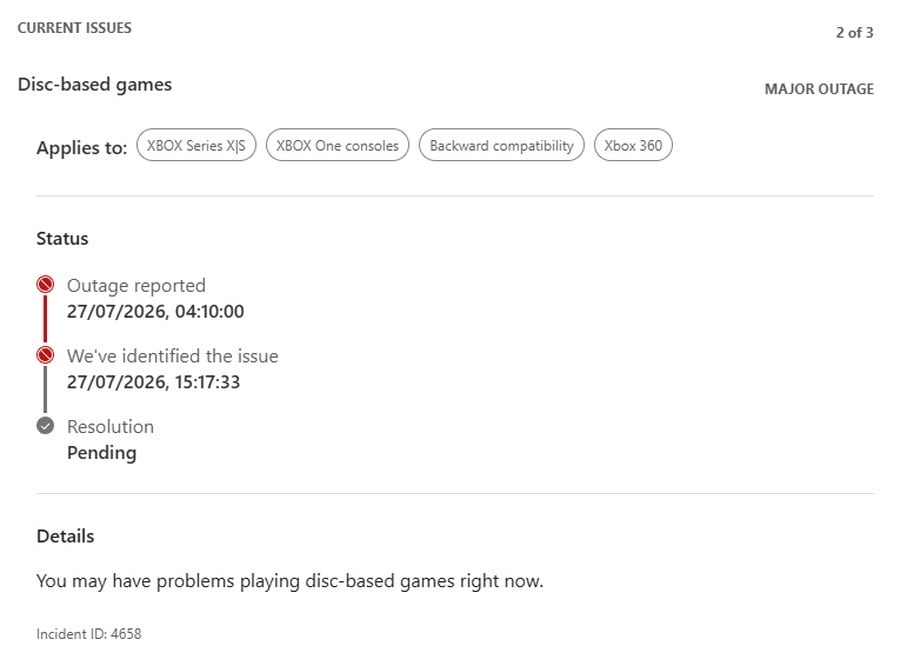
Monday, July 27th, 2026 – Late Afternoon (GMT/BST): The outage deepened further, reaching a critical point that amplified concerns about digital rights management. Around 3:17 PM BST, the Xbox Status page confirmed an even more severe development: "You may have problems playing disc-based games right now," alongside continued issues with backward compatibility. This particular update sent ripples through the gaming community, as it demonstrated that even physical media, traditionally seen as a safeguard against online service interruptions, was rendered unplayable due to required server authentication checks. For many, this underlined the pervasive reliance on online infrastructure, even for ostensibly offline content.
-
Monday, July 27th, 2026 – Evening through Early Tuesday, July 28th, 2026: As the outage stretched through the night in various time zones, Xbox engineers reportedly worked tirelessly to identify and resolve the root cause of the widespread disruption. Communication from official channels became less frequent during these hours, as is common during complex troubleshooting, but user reports of issues persisted across social media platforms and gaming forums, highlighting the global scale of the problem. Players expressed significant frustration over lost gaming time, inability to connect with friends, and the unsettling experience of being locked out of their purchased libraries.
-
Tuesday, July 28th, 2026 – Early Morning (GMT/BST): After approximately 20 hours, a breakthrough was announced. At 12:44 AM BST, Xbox Support released an official statement on Twitter/X, proclaiming "Good news – the earlier Xbox issue should now be mitigated." The statement confirmed that services were gradually returning to normal, with players once again able to "launch games, sign in, and complete purchases." Xbox Support thanked its community for their patience "through a long one" and encouraged users to report any lingering issues via their support website. The announcement brought relief to the millions of affected players, although the memory of the prolonged disruption remained fresh.
The Far-Reaching Impact on the Gaming Community

The nearly day-long outage had a substantial impact on Xbox’s vast global user base. With tens of millions of active users across its various consoles (Xbox One, Xbox Series X|S) and PC ecosystem, any disruption to core services affects a significant portion of the gaming population. The simultaneous inability to access digital libraries, launch physical disc games, and process new purchases effectively brought the Xbox experience to a standstill for many.
Social media platforms, particularly Twitter/X and Reddit, became hubs of frustrated discourse. Players reported scenarios ranging from children unable to play their favorite single-player games to competitive gamers missing crucial tournament windows or casual players simply trying to unwind after a long day. The financial implications, while difficult to quantify precisely, were also considerable. For the duration of the outage, potential digital game sales, microtransaction purchases, and new Xbox Game Pass subscriptions would have been severely curtailed. Furthermore, the disruption could have a subtle, long-term effect on consumer confidence, potentially influencing future purchasing decisions, especially concerning digital-only content or consoles.
Digital Ownership vs. Physical Media: A Recurring Debate
The most significant implication highlighted by this particular outage revolves around the ongoing and increasingly fervent debate about digital ownership versus physical media. For years, the gaming industry has steadily shifted towards a digital-first, if not digital-exclusive, model. Digital storefronts offer unparalleled convenience, instant access, and often exclusive content. However, the Xbox outage starkly illustrated the inherent vulnerabilities of this model.
The fact that even disc-based games required an online authentication check to launch underscored the pervasive nature of Digital Rights Management (DRM). While intended to prevent piracy, DRM schemes often tie the functionality of games, even those physically owned, to the health and availability of online servers. When these servers fail, as they did during this incident, the consumer’s ability to access their purchased content is immediately revoked, regardless of whether they hold a physical copy.
Proponents of physical media often cite scenarios like this as their primary argument. They advocate for the tangible nature of discs or cartridges, the ability to resell games, and the perceived immunity from server-side issues. While physical games traditionally offered a degree of offline playability, modern console architectures often blur this line, necessitating online "day one" patches, license checks, or even full game downloads for disc-based titles. This incident reinforced the perspective that in a heavily interconnected world, true "ownership" in the traditional sense is increasingly elusive for digital content and, surprisingly, for much of what was once considered physical.
The broader implications extend to game preservation. If server infrastructure eventually becomes obsolete or publishers cease operations, the digital licenses for thousands of games could become inaccessible. This concern is particularly poignant for backward compatibility libraries, which rely heavily on digital authentication for older titles.
Xbox’s Response and the Road Ahead
Xbox’s official response during the outage followed a standard protocol: acknowledging the problem, communicating updates via dedicated status pages and social media, and ultimately announcing mitigation. The candid "Good news – the earlier Xbox issue should now be mitigated" message, followed by an expression of gratitude for player patience, aimed to reassure the community.
However, repeated incidents, such as the Halo launch issue a week prior and this more extensive outage, inevitably place pressure on Microsoft to review and reinforce its server infrastructure. As a tech giant with substantial cloud computing capabilities (Azure), the expectation for robust and resilient online services is exceptionally high. Future preventative measures might include enhancing server redundancy, improving disaster recovery protocols, and potentially re-evaluating certain aspects of their DRM implementation to minimize the impact of future outages on core game accessibility.
From an industry perspective, this event serves as a potent reminder for all platform holders—including PlayStation, Nintendo, Steam, and Epic Games—of the critical importance of server stability. As gaming continues its trajectory towards always-online experiences, cloud gaming, and digital-only hardware, the reliability of underlying network infrastructure becomes paramount. Consumer trust is a fragile commodity, and repeated incidents of service denial can erode brand loyalty and fuel calls for greater transparency and consumer protections regarding digital purchases.
The Xbox outage of late July 2026 was more than just a temporary inconvenience; it was a significant event that underscored the intricate dependencies of modern gaming. While services have been restored, the episode has undoubtedly left a lasting impression, reigniting crucial conversations about digital ownership, the resilience of online platforms, and the delicate balance between convenience and control in the evolving landscape of interactive entertainment. The gaming community, now more than ever, is keenly aware of the invisible threads that connect their purchased experiences to distant servers, and the critical importance of keeping those connections robust and uninterrupted.