


Konami Digital Entertainment, in partnership with Red Art Games, has officially released the Super Bomberman Collection, a comprehensive anthology that brings together seven seminal titles from the franchise’s formative years on the Nintendo Entertainment System (NES) and Super Nintendo Entertainment System (SNES). This release follows a period of renewed activity for Konami, which has recently signaled a strategic return to its legacy intellectual properties, including Silent Hill, Metal Gear Solid, and Castlevania. The Super Bomberman Collection specifically targets the preservation of the 16-bit era, providing modern audiences with access to twelve distinct versions of these classic titles, including several that have never previously received an official English localization. Tested on the Xbox Series X, the collection serves as both a historical archive and a functional multiplayer suite, retailing at a competitive price point of $19.99/€19.99.
Historical Context and the Evolution of the Bomberman Franchise
The Bomberman franchise, originally developed by the now-defunct Hudson Soft and currently owned by Konami, has long been a cornerstone of the maze-based action genre. The series’ core mechanic—strategic bomb placement within a grid-based arena to eliminate enemies and clear obstacles—has remained remarkably consistent since its debut in the early 1980s. However, the SNES era represented a significant technological and creative leap for the series.
The Super Bomberman Collection documents this evolution by including the Japanese Famicom (NES) versions of the original Bomberman and Bomberman II. These titles established the foundational "Normal Mode" (a single-player campaign) and the early iterations of "Battle Mode." The inclusion of these 8-bit versions provides necessary context for the advancements seen in the subsequent "Super" series. When the franchise transitioned to the SNES in 1993, it leveraged the console’s superior hardware to introduce 4-player and eventually 5-player local multiplayer, a feature that would define the series’ legacy in the competitive gaming space.

Detailed Chronology of Included Titles
The collection is anchored by five mainline entries originally released for the Super Famicom/SNES between 1993 and 1997. Each title introduced specific innovations that expanded the scope of the gameplay:
- Super Bomberman (1993): This title marked the franchise’s debut on 16-bit hardware. It featured a 50-level campaign and was the first to support 4-player multiplayer via the SNES Multi-tap peripheral.
- Super Bomberman 2 (1994): Unlike its predecessor, this entry focused heavily on a story-driven single-player experience with unique boss mechanics and more intricate level designs. It remains the only entry in the "Super" series that does not support cooperative play in its campaign mode.
- Super Bomberman 3 (1995): This installment is historically significant for introducing "Louies"—kangaroo-like mounts that provide players with unique abilities and an extra hit point. It also increased the multiplayer capacity to five players.
- Super Bomberman 4 (1996): Previously a Japan-exclusive, this entry expanded the mount system to include various monsters and featured a time-travel-themed campaign. Its inclusion in this collection marks its first official Western release.
- Super Bomberman 5 (1997): Serving as the final 16-bit entry, this game introduced branching paths and multiple endings, significantly increasing replayability. Like its predecessor, it was previously unavailable in English-speaking markets.
By providing both the original Japanese versions and the Western localized versions, the Super Bomberman Collection allows players to observe the subtle regional differences in sprite work and text that occurred during the 1990s localization processes.
Technical Specifications and Emulation Quality
For the Super Bomberman Collection, Konami has utilized a robust emulation wrapper that prioritizes input accuracy and visual fidelity. On the Xbox Series X, the games run with negligible input latency, a critical factor for a series that demands frame-perfect movement and bomb placement. The collection includes a suite of modern "Quality of Life" (QoL) features designed to mitigate the inherent difficulty of retro gaming.
The "Save State" and "Rewind" functions allow players to navigate the more punishing sections of the NES-era campaigns without the frustration of total progress loss. Furthermore, the visual presentation offers several customizable parameters. Players can choose between a "Pixel Perfect" aspect ratio, a standard 4:3 fit, or various stretch options. To replicate the aesthetic of the original hardware, Konami has included multiple CRT (Cathode Ray Tube) filters, featuring simulated scanlines and screen curvature.

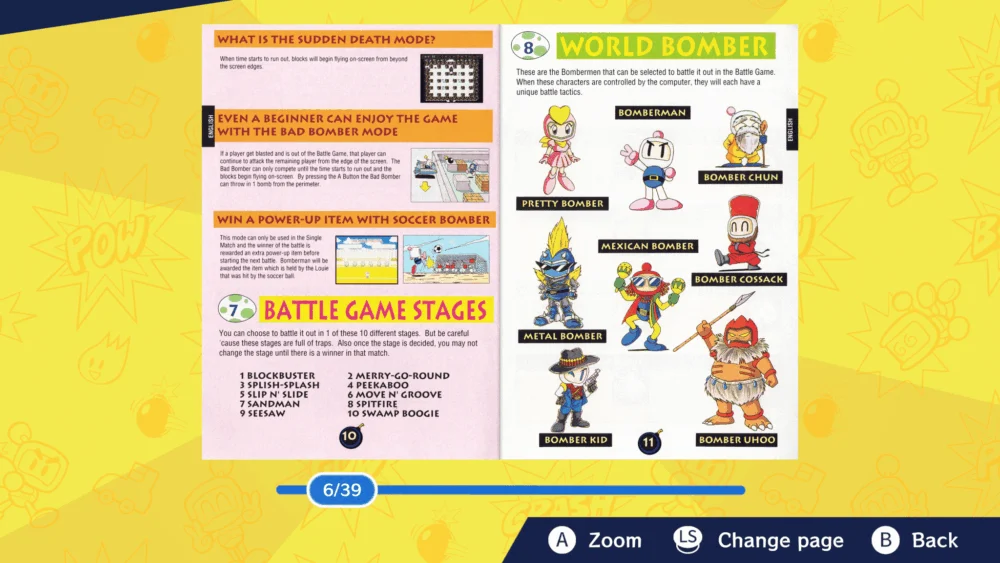
A significant addition to the technical package is the inclusion of the original digital manuals. These documents provide more than just control schemes; they contain original concept art, lore descriptions, and gameplay tips that were standard during the physical media era but are often lost in digital re-releases. This commitment to archival quality is a notable trend in Konami’s recent "Master Collection" strategy.
New Content and Localization Milestones
The primary draw for series historians is the inclusion of Super Bomberman 4 and Super Bomberman 5. For nearly three decades, Western fans were forced to rely on unofficial fan translations or imported hardware to experience these titles. The Super Bomberman Collection provides a professional English localization for both games, ensuring that the dialogue, menu systems, and ending sequences are fully accessible to a global audience.
In addition to localization, the collection introduces a "Boss Rush" mode. This feature aggregates the various boss encounters from across the Super Bomberman series into a timed challenge. This mode serves as an endgame for veteran players, requiring a deep understanding of boss patterns and bomb physics. While the collection lacks a centralized online multiplayer infrastructure—a feature present in modern titles like Super Bomberman R 2—it compensates by preserving the original local multiplayer logic, which supports up to five players on compatible hardware setups.
Market Analysis and Industry Implications
The release of the Super Bomberman Collection at a $19.99 price point suggests a strategic move by Konami to capture the "mid-core" retro market. By bundling seven games (and twelve total versions), the per-game cost is approximately $2.85, positioning it as a high-value proposition compared to individual "Arcade Archives" releases which typically retail for $7.99 per title.

Industry analysts suggest that this collection serves two purposes. First, it acts as a low-risk revenue stream that leverages existing assets. Second, it maintains brand relevancy for the Bomberman IP between major new releases. The collaboration with Red Art Games, a publisher known for physical boutique releases, also indicates a desire to appeal to the collector market. The decision to include the NES titles as "bonus content" further enhances the perceived value of the package, presenting it as a definitive historical document of the series’ peak years.
Comparative Evolution of Gameplay Mechanics
When analyzed against contemporary entries such as Super Bomberman R 2, the games in this collection highlight a shift in design philosophy. Modern Bomberman titles often emphasize level editors, complex power-up systems, and "Battle Royale" online modes. In contrast, the Super Bomberman Collection showcases the purity of the original "Power-Up" economy.
The progression from Super Bomberman 1 to 5 demonstrates the gradual introduction of complexity:
- The Fire/Bomb/Skate Foundation: The early titles focused on increasing blast radius, bomb capacity, and movement speed.
- The Interaction Phase: Mid-series entries introduced the "Power Glove" (picking up and throwing bombs) and the "Kick" (sliding bombs across the grid).
- The Mount Phase: The introduction of Louies in Super Bomberman 3 changed the meta-game, as the mounts acted as both shields and specialized tools (e.g., jumping over blocks or dashing).
This evolution is preserved perfectly within the collection, allowing players to experience the mechanical "power creep" that occurred over the five-year span of the SNES’s lifecycle.

Broader Impact on Game Preservation
The Super Bomberman Collection represents a positive step in the ongoing industry conversation regarding game preservation. As original SNES hardware and cartridges become increasingly expensive and prone to component failure (such as capacitor leakage or bit rot in ROM chips), official digital compilations provide a legal and accessible way to maintain gaming history.
Konami’s inclusion of the original manuals and the preservation of original "cheat codes"—such as those used to unlock hidden stages or max out power-ups—demonstrates an understanding of the retro community’s needs. While the lack of online play may be seen as a drawback for some, the collection’s focus on "couch co-op" and local versus play honors the social context in which these games were originally played.
In conclusion, the Super Bomberman Collection is a meticulously assembled anthology that successfully bridges the gap between 1990s nostalgia and modern convenience. By providing flawless emulation, historical localizations, and a wealth of archival material, Konami has delivered a package that respects the legacy of Hudson Soft while providing a functional and entertaining product for the current generation of consoles. The collection stands as a testament to the enduring appeal of simple, well-executed game mechanics and sets a high standard for future retro compilations from the publisher.