


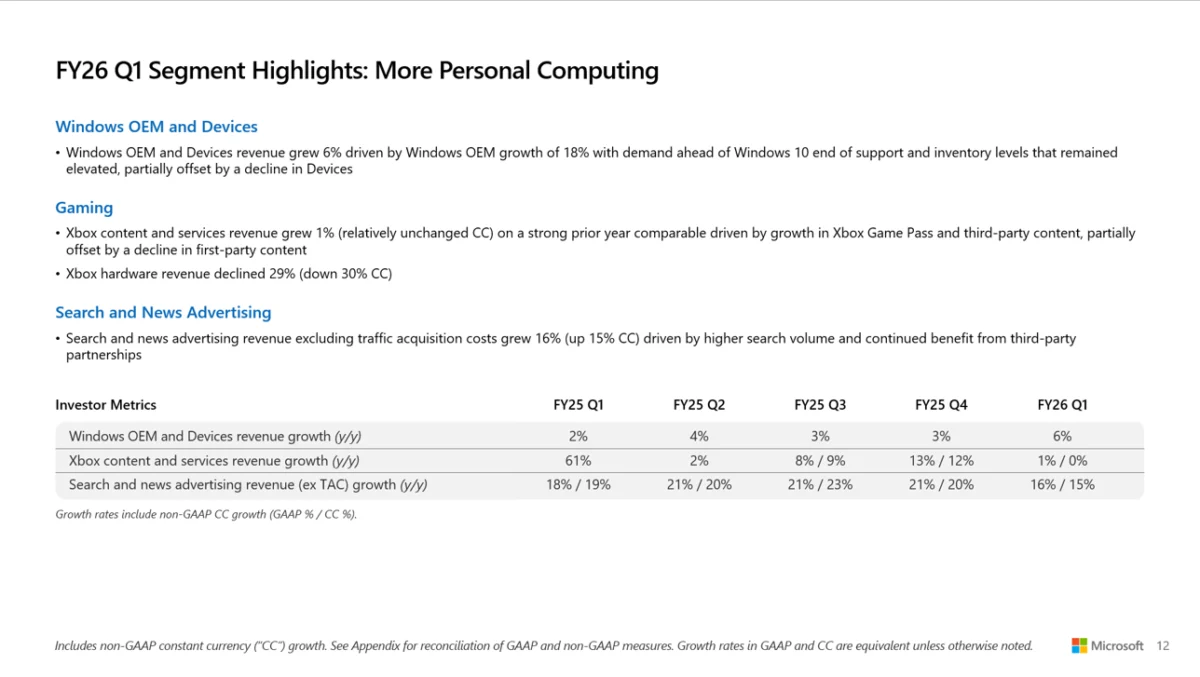
Despite significant player discontent and widespread criticism following recent price increases for its Xbox Game Pass subscription service, Microsoft executives appear unconcerned, projecting an increase in subscriber numbers and a reduction in losses within the Xbox services division for the upcoming fiscal quarter. This optimistic outlook was revealed during Microsoft’s first-quarter earnings call for fiscal year 2026, which covered the period from July to September.
Financial Performance and Future Projections
During the Q1 FY2026 earnings call, Microsoft disclosed that revenue generated from Xbox’s content and services, a category encompassing the popular Game Pass subscription, remained stable and demonstrated signs of growth. It is crucial to note that this reported revenue does not yet reflect the impact of the price adjustments, which were implemented in most global markets in October and are slated for full rollout across remaining regions in November. Consequently, the financial ramifications of the price hike will become evident in Microsoft’s next earnings report, anticipated in late January 2026.
An intriguing detail emerged from the executive commentary, where a Microsoft representative indicated an expectation of declining overall services and subscriptions revenue, yet simultaneously projected an uptick in Game Pass subscriptions. This nuanced statement suggests a strategic bet on the enduring appeal of the Game Pass library and its value proposition, even at a higher price point.
The precise wording from the earnings call stated: "And in Xbox content and services, we expect revenue to decline in the low to mid-single digits against a prior year comparable that benefited from strong first-party performance, partially offset by growth in subscriptions." This phrasing has sparked discussion regarding whether the company anticipates an increase in the sheer volume of subscribers or merely a revenue boost resulting from higher individual subscription costs. If the revenue generated from the price increase outweighs any potential subscriber attrition, the move could be deemed a financial success, underscoring Xbox’s apparent confidence in attracting and retaining a larger subscriber base.
The Game Pass Value Proposition: A Shifting Landscape
Microsoft’s unwavering confidence in Game Pass’s future growth appears to be underpinned by its substantial investment in day-one releases of major titles. The inclusion of highly anticipated games such as "Outer Worlds 2" and the forthcoming "Call of Duty: Black Ops 7" directly onto the Game Pass platform is a key component of their strategy. By consistently offering a robust and expanding library of premium content, Xbox aims to fortify its subscription service, compelling both existing subscribers to remain loyal and attracting new users to the ecosystem. This strategy hinges on the belief that the sheer volume and quality of available games will justify the increased subscription fees.
Player Reaction and Industry Skepticism
In stark contrast to Microsoft’s optimistic projections, the announcement of the Game Pass price hikes in October was met with considerable player backlash and widespread skepticism. Many consumers, including industry observers, expressed concerns that the increased costs would diminish the accessibility of gaming. The perceived value of Game Pass has historically been its ability to offer a vast library of games, encompassing both indie titles and AAA blockbusters, for a monthly fee often less than the price of a single new release.
The significant price increase, particularly for the ultimate tier which reached approximately $30 in some markets, has led many to question whether the service still represents a cost-effective option. Critics argue that at this elevated price point, it might become more financially prudent for consumers to save their money and purchase games outright for $60 or $70, thereby gaining permanent ownership of their titles rather than relying on a subscription-based model. This sentiment highlights a fundamental shift in how players perceive the long-term value of subscription services versus outright ownership in the current gaming landscape.
Historical Context of Game Pass Evolution
The Game Pass service was initially launched in June 2017 as a groundbreaking initiative by Microsoft to offer a Netflix-style subscription model for video games. The service promised access to a curated, rotating library of over 100 games for a modest monthly fee, revolutionizing the way many players engaged with gaming content. Early adopters lauded the service for its affordability and the opportunity to discover a wide array of titles without the significant upfront investment typically associated with purchasing individual games.
Over the years, Game Pass has evolved significantly, expanding its library to include major first-party releases on day one, such as titles from Bethesda and Activision Blizzard following their respective acquisitions by Microsoft. This strategy has been instrumental in driving subscriber growth and solidifying Game Pass as a cornerstone of Microsoft’s Xbox ecosystem. However, this continuous expansion and the increasing value proposition have also placed considerable financial pressure on the service, leading to the recent price adjustments.
Market Dynamics and Competitive Landscape
The gaming industry is a highly competitive arena, with various platforms and subscription services vying for consumer attention and discretionary spending. Sony’s PlayStation Plus, Nintendo’s Switch Online, and a growing number of third-party subscription offerings present consumers with multiple options. Microsoft’s decision to raise Game Pass prices occurs at a time when competitors are also evaluating their own pricing and content strategies.
While specific subscriber numbers for competitors are not always publicly disclosed, the overall growth of the subscription gaming market suggests a strong consumer appetite for curated content libraries. However, price sensitivity remains a significant factor, particularly in economies experiencing inflation or economic uncertainty. Microsoft’s gamble on continued subscriber growth despite price increases suggests a belief that the unique value of Game Pass, especially its day-one releases, will continue to outweigh the cost for a substantial portion of its target audience.
Analysis of Implications: Balancing Value and Profitability
Microsoft’s strategy appears to be a calculated effort to balance the increasing costs associated with developing and acquiring high-quality game content with the need to ensure the profitability of its Xbox services division. The company’s confidence in overcoming negative sentiment suggests a data-driven approach, possibly informed by internal metrics on subscriber retention and acquisition costs.
The implications of this strategy are far-reaching. If successful, it could set a precedent for other subscription services in the gaming industry, indicating that even significant price hikes can be absorbed if the perceived value remains high enough. Conversely, if the price increases lead to a substantial exodus of subscribers or a significant slowdown in growth, it could prompt a re-evaluation of Microsoft’s long-term strategy for Game Pass and potentially signal a shift in consumer tolerance for rising subscription costs.
Furthermore, the company’s assertion of anticipating subscriber growth despite backlash might also be interpreted as a message to investors, aiming to reassure them of the service’s long-term viability and revenue potential. This dual communication strategy—addressing both the consumer base and the financial market—is a common practice for publicly traded companies navigating challenging market conditions and strategic shifts. The coming quarters will be crucial in determining whether Microsoft’s bold move to increase Game Pass prices will ultimately prove to be a strategic triumph or a miscalculation in a price-sensitive market.