


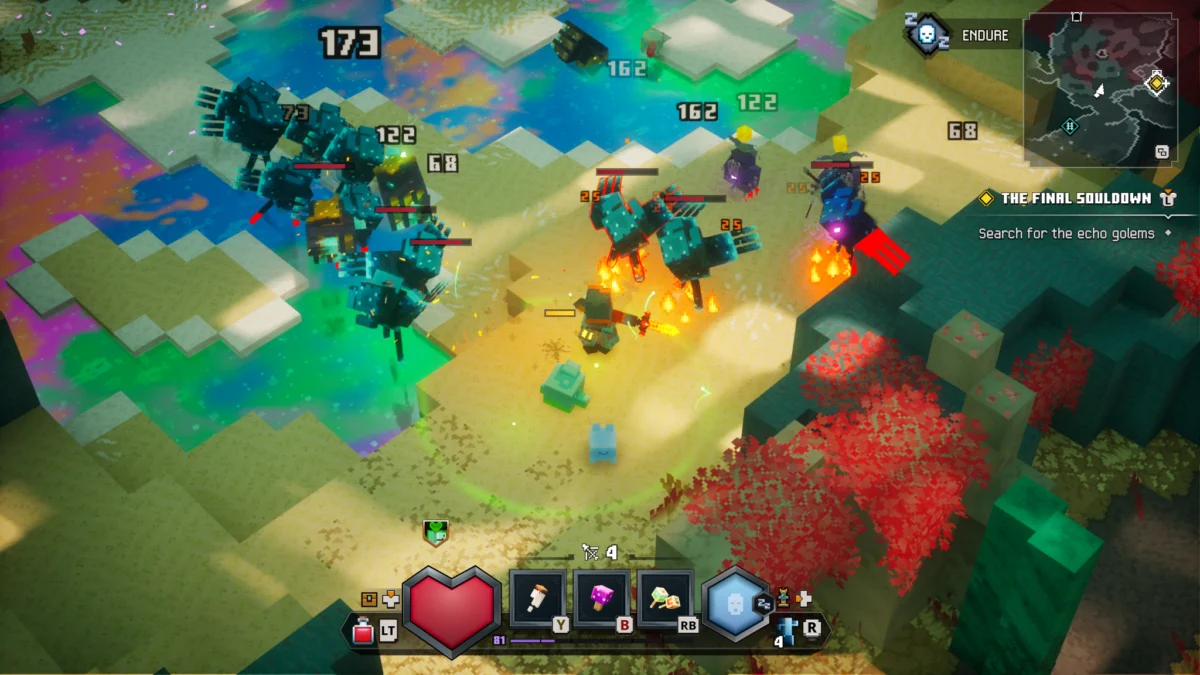
Minecraft Dungeons II has officially launched, marking a significant milestone for Mojang Studios and the broader Minecraft ecosystem as it seeks to transition from a "proof of concept" spin-off into a premier contender within the action-RPG genre. Released approximately six years after the original Minecraft Dungeons, this sequel represents a fundamental shift in design philosophy, moving away from the linear, restricted progression of its predecessor in favor of a more expansive, semi-open world structure. While the 2020 original was praised for its accessibility and faithful recreation of the Minecraft aesthetic, it faced criticism for its brevity and lack of mechanical depth. Minecraft Dungeons II addresses these concerns directly, offering a campaign that spans approximately 20 hours—quadrupling the length of the original base game—while introducing sophisticated character customization systems and a significantly heightened difficulty curve.

The Evolution of the Minecraft Dungeons Franchise
To understand the trajectory of Minecraft Dungeons II, it is essential to examine the chronology of the series. The original title launched in May 2020 during a period of rapid expansion for the Minecraft IP. Developed by Mojang Studios and Double Eleven, the first game was built on Unreal Engine 4 and served as an entry-level "Diablo-lite" experience. Over the subsequent three years, the developers supported the title with six major DLC expansions, including Jungle Awakens, Creeping Winter, and Echoing Void, which eventually brought the total content to a respectable level. However, the core architecture remained limited by its level-based mission select screen and a simplified equipment system.

Development on the sequel reportedly focused on "player agency" and "environmental cohesion." By 2024, rumors began to circulate regarding a project that would merge the survival-crafting DNA of the flagship Minecraft title with the isometric combat of the Dungeons spin-off. The result, Minecraft Dungeons II, maintains the iconic blocky aesthetic while utilizing updated rendering techniques to provide greater visual fidelity and improved readability during high-intensity combat encounters.

Structural Overhaul: From Linear Levels to a Semi-Open World
The most transformative change in Minecraft Dungeons II is the introduction of a hand-crafted Overworld. In the previous entry, players interacted with a static map to teleport between isolated missions. The sequel replaces this with a continuous landscape that connects various biomes, encouraging organic exploration. While the primary narrative follows a linear path, the world is populated with rifts, caves, and secret nooks that reward players for deviating from the objective markers.

A notable addition to the world-building is the introduction of "The Sift," a psychedelic, hyper-saturated realm that explores new visual territories for the franchise. This biome, alongside traditional forests, snowy tundras, and desert settlements, provides a diverse backdrop for the game’s expanded side-quest system. Data gathered during the initial launch period indicates that these side objectives are crucial for acquiring "Unique" grade weaponry, which offers specialized traits not found in standard loot drops.

However, the map’s current state suggests a long-term service model. Approximately two-thirds of the world map remains inaccessible or "blank" as of the Day One build. While this might initially appear as a lack of content, the developer’s roadmap indicates that these areas are reserved for planned post-launch expansions. Unlike the original game, where the 5-hour campaign felt incomplete, the 20-hour baseline of the sequel provides a more substantial initial package, even with these future territories cordoned off.

Mechanical Depth and Character Customization
Minecraft Dungeons II significantly increases the complexity of character builds, moving closer to the standards set by contemporary ARPGs like Diablo IV or Path of Exile, albeit while retaining a class-less system. In the original game, players were limited to a single armor slot, which dictated their passive bonuses and overall "class" identity. The sequel expands this to four armor slots, allowing for multi-faceted builds that combine various enchantments and stat boosts.

Key Gameplay Innovations:
- The Mobility System: Players now have access to a dedicated jump button, which is integrated into both platforming challenges and combat. This allows for a new "Area of Effect" (AoE) slam move, providing a vital tool for crowd control when dealing with large mobs.
- Talismans and Artifacts: The three-artifact limit returns, but it is now supplemented by upgradeable Talismans. These items provide significant, stackable buffs that can be tailored to specific playstyles, such as "Glass Cannon" ranged builds or high-durability melee tanks.
- The Mini-Inventory: A major quality-of-life improvement is the inclusion of a mini-inventory interface. This allows players in co-op sessions to swap gear or apply enchantments without pausing the game for the entire party, maintaining the flow of gameplay during multiplayer raids.
The gear progression system has also been refined. The town Blacksmith now allows players to upgrade their favorite equipment to their current power level for a reasonable resource cost. This reduces the need for "grinding" specific dungeons to find a higher-level version of a preferred weapon, allowing players to maintain a consistent build throughout the campaign.

Difficulty Scaling and Combat Analysis
Perhaps the most surprising aspect of Minecraft Dungeons II is its uncompromising difficulty. While the Minecraft brand is often associated with a younger demographic, the sequel doubles down on a "hardcore" experience. On standard difficulty, players are frequently met with "one-shot" kill mechanics from bosses and specialized elite enemies.

The combat encounters are designed around resource management and positioning. The single health potion, a staple of the series, has an unforgiving recharge rate, forcing players to rely on life-steal enchantments or defensive artifacts. This shift in difficulty suggests that Mojang is targeting the "mid-core" to "hardcore" gaming audience that grew up with the original Minecraft and is now seeking more rigorous challenges. In a co-op setting, this difficulty necessitates role delegation, where players must coordinate their builds—such as one player focusing on healing and buffs while others handle damage output.

Technical Performance and Connectivity
As a modern multi-platform release, Minecraft Dungeons II supports cross-play and features a robust "offline" mode. The inclusion of offline characters is a strategic move to safeguard the experience against server instability or poor internet connectivity. During the launch window, some technical friction was reported regarding online multiplayer sessions, including lag spikes and matchmaking errors.

For players utilizing "online" characters, the game’s performance is tethered to server health. Journalistic testing during the review period noted that high-latency environments could lead to frustrating deaths, particularly in the late-game Soul Storms where frame-perfect dodging is required. Conversely, the "couch co-op" experience remains a highlight of the title. The system allows guests to join without creating a dedicated account, with the option to clone the primary player’s level and gear to ensure immediate parity in power.

Broader Implications for the ARPG Market
The launch of Minecraft Dungeons II signifies a maturing of the Minecraft spin-off strategy. Following the mixed reception of Minecraft Legends, which attempted to blend action and real-time strategy, Dungeons II returns to a genre where the IP has already proven successful. By deepening the mechanics and expanding the world, Mojang is positioning the series not just as a branded spin-off, but as a viable alternative to the industry’s leading dungeon crawlers.

The "budget" price point relative to other AAA releases, combined with the substantial 20-hour campaign, offers a high value-to-cost ratio. However, the lack of a robust endgame at launch remains a point of contention. Currently, the post-game consists primarily of "Soul Storms"—hourly world events that increase enemy hostility—and replaying existing dungeons at higher difficulty tiers. This is a step back from the original game’s "Tower" mode, a rogue-lite feature that provided significant replayability. Industry analysts expect that a similar mode will be reintroduced through the game’s live-service roadmap.

Conclusion
Minecraft Dungeons II is a successful expansion of a formula that was previously criticized for being too simplistic. By introducing a semi-open world, quadrupling the campaign length, and increasing the complexity of character builds, Mojang has delivered a sequel that feels like a complete realization of the original concept. While technical hurdles and a currently thin endgame prevent it from achieving perfection, the core combat loop and world design are sufficiently engaging to secure its place as a top-tier action-RPG. As the map continues to fill with planned DLC, Minecraft Dungeons II is poised to remain a relevant and challenging fixture in the gaming landscape for years to come.