


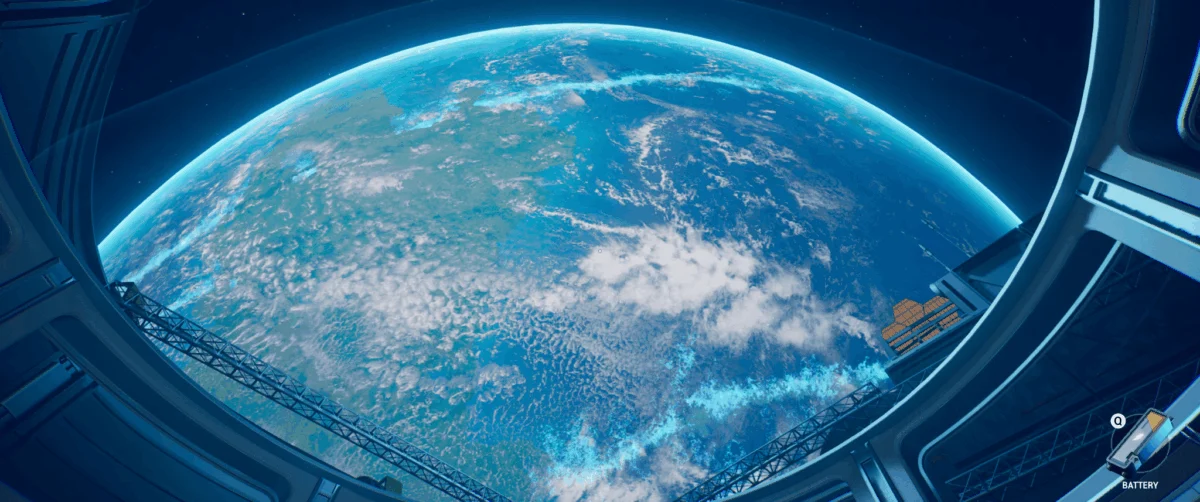
Rivage is a first-person science fiction puzzle adventure developed by Exnilo that challenges players to navigate a complex temporal loop while stranded on a derelict space station. Set in the mid-25th century, the title places users in the role of Miranda, a medical professional who finds herself the sole inhabitant of Ares Station, a research facility orbiting the exoplanet Vesta. The game utilizes a "Groundhog Day" style mechanic where time resets following specific triggers or the exhaustion of station resources, forcing a repetitive but iterative approach to problem-solving and narrative discovery.

Narrative Foundation and Setting
The events of Rivage are set on Sunday, May 1, 2467. The protagonist, Miranda, begins every cycle at precisely 9:32 AM. The premise establishes that Ares Station was originally staffed by a full complement of researchers and engineers tasked with evaluating Vesta, a vibrant blue exoplanet, for its potential to support human life. However, upon the commencement of the game, the crew is missing, and the station is in a state of critical power failure.
The environment of Ares Station is designed with a high degree of detail, intended to convey a "lived-in" atmosphere. Players explore various sectors, including personal quarters, laboratories, a galley, and a garage. Documentation found throughout the station suggests that the mission was part of a broader interstellar initiative to find viable habitats beyond Earth. The narrative mystery centers on two primary questions: the whereabouts of the missing crew and the nature of the temporal anomaly that has trapped Miranda in a singular, repeating day.

The Mechanics of Temporal Recurrence
The core gameplay loop of Rivage is defined by the K9 system, an augmented automated unit that assists the player. This system serves as the primary data-logging tool, functioning as a bridge between the various time loops. In a genre where repetition can often lead to player fatigue, the K9 system is designed to mitigate redundancy by automatically storing and applying discovered information.
When a player cracks a computer password, finds an audio log, or scans an ID card to gain security clearance, the K9 system retains this data. In subsequent loops, these actions are automated or the information is pre-filled, allowing the player to bypass previously solved obstacles and focus on new areas of the station. This mechanical progression suggests a design philosophy that values the player’s time while maintaining the narrative tension of the loop.

To supplement the K9 system, Exnilo integrated a built-in screenshot function. This allows players to take visual notes of emails, diagrams, and numerical codes. Given the density of information provided through the station’s terminals, this tool is essential for managing the sheer volume of data required to progress through the game’s later stages.
Resource Management and Environmental Constraints
Ares Station’s failing infrastructure introduces a resource management element to the puzzle-solving experience. The station operates on a finite number of power "units." Nearly every significant interaction—opening pressurized doors, activating terminals, or using specialized machinery—consumes a portion of this energy.

Once the power supply is exhausted, the station enters a blackout state, effectively ending the current loop and forcing a reset. This mechanic imposes a tactical layer on exploration, as players must plan their routes and prioritize which doors to open or which systems to investigate within a single cycle. This "energy economy" serves as a soft timer, preventing players from exploring the entire station in a single run and reinforcing the necessity of the temporal loop.
Furthermore, the station is plagued by localized anomalies. These phenomena manifest in various ways, often defying the known laws of physics. Reported anomalies include:

- Gravitational Distortions: Areas where objects, such as food items in the galley or heavy crates in the garage, float in fixed or orbiting patterns.
- Spatial Anomalies: Objects or regions that can facilitate teleportation or instantaneous movement across the station.
- Temporal Shifting: Specific items that exhibit time-manipulation properties, allowing players to interact with objects in different states of repair or position.
The reset mechanism itself is tied to an anomaly located within the storage room, manifested as an arcade machine. While the game provides internal lore regarding this machine through computer logs, the lack of an explicit tutorial regarding its function has been noted as a point of friction in the early player experience.
Puzzle Architecture and User Interface
The puzzles in Rivage are primarily logic-based and environmental. Progression is often gated by information retrieval rather than physical dexterity. Common puzzle types include:

- Terminal Interfacing: Many of the station’s computers require the use of a command-prompt style interface. Players must learn specific syntax and commands to navigate file directories and trigger station functions.
- Data Decryption: Players encounter ASCII codes and damaged data files that must be reconstructed or translated to reveal passwords and coordinates.
- Environmental Manipulation: This includes tasks such as plotting a flight path for a probe around the planet Vesta or mixing chemical components to manufacture essential hardware parts.
While the game supports controller input, the complexity of the command-line interfaces suggests a preference for mouse and keyboard setups. The precision required for certain data-entry tasks can be more cumbersome when using a traditional gamepad.
Chronology of In-Game Events
Based on logs recovered during the gameplay experience, a timeline of the Ares Station mission can be reconstructed:

- Early 2467: Ares Station arrives in orbit around Vesta. Preliminary scans indicate high habitability potential.
- April 2467: Crew members begin reporting "minor glitches" in station systems and localized gravitational oddities.
- April 28, 2467: Dr. Miranda and the medical team note increased psychological stress among the crew, attributed to the anomalies.
- May 1, 2467 (9:00 AM): Total system failure is initiated. The crew attempts an emergency evacuation or containment procedure.
- May 1, 2467 (9:32 AM): The temporal loop begins. Miranda wakes up for the first of what will be dozens, if not hundreds, of iterations.
Critical Analysis of Design and Onboarding
The implementation of the timeloop mechanic in Rivage presents a significant design challenge. While games like Outer Wilds or The Forgotten City have successfully utilized this structure to create a sense of discovery, Rivage has faced scrutiny regarding its onboarding process. The game utilizes a minimalist approach to instruction, relying on a brief sequence of concept art to establish the setting.
Critics have pointed out that the "eureka" moments—the instances of sudden realization that define the best puzzle games—are occasionally absent in Rivage. Some puzzles allow for "brute-forcing," where a player can guess a solution without fully understanding the underlying logic. For instance, the final chemical mixing puzzle can be solved through trial and error, which some players have found to be an anticlimactic conclusion to an otherwise rigorous experience.

The repetitive nature of the loops, while central to the theme, also risks alienating players if the path to new content is not clearly signaled. The necessity of backtracking to previous areas to retrieve a single overlooked code can lead to a sense of frustration, particularly when the power management system forces a reset mid-way through a task.
Broader Impact and Industry Context
Rivage arrives at a time when the "timeloop" subgenre of adventure games is seeing a resurgence. By focusing on a hard science-fiction aesthetic and a heavy emphasis on terminal-based interaction, Exnilo has attempted to carve out a niche for players who prefer methodical, atmospheric investigation over action-oriented gameplay.

The game’s success or failure likely hinges on the player’s tolerance for repetition and their willingness to engage with a narrative that is delivered almost entirely through environmental storytelling and text logs. The developer’s decision to leave certain mechanics unexplained reflects a broader trend in independent gaming toward "minimalist hand-holding," though in the case of Rivage, this has proven to be a polarizing choice.
In conclusion, Rivage offers a dense, atmospheric exploration of isolation and temporal instability. While its mechanical execution of the loop provides some innovative quality-of-life features like the K9 system, the game’s pacing and onboarding remains a hurdle for those not deeply invested in the specific demands of the genre. As a technical achievement, the detailed rendering of Ares Station and the complex interlocking puzzles demonstrate a high level of ambition from the Exnilo development team. However, the emotional and narrative payoff of the experience is subject to the player’s ability to navigate the inherent frustrations of a life lived thirty minutes at a time.