



The world of video games often presents titles that defy initial expectations, offering deep engagement through mechanics that, on paper, might seem mundane. Such is the case with Big Ambitions, a business simulation game that has unexpectedly captured the attention of players, including those who, like many, recall the golden era of tycoon games with nostalgia. Games such as Transport Tycoon, Rollercoaster Tycoon, and even the Sim series, which included titles like SimGolf and SimPark, defined a genre for a generation, fostering a love for strategic management and economic growth. While the genre has seen its share of successes, with titles like The Guild 2 offering complex simulations, a general saturation had led some players to drift away from the business sim landscape. Big Ambitions has emerged as a powerful resurgence, rekindling that passion through a surprisingly addictive gameplay loop.
The Paradox of Big Ambitions: Mundane Tasks, Compelling Gameplay
At its core, Big Ambitions presents a premise that could easily be perceived as tedious. Players are tasked with the fundamental elements of starting and running businesses: setting prices, meticulously managing employee schedules, sourcing products, and continuously optimizing operations to achieve maximum profitability. This strategic layer, while central to the genre, is further complicated by a series of seemingly trivial, yet crucial, personal management elements. Players must ensure their in-game avatar’s basic needs are met. This includes fueling and repairing their vehicle, a constant consideration for logistical operations. Beyond that, the character requires sustenance, hygiene, and even leisure activities such as watching television or playing video games to maintain happiness and efficiency.
This duality – the grand ambition of building a business empire juxtaposed with the micro-management of an avatar’s daily routine – is precisely where Big Ambitions carves its unique niche. The initial perception of these tasks might lean towards the incredibly dull. Imagine the spreadsheet-like precision required for supply chains: renting warehouses, hiring dedicated purchasing officers and logistics managers, and maintaining optimal import inventory levels. These are not glamorous activities, yet the game transforms them into compelling challenges.
The developers have crafted an experience that, despite its initial grind, becomes remarkably addictive. Anecdotal evidence from players suggests that what begins as a potentially boring chore can quickly escalate into dozens of hours of engrossing gameplay. The satisfaction derived from discovering a truly effective business model, one that can be replicated across different districts and scaled into a major franchise, is a powerful motivator. While the long-term endgame might eventually settle into a routine of maintaining automated systems and fulfilling avatar needs, the journey to that point is filled with constant discovery and rewarding progression.
Unpacking the Appeal: The Psychology of Success in Big Ambitions
The enduring question for many who encounter Big Ambitions is: why does it work so well? While the incremental nature of business growth is a well-established psychological hook in simulation games, Big Ambitions adds layers that amplify this appeal. One significant factor is the game’s approach to player guidance. It refrains from overly hand-holding its players, allowing them the agency to experiment, fail, and ultimately learn through their own experiences. This sense of self-discovery fosters a feeling of genuine accomplishment, making players feel like astute strategists when they finally crack a complex business puzzle.

The game continually provides players with tangible goals to pursue. Whether it’s expanding a burgeoning retail chain, establishing a series of successful burger joints, or aspiring to a lifestyle of luxury complete with high-end apartments and exotic vehicles, there is always a clear objective on the horizon. This constant pursuit of new milestones prevents stagnation and keeps players engaged with the progression loop.
Furthermore, Big Ambitions introduces a competitive element through an in-game leaderboard. As a player’s income increases, their position on this leaderboard steadily rises, offering a visible metric of success against other virtual entrepreneurs. This feature taps into the innate human desire for recognition and competition, providing an additional layer of motivation. The game also incorporates a dynamic competitive landscape where rival businesses actively attempt to disrupt operations. These "business attacks" can range from aggressive price wars aimed at undercutting competitors in local markets to strategic moves designed to tank demand and cripple rival stores. While these challenges can be stressful, the game is designed such that players who have built a sufficient financial buffer can weather these storms without significant repercussions. As players grow their empires, these rival tactics become increasingly negligible, reinforcing the feeling of mastery and resilience.
There is a notable desire among the player base for more direct offensive capabilities against rivals, a feature that could introduce an even more aggressive strategic dimension. While not explicitly confirmed to be absent, the game’s extensive tutorial and depth suggest that such mechanics might exist, awaiting discovery by dedicated players. The developers have noted that the game recently launched into its 1.0 version, indicating a commitment to ongoing development and potential future expansions of gameplay features.
Historical Context and Market Trends
The resurgence of interest in complex business simulation games like Big Ambitions can be seen as a reaction to several prevailing trends in the gaming industry. For years, the market has been dominated by fast-paced action titles, competitive multiplayer games, and narrative-driven experiences. While these genres continue to thrive, there has been a discernible shift towards more contemplative and strategic gameplay. Players are increasingly seeking experiences that offer depth, long-term engagement, and a sense of tangible progression that can be measured over time.
The "tycoon" genre, in particular, has a rich history dating back to the early days of personal computing. Titles like Elite (1984), which featured trading and fleet management in a space setting, and Railroad Tycoon (1990), which simulated the expansion of railway networks, laid the groundwork for more complex simulations. Transport Tycoon (1994) and Rollercoaster Tycoon (1999) became cultural touchstones, popularizing the genre for a broader audience. These games offered players the fantasy of building and managing vast enterprises, appealing to a desire for control and strategic foresight.
Big Ambitions can be seen as a modern interpretation of these classic games, updated with contemporary graphics, more intricate simulation mechanics, and a deeper level of personal avatar integration. The success of titles like Stardew Valley, which blends farming simulation with RPG elements, and Factorio, a complex factory-building game, demonstrates a growing player appetite for games that require meticulous planning, resource management, and a satisfying loop of problem-solving and optimization.
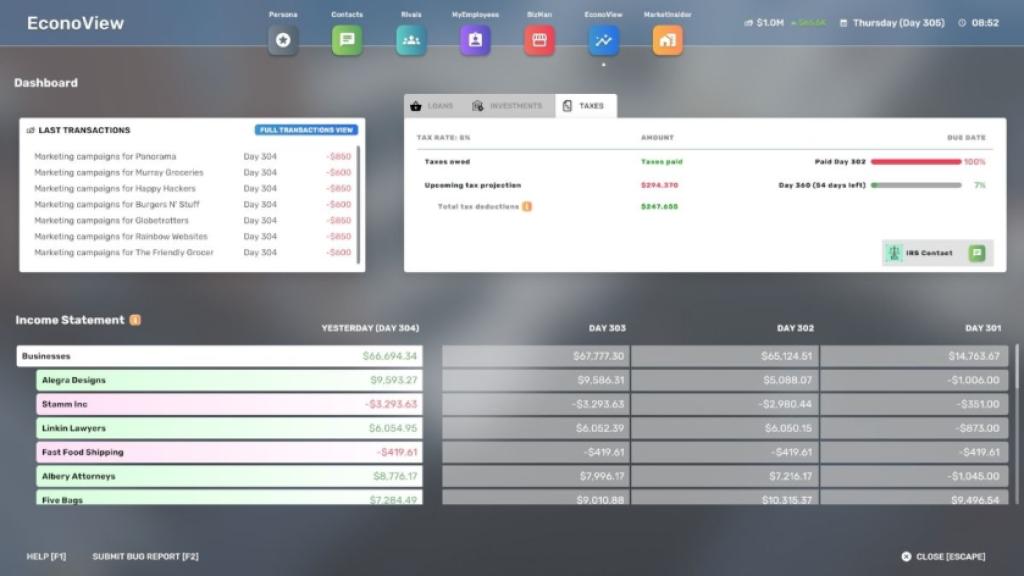
The recent launch of Big Ambitions into its 1.0 version signifies a significant milestone, moving from early access to a full release. This transition often brings a surge of new players eager to experience the complete vision of the developers. The game’s developers, ImmanitasEntertainment, have been actively engaged with their community, soliciting feedback and implementing updates that have shaped the game into its current form. The continued support and potential for future content updates are crucial for maintaining player engagement in the long run, especially for a genre that thrives on ongoing evolution and expansion.
Broader Impact and Player Reception
The impact of Big Ambitions extends beyond its immediate player base. It serves as a testament to the enduring appeal of deep simulation games and the potential for innovative gameplay mechanics to revitalize established genres. The game’s ability to transform seemingly mundane tasks into compelling challenges is a masterclass in game design, demonstrating that engaging gameplay can arise from unexpected sources.
Player reception has been overwhelmingly positive, with many expressing surprise at how engrossing the game has become. Forums and social media platforms are abuzz with discussions of optimal business strategies, personal avatar management tips, and shared experiences of overcoming rival business attacks. This active community engagement is a vital component of the game’s success, fostering a sense of shared experience and collective discovery.
The game’s success also highlights the potential for indie developers to create impactful experiences that can rival larger, AAA productions. By focusing on deep simulation mechanics and a unique gameplay loop, Big Ambitions has carved out a significant niche for itself in a competitive market. The fact that the game only recently launched into its 1.0 state and has already garnered such widespread attention suggests a promising future for both the game and its developers. As the game continues to evolve, it is likely to attract even more players seeking a deeply rewarding and strategically rich business simulation experience. The potential for further expansions and content updates from ImmanitasEntertainment promises to keep the "ambitions" of its players high and their engagement with the game unwavering for the foreseeable future.