


The landscape of personal computing and gaming is undergoing a significant transformation, spearheaded by companies like Valve, which has consistently pushed the boundaries of traditional hardware. Its latest endeavor, the Steam Frame, represents a bold leap into the converging worlds of virtual reality (VR) and portable PC gaming. Priced from $1,059, this standalone VR headset aims to be a hybrid gaming console, leveraging Valve’s established SteamOS ecosystem and offering a unique blend of immersive VR experiences and traditional 2D gaming on a virtual screen. After three weeks of intensive testing, the Steam Frame emerges as an ambitious, albeit experimental, device that showcases Valve’s long-term vision for a unified gaming platform.

A Groundbreaking Standalone Half-Life Alyx Experience
The most striking demonstration of the Steam Frame’s potential lies in its ability to run Half-Life Alyx as a standalone experience. Previously a benchmark title exclusively for high-end PC VR setups, Alyx on the Frame offers a glimpse into a future where complex VR narratives are untethered from powerful desktop rigs. Players can once again don gravity gloves and navigate the dystopian landscapes of City 17, engaging in intense firefights with barnacles and alien grunts, all without the need for a connected PC or external room sensors. While the performance in this prerelease beta build exhibited some compromises—such as lower framerates for character animations and noticeably scaled-down graphics compared to its PC counterpart—the sheer fact of playing Half-Life Alyx natively on a self-contained unit is a monumental achievement. This specific implementation of foveated rendering, which dynamically reduces resolution in peripheral vision based on eye-tracking, likely plays a crucial role in optimizing performance for the Snapdragon 8 Gen 3 chip. This initial success with Alyx serves as a powerful testament to what the Steam Frame could become if Valve continues to optimize its software and expand its library of truly standalone VR titles.

Valve’s Hybrid Vision: More Than Just a VR Headset
The Steam Frame is not merely another VR headset entering an increasingly crowded market; it embodies Valve’s evolving philosophy of blending different computing paradigms. Running on an ARM-based chip and SteamOS, the device attempts to merge the portability of the Steam Deck with the immersive capabilities of a VR headset. This ambitious approach positions the Frame as a "hybrid, melty, invisible, and modular" platform, drawing parallels to Apple’s Vision Pro in its aspiration to unify handheld, desktop, and immersive technologies.
Since its inception, Valve has demonstrated a willingness to experiment with hardware. The Steam Machines, launched years ago, sought to bring PC gaming to living rooms, while the Steam Controller aimed to redefine input. More recently, the Steam Deck revolutionized handheld PC gaming. The Steam Frame follows this lineage, attempting to extend the Steam ecosystem into the wearable display space. Its internal architecture, featuring a Snapdragon 8 Gen 3 processor, aligns it more with modern smartphones than dedicated VR chipsets like Qualcomm’s XR series, suggesting a flexible design choice that allows for diverse applications beyond pure VR.
Design, Ergonomics, and the Glasses Conundrum

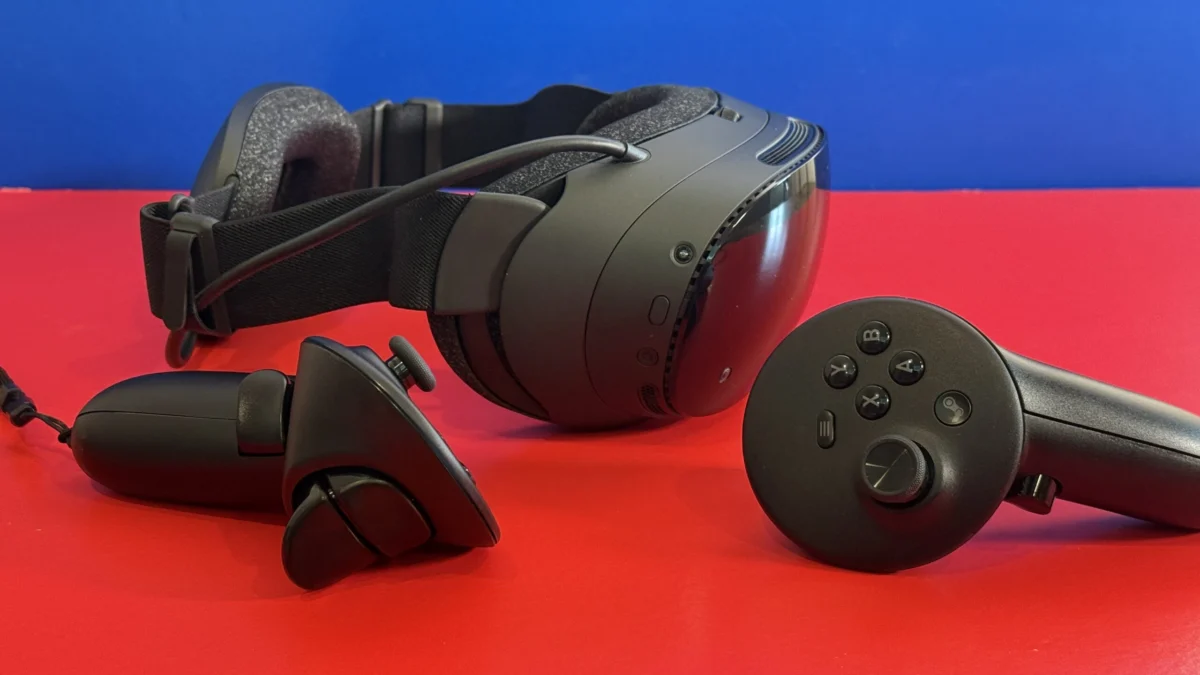
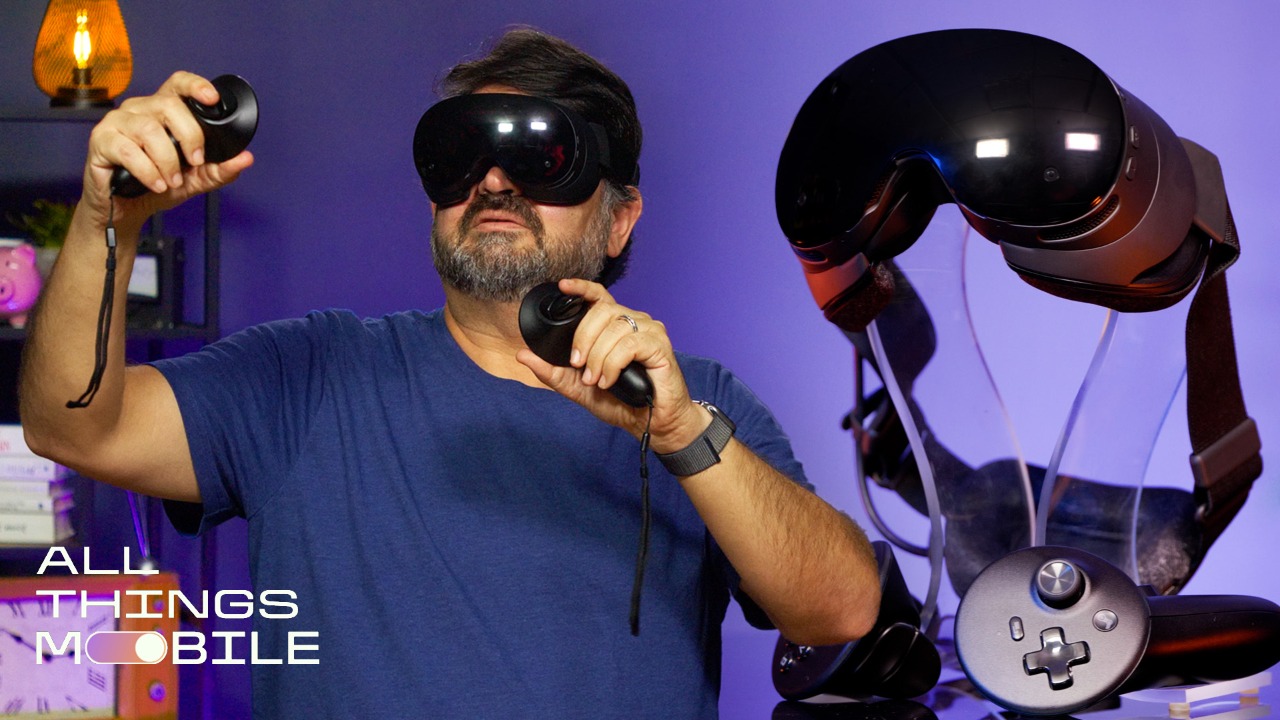
Aesthetically, the Steam Frame adopts a somewhat generic, black, and reasonably sleek appearance, distinguishing it from the more iconic cubic Steam Machine. Its design incorporates a rear headstrap battery pack, connected by a small cable, which contributes to a balanced weight distribution. The controllers, while familiar in form with dual analog sticks, triggers, and hand straps, feature a crucial d-pad on one and a four-button layout on the other. This thoughtful button arrangement allows for seamless compatibility with traditional Steam games without requiring external controllers, a significant advantage for its hybrid functionality.
Comfort, however, presents an initial hurdle, particularly for glasses wearers. Out of the box, the Frame struggles to accommodate thicker spectacles, leading to a tight, uncomfortable fit and potential lens fogging, despite an included glasses spacer. This contrasts with devices like the Meta Quest, which offers better out-of-the-box glasses compatibility. The situation significantly improves with prescription lens inserts, such as those provided by Zenni. However, Zenni’s stated maximum prescription range of -6 for Frame inserts raises concerns for individuals with higher prescriptions, like the reviewer’s -8, highlighting a potential accessibility issue that Valve and its partners will need to address. The omission of a carrying case also feels like an oversight for a device that is meant to be portable and whose delicate lenses should be protected from sunlight.

Pricing and Market Context: A Premium Proposition
The Steam Frame enters the market with a starting price of $1,059 for the 256GB model, with a 1TB version available for $1,299. While certainly a premium, this pricing strategy aligns with Valve’s recent hardware releases, such as the $1,050-and-up Steam Machine. In the rapidly evolving XR market, where devices like the Samsung Galaxy XR retail for $1,899 and Apple’s Vision Pro for $3,699, the Frame’s cost, while high, is not entirely out of step. It also compares favorably to Valve’s own 2019 Index VR headset ($999), which required a PC connection and external sensors, making the Frame’s standalone capability a notable upgrade for a similar price point.

However, the effective cost can increase substantially with essential accessories. Prescription lens inserts (e.g., $68 from Zenni), an optional $59 ergonomic kit (including a top headstrap, nosepiece light blocker, and velcro grip loops), and the $149 Arcturus Vision snap-in color camera module add an additional $276 to the total. This means a fully kitted-out 1TB Steam Frame could approach $1,575, a significant investment for consumers.
As a Standalone VR Headset: Crisp Visuals, Feature Gaps

Visually, the Steam Frame delivers a crisp and clear experience thanks to its dual LCD displays, each offering a resolution of 2,160×2,160 pixels per eye—comparable to the Meta Quest 3. The pancake lenses contribute to exceptional clarity across the field of view, and an adjustable interpupillary distance (IPD) dial ensures optical comfort.
Beyond the display, the Frame incorporates eye-tracking technology, a feature often reserved for higher-end VR/AR devices. However, Valve’s implementation primarily focuses on "foveated rendering" and "foveated streaming," dynamically optimizing resolution where the user’s central vision is not focused. This conserves processing power for standalone use and bandwidth for PC streaming, making a noticeable difference in optimized titles like Half-Life Alyx and Dungeons of Eternity.

A notable omission, especially when compared to rivals like Meta, Apple, and Samsung, is the lack of hand tracking. Users are currently reliant on the physical controllers for interaction. While Valve has indicated that hand tracking is a planned future addition, its absence at launch limits intuitive interaction. Similarly, the integrated passthrough cameras, initially low-resolution black and white, are a throwback to older VR generations. The $149 Arcturus Vision camera module addresses this by providing full-color passthrough and 5K 60fps video recording, making it a highly recommended, albeit extra, purchase for mixed-reality applications.
Valve also emphasizes PC VR streaming, offering a custom 6Ghz wireless USB dongle for low-latency connections, though standard Wi-Fi streaming is also supported. This hybrid approach caters to both standalone users and those who wish to leverage their existing PC gaming libraries.

As a Portable Steam Console: Potential and Limitations
One of the Steam Frame’s most intriguing aspects is its ability to function as a portable gaming console, projecting 2D Steam games onto a large, adjustable virtual screen within the headset. This feature allows users to play their Steam library on a massive display, reminiscent of the Apple Vision Pro’s virtual monitor capabilities. The custom controllers, with their Steam-ready d-pad and button layouts, facilitate this by offering a "controller mode" and a "navigational laser-like pointer" activated by a grip trigger. This dual-mode interaction, while sometimes requiring a "juggling act," is a clever solution for navigating both game menus and virtual environments.

However, the Frame’s ARM-based processor, while capable, presents compatibility challenges. While around 130 "Great on Frame" optimized 2D and VR titles are available at launch, many demanding Steam Deck games, such as Elden Ring, Ratchet and Clank, and No Man’s Sky, struggle or fail to run. Lighter titles like Brotato, Dave the Diver, Dredge, Portal 2, Sektori, Baby Steps, Crazy Taxi, and Stray perform well, showcasing its potential for casual and less graphically intensive gaming. Valve’s history with the Steam Deck and Steam Machine suggests that game compatibility will improve over time through software updates and developer optimizations.
Battery life is another significant limitation. The Steam Frame offers a maximum of two hours on a charge, often depleting in as little as an hour during more intensive use. This necessitates frequent charging or tethered play, undermining its portability. Valve is reportedly developing a pro-level headstrap with hot-swappable batteries, which could alleviate this issue.

The Modular and Open-Source Foundation: A Framework for Evolution
Valve’s "Frame" moniker is deliberate, signifying a "framework" for future hardware and software evolution. The device is designed with modularity in mind; the headset and rear battery pack can be detached, allowing for alternative power solutions or future upgrades. An expansion port on the bottom of the headset, currently used by the Arcturus Vision camera module, hints at a broader ecosystem of snap-in accessories.

This modular philosophy extends to the software. Running on SteamOS, a Linux-based operating system, the Frame is inherently open to customization and modding. Jeremy Selan, a software developer on the Steam Frame team, stated, "We want this to be your PC, and people mod it, take it apart, make accessories for it. We’ll be putting out the CAD for all these [Steam Frame] systems. This is entirely based on open-source technology stacks based upon SteamOS." He further emphasized, "Our hope is that this isn’t just one device, that this would be sort of the root of a growing SteamOS ecosystem… This is going to lay the foundation for a new sort of evolutionary tree of that, to also bring it into the VR and XR space."
This commitment to open-source development and hardware specifications could foster a vibrant community of modders and accessory developers, much like the PC hardware scene. The "Lepton" conversion tool, which facilitates running PC VR and even Android APK files, further positions the Frame as a potential "Rosetta Stone for VR gaming," broadening its content library beyond native Steam Frame titles.

Broader Implications and Future Outlook
The Steam Frame is less about defining the immediate future of XR and more about establishing a flexible framework for its evolution. The device’s current form factor, while more compact than some competitors, still falls into the traditional VR headset category. However, the modular design and Valve’s stated intentions suggest a trajectory towards slimmer, glasses-like displays that could tether to powerful external compute units, much like upcoming devices such as the Xreal Aura or Meta’s rumored next-gen visors. The question of why not simply tether a future Steam Deck 2 to advanced AR glasses for a similar immersive experience lingers, and it’s a path Valve might explore.

For now, the Steam Frame is an experimental journey. It represents Valve’s continued commitment to hardware innovation and its belief in a unified Steam ecosystem across various form factors. While its current limitations—particularly in battery life, initial game compatibility, and comfort for glasses wearers—make it a niche product for early adopters and enthusiasts, its potential is undeniable. Valve’s track record with continuous updates for the Steam Deck and Steam Machine suggests that the Frame will likely evolve significantly post-launch. However, given potential supply limitations similar to previous Valve hardware releases, many consumers may have to wait to experience this ambitious hybrid device. The Steam Frame is a foundation, not a finished skyscraper, and its true impact will be measured in how Valve and the community build upon this innovative framework in the years to come.