


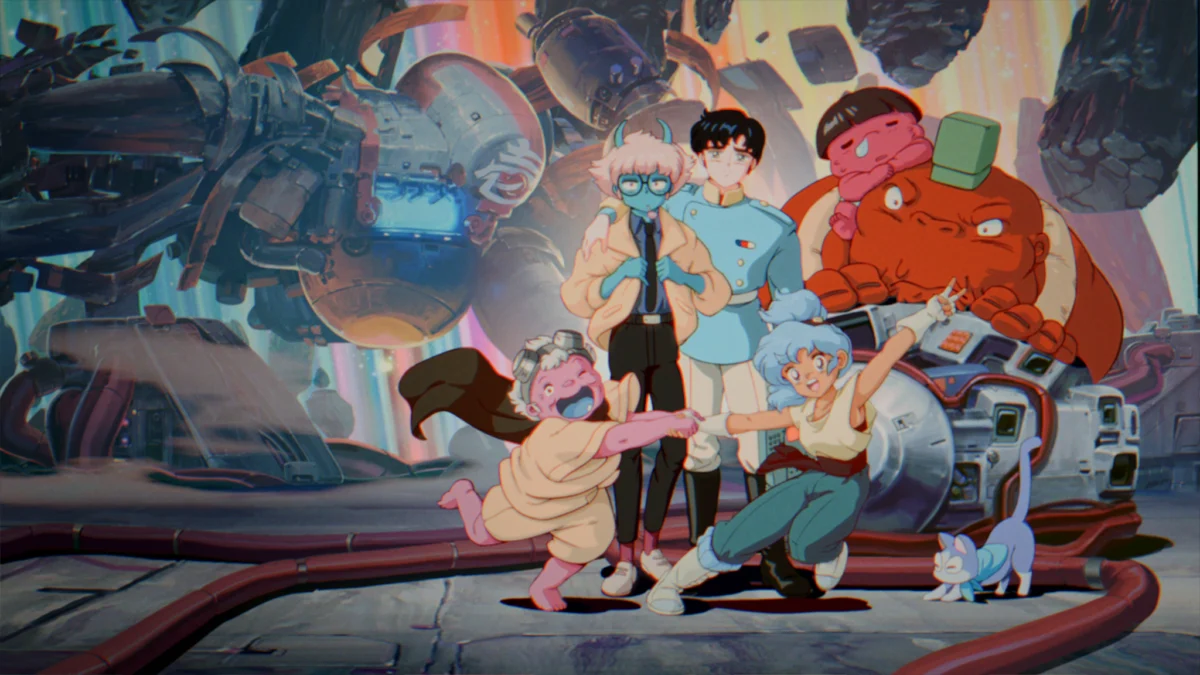
Orbitals, the latest title from developer Shapefarm in collaboration with the animation specialists at Studio Massket, arrives as a dedicated two-player co-operative adventure that attempts to bridge the gap between interactive media and the nostalgic aesthetic of 1980s Saturday-morning cartoons. Released on the Nintendo Switch 2, the game represents a growing trend in the "buddy-adventure" genre, popularized by titles such as Hazelight’s It Takes Two and the more recent Split Fiction. While the experience is defined by a striking visual identity and a narrative centered on survival within a crumbling space station, the title navigates a turbulent path between technical limitations and creative ambition. Over a campaign lasting approximately six to seven hours, Orbitals transitions from a mechanically sluggish introduction into a high-stakes, imaginative spectacle that rewards player persistence.

Narrative Framework and Character Dynamics
The story of Orbitals follows two teenagers, Maki and Omura, who reside within a settlement built into the remains of a dilapidated space station. The settlement faces an existential threat from an encroaching supernatural cosmic storm, a phenomenon that expands daily and forces the protagonists to venture into the surrounding reaches of space to secure vital resources. The characterization relies on a classic dynamic of opposites: Maki is portrayed as earnest, optimistic, and driven, while Omura serves as the cautious, reserved counterbalance.

This interpersonal dynamic is not merely a narrative device but is woven into the co-operative requirements of the gameplay. While the overarching plot follows a relatively predictable trajectory—including a clearly defined antagonist—the strength of the writing lies in the incidental dialogue and the growth of the bond between the two leads. The campaign structure is linear, focusing on a series of missions that alternate between exploration, resource gathering, and combat against massive mechanical entities.

Aesthetic Engineering and the Studio Massket Collaboration
The most immediate and enduring quality of Orbitals is its presentation. Shapefarm has opted for a deliberate "retro-anime" art style that draws heavily from the visual language of the 1980s and early 90s. This is achieved through a specific technical implementation: while the game’s overall performance is capped at 30 frames per second (FPS), the character animations are intentionally rendered at 24FPS. This creates a "limited animation" look synonymous with classic hand-drawn series, a technique recently observed in Compulsion Games’ South of Midnight. Unlike other titles that allow players to toggle this effect, Orbitals mandates it as a core component of its visual identity.

The partnership with Studio Massket is evident in the seamless transition between traditional cinematic cutscenes and in-engine gameplay. The color palette utilizes the high-contrast, slightly muted tones of vintage celluloid, and even the UI elements, such as subtitles and menus, are designed to mirror the typography of localized anime dubs from the VHS era. This commitment to theme extends to the soundtrack, which features a "pulpy" electronic score and a catchy, era-appropriate theme song that establishes the game’s atmosphere from the main menu.

Mechanical Systems: The "Tools Not Rules" Philosophy
Unlike many contemporary co-op titles that introduce and discard mechanics with every new level, Orbitals provides players with a consistent toolkit that must be applied creatively to various scenarios. At the outset, players have access to three primary tools, with a fourth unlocked during the second act:

- The Claw: A kinetic device used for pushing and pulling environmental objects.
- The Water Gun: Used for cooling heated surfaces or interacting with biological elements.
- The Energy Beam: A precision tool for activating remote switches or powering machinery.
- The Microwave: A fly-by-wire energy pulse that allows players to take temporary control of specific mechanical objects.
The game allows players to decide which character carries which tool, adding a layer of strategic negotiation to the experience. This "tools-based" approach results in puzzles that require synchronized efforts. For instance, one player may need to use the Water Gun to create a temporary path over lava while the other uses the Claw to move obstacles out of the way. Later sections introduce more complex interactions, such as using the Water Gun to trigger explosive seed pods to clear mechanical blockages.

Exploration and Combat: A Dual-Flavored Experience
The gameplay is divided into two distinct modes: ground-based platforming and ship piloting. The platforming occurs primarily in 3D environments, though the developers frequently shift the perspective to 2D to pay homage to classic side-scrollers. Movement on foot has been described as somewhat deliberate and, at times, sluggish. This is partly attributed to the 30FPS cap and the priority given to animation frames over instantaneous input response, which can lead to a learning curve for players accustomed to high-refresh-rate action titles.

Ship piloting introduces a different set of challenges. One player assumes the role of the pilot, navigating the vessel through debris-filled corridors, while the second player operates the gunnery station. Curiously, the flight model is largely restricted to a single horizontal plane rather than full 3D space flight, a design choice that initially feels restrictive but allows for more focused, arcade-style combat encounters. These sections evolve significantly throughout the game, culminating in a late-game sequence that incorporates perspective shifts reminiscent of the NieR series, blending bullet-hell elements with high-speed navigation.

Technical Performance and Connectivity Analysis
Despite the high production values in the art department, Orbitals faced several technical hurdles during its launch window. Reviewers and early adopters have noted significant issues with input latency during the opening hours. While some of this is an intentional byproduct of the 24FPS animation style, the initial lack of responsiveness proved a barrier to entry for some. Interestingly, this sensation of "unresponsiveness" appeared to diminish as players acclimated to the game’s rhythm, or as the game moved into more optimized later levels.

Connectivity remains a primary concern for the online co-operative experience. Even on high-speed fiber connections, frequent disconnections have been reported. These interruptions are particularly disruptive due to the game’s checkpoint system; a disconnection during a lengthy cutscene or immediately prior to a boss fight often forces both players to restart the entire sequence. Furthermore, the game’s "Friends Pass" system—intended to allow one player to invite a friend who does not own the full game—utilizes a clunky system-level invite process rather than an integrated in-game lobby. This lack of a streamlined "jump-in" feature, combined with communication errors, adds friction to the multiplayer experience.

The Mid-Game Pivot: From B-Tier to Spectacle
One of the most notable aspects of Orbitals is the dramatic increase in quality after the first two hours. The introductory missions suffer from poor player signposting and a reliance on trial-and-error puzzle design that can frustrate the duo. However, the first major boss fight serves as a turning point. This encounter requires precise communication and the simultaneous use of ship-based and tool-based mechanics, marking a shift toward more confident and imaginative game design.

The latter two-thirds of the campaign introduce level designs that better complement the world-building. Puzzles become more creative, often separating the two players and forcing them to navigate independent paths that eventually converge. This separation allows Maki and Omura to have individual "standout" moments, reinforcing the theme of mutual reliance. By the final act, the developers at Shapefarm demonstrate a mastery of scale and spectacle that rivals the industry leaders in the genre.

Broader Impact and Genre Standing
Orbitals enters a market where high-quality, dedicated co-op experiences are in high demand but remain relatively rare. By leaning so heavily into a specific aesthetic niche, Shapefarm has created a product that stands out visually even if it does not technically surpass the mechanical polish of It Takes Two. The game serves as a testament to the viability of "AA" development—titles that may lack the massive budget of a first-party blockbuster but compensate through distinct artistic direction and focused gameplay loops.

The inclusion of unlockable versus mini-games provides some post-campaign longevity, allowing players to compete in the same environments they previously navigated as partners. These mini-games highlight the versatility of the engine and the tools provided to the player.

Conclusion: A Rewarding Journey for Patient Players
In summary, Orbitals is a game of significant contrasts. It is a title where the first impression is one of visual wonder followed by mechanical skepticism. The sluggish movement and technical "teething problems" regarding connectivity are legitimate flaws that prevent it from achieving a perfect score. However, for those who can move past the initial friction, the game reveals itself to be a deeply charming and inventive adventure.

The collaboration between Shapefarm and Studio Massket has resulted in what is arguably the most authentic playable anime movie to date, surpassing the visual fidelity of previous genre entries. While it may not dethrone the current giants of the co-operative genre, Orbitals carves out its own territory through sheer personality and a strong finish. It is a journey that validates the "takes two" philosophy, proving that even in the cold reaches of space, a bit of teamwork and a lot of style can go a long way.

Orbitals is currently available on the Nintendo Switch 2. Review code was provided by the publisher for the purpose of this analysis.