


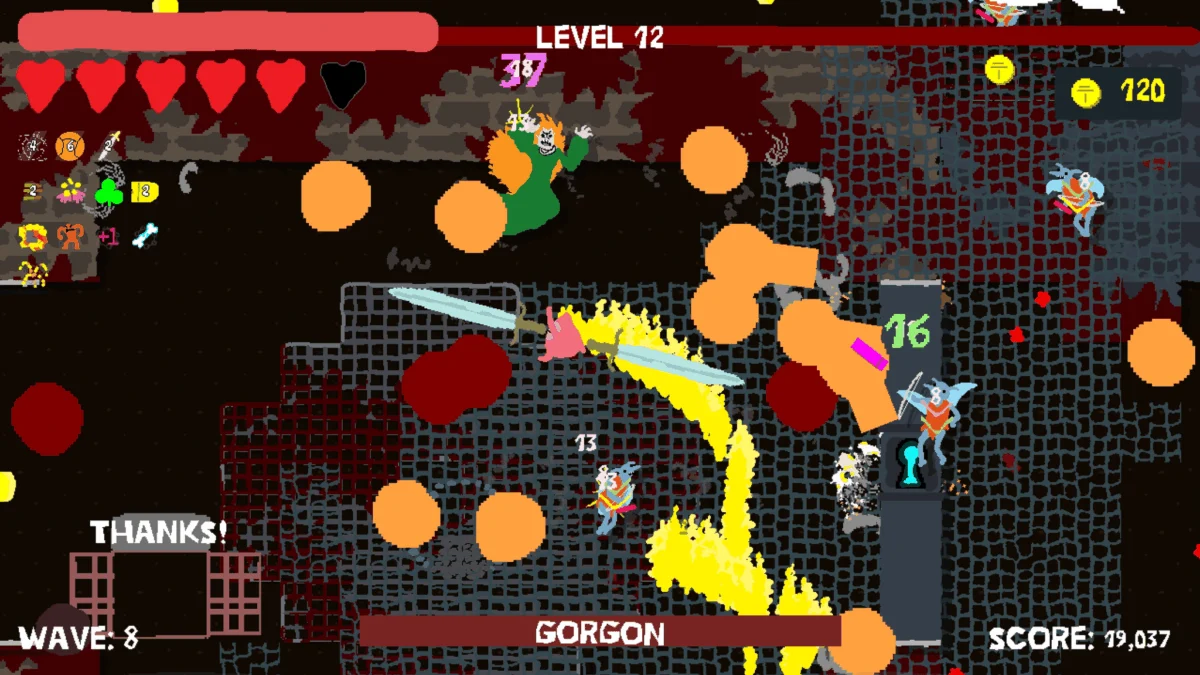
Blood Dungeon represents a significant departure for developer Messhof, the creative force behind the critically acclaimed Nidhogg series, as the studio ventures into the burgeoning "bullet-heaven" subgenre with a distinctive platforming twist. Released in late 2026, the title seeks to bridge the gap between the precision-based movement of traditional side-scrollers and the chaotic, high-density combat popularized by titles like Vampire Survivors. By incorporating verticality and complex environmental navigation into a genre typically defined by top-down, open-field movement, Messhof has introduced a mechanical tension that challenges established conventions of the rogue-lite market. The game tasks players with navigating treacherous subterranean environments, battling overwhelming hordes of enemies, and managing a sophisticated upgrade economy centered on the collection of blood and bones.

Technical Overview and Core Gameplay Loop
The fundamental architecture of Blood Dungeon is built upon a high-intensity combat loop that rewards both reflexive movement and long-term strategic planning. Unlike traditional bullet-heaven titles where the player character often moves on a flat 2D plane, Blood Dungeon requires constant engagement with the environment through jumping, climbing, and wall-sliding. This integration of platforming elements adds a layer of difficulty; players must not only track hundreds of incoming projectiles and enemy entities but also account for gravity and platform placement.
The primary resource within each run is blood, which serves as the experience point (XP) equivalent. As enemies are defeated, they drop blood droplets that fill a meter at the top of the user interface. Each time the meter is filled, the player is presented with a choice of three randomized upgrades, ranging from offensive weaponry to passive charms and magical spells. The synergy between these upgrades is the cornerstone of a successful run. Early-game weapons often feel underpowered, requiring the player to rely heavily on the game’s tight platforming controls to survive. However, as the run progresses, the offensive capabilities scale exponentially. High-level builds can result in the screen being filled with exploding projectiles, such as "exploding basketballs," piercing laser waves, and volleys of bullets that trigger additional projectiles upon every kill.

Chronology of Progression and the Meta-Economy
Blood Dungeon utilizes a two-tier progression system designed to encourage repeated play sessions. The immediate tier is the "in-run" leveling system fueled by blood, while the secondary tier is the permanent meta-progression handled through the "Bone Shop."
During the initial three to four hours of gameplay, the progression curve is notably steep. Industry analysts have described this introductory period as "glacial," as players begin with limited movement options and a single weapon slot. The difficulty during this phase is high, and the frequency of failed runs is significant. Success in these early stages yields "bones," a persistent currency that remains with the player after death.

The Bone Shop serves as the central hub for permanent character enhancement. Strategic investment of bones allows players to unlock critical upgrades that fundamentally alter the game’s difficulty balance. These include:
- Weapon Slot Expansion: Increasing the capacity from a single weapon to three or four simultaneous slots.
- Vitality Increases: Adding extra heart containers to the player’s health pool.
- Movement Enhancements: Increasing jump height and dash distance to improve survivability in dense combat scenarios.
- Resource Gain Buffs: Improving the drop rate of blood and bones to accelerate future progression.
As players invest in these permanent upgrades, the "power ramp-up"—a hallmark of the bullet-heaven genre—becomes more accessible, shifting the gameplay from a desperate survival struggle to a dominant display of firepower.

Level Design and Environmental Variety
Messhof has implemented a variety of level archetypes in Blood Dungeon, each offering unique geometric challenges that force players to adapt their movement strategies. Upon defeating the three primary bosses of a level, players unlock new environments and character variants. Notable level designs include:
- The Pit: A vertical loop that allows for infinite falling or climbing. This level emphasizes aerial control and rewards weapons with vertical reach or downward-firing capabilities.
- The Corridor: A horizontal equivalent to The Pit, focusing on forward momentum and crowd control as enemies swarm from both sides of the screen.
- The Tombs: A destructible environment where weapon fire can break through blocks to reveal hidden paths, currency, and tactical shortcuts. This level introduces a degree of environmental interaction rarely seen in the genre.
Each level concludes with a series of boss encounters. Defeating these entities not only progresses the player through the game’s content but also awards a "Crown" for that specific level, signifying mastery and unlocking higher-tier character variants.

Character Diversity and Movement Mechanics
The roster of playable characters in Blood Dungeon is diverse, with each offering a unique starting weapon and a distinct movement profile. These differences are not merely cosmetic; they dictate the player’s tactical approach to the game’s platforming challenges.
For instance, the character "Leggy," a four-legged arachnid-inspired entity, has become a favorite among the community due to its starting weapon: a spider-web launcher. These webs persist in the environment, allowing Leggy to climb surfaces that are otherwise inaccessible to other characters. In contrast, the character "Fly" offers a flight mechanic that provides unparalleled horizontal and vertical freedom but is balanced by a lack of traditional jump height. Other characters, such as "Baby," feature more restrictive movement sets, offering a higher difficulty ceiling for veteran players seeking a challenge.

The interplay between character-specific movement and randomized weapon drops ensures that no two runs are identical. A character with poor vertical mobility might struggle initially but become unstoppable if they roll a high-tier projectile build that clears the screen before platforming becomes a necessity.
Artistic Direction and Technical Presentation
The aesthetic of Blood Dungeon is intentionally provocative, utilizing a "crude" visual style that mimics early digital illustration software, specifically MS Paint. This lo-fi approach is augmented by heavy CRT filters and scanline effects, intended to evoke a sense of nostalgic, retro-computing aesthetics. While the visual style has been described as "charming" by some, others find the intensity of the filters distracting. Messhof has included the option to toggle these post-processing effects, allowing for a cleaner visual presentation.

The auditory experience is similarly polarizing. The soundtrack features a frantic, high-tempo drum-and-bass score that mirrors the chaotic energy of the gameplay. While the music effectively heightens the tension during dense combat encounters, it lacks the melodic hooks found in more traditional arcade soundtracks. This "Marmite" effect—where players either embrace the intensity or find it overwhelming—extends to the overall sound design, which prioritizes feedback and impact over musicality.
Market Context and Broader Implications
The release of Blood Dungeon comes at a time when the "Survivor-like" genre is facing significant saturation. Since the explosion of the genre in 2021, developers have struggled to innovate beyond the core mechanic of "auto-firing while moving." By reintroducing the manual complexity of 2D platforming, Messhof is attempting to evolve the genre into something more technically demanding.

Initial data suggests that while the game’s slow early-game progression may deter casual players, its depth and mechanical tightness are resonating with the core "rogue-lite" audience. The integration of permanent meta-progression ensures a high retention rate, as players are incentivized to grind for the "Bone Shop" upgrades that eventually unlock the game’s full potential.
Industry analysts suggest that Blood Dungeon could signal a shift in the genre toward "hybridization," where the bullet-heaven framework is used as a foundation for other classic genres, such as Metroidvanias or puzzle-platformers. Messhof’s reputation for tight, responsive controls—perfected in the Nidhogg series—is evident here, providing a solid foundation for what is otherwise a chaotic and visually dense experience.

Conclusion
Blood Dungeon is a bold experiment in genre-blending that rewards patience and persistence. While its initial hours may feel restrictive and the visual/auditory style may be divisive, the eventual payoff is a sophisticated and rewarding combat experience. By successfully marrying the precision of platforming with the overwhelming scale of bullet-heaven combat, Messhof has created a title that stands out in a crowded market. The game’s reliance on a deep meta-economy and diverse character roster provides significant replay value, ensuring that Blood Dungeon will remain a topic of discussion within the indie development community for the foreseeable future. As players continue to unlock the game’s secrets and master its vertical challenges, the title’s influence on the evolution of the rogue-lite genre is likely to grow.