


The highly anticipated medieval city-builder, Manor Lords, has captivated players with its blend of strategic depth, historical realism, and intricate simulation mechanics. As players delve into the challenges of forging a thriving settlement from the wilderness, one recurring and often perplexing element emerges: the stubborn persistence of abandoned supplies. Piles of raw timber, stacks of planks, stone, or other essential goods frequently remain scattered across the landscape after a structure is demolished, or following the initial collection phase, presenting a significant logistical hurdle for even the most meticulous of lords. This phenomenon is not merely an aesthetic concern; these exposed items are vulnerable to environmental decay and, critically, can impede the construction of new buildings, leading to delays and inefficiencies in a burgeoning medieval economy. The paradox often deepens when players observe idle villagers and readily available storehouses or granaries nearby, yet the discarded resources continue to sit uncollected, a silent testament to a hidden complexity within the game’s AI and prioritization systems.
The Puzzling Persistence of Leftover Resources: A Core Gameplay Challenge
Upon establishing their first settlement, players quickly become familiar with the foundational loop of resource gathering, production, and construction. However, as their manors expand and evolve, necessitating the demolition of old structures or the re-zoning of land, the problem of uncollected goods becomes more pronounced. A single log left abandoned on a prime building site can halt progress, forcing players into a frustrating waiting game. This visual clutter and functional obstruction become a significant point of friction for players who strive for order and efficiency in their virtual domains.
The game’s design incorporates a realistic decay system, where resources left exposed to the elements for too long will degrade and eventually be lost. Timber, for instance, can rot, and other raw materials might suffer similar fates, representing a tangible loss of valuable production efforts. Beyond decay, the most immediate and impactful consequence is the physical obstruction of construction. A new building cannot be erected on a tile occupied by abandoned resources, forcing players to either redesign their plans or find a way to clear the area. This challenge is compounded by the fact that the game’s sophisticated villager AI, while generally efficient in managing core tasks, sometimes struggles to prioritize the collection of these seemingly "orphaned" resources.
Different types of resources fall under different logistical categories. General goods, encompassing processed materials like planks, roof tiles, and iron, along with food items and hides, are typically stored in Storehouses and Granaries, respectively. Raw timber, on the other hand, is exclusively handled by Logging Camps. This distinction is crucial, as the strategies for clearing each type of resource vary based on the assigned infrastructure and villager roles. The early access nature of Manor Lords means that such intricate systems are still undergoing refinement, and what appears to be a bug might often be an emergent property of complex interdependencies or a deliberate design choice emphasizing player agency and micro-management.
Chronology of a Player’s Encounter with Resource Gridlock
A player’s journey through Manor Lords often presents this logistical challenge in a chronological fashion, escalating in complexity as their settlement grows.
- Early Game Simplicity: In the initial stages, with a small population and limited construction, resource piles are few and far between. Any scattered logs or stone are typically cleared relatively quickly as villagers have fewer competing tasks and shorter distances to travel to the nascent storage facilities. The problem, if it arises, is easily overlooked or resolved without conscious effort.
- Mid-Game Expansion and Emerging Issues: As the player’s village grows into a town, and construction projects become more ambitious, the frequency of demolitions and the volume of resource generation increase dramatically. This is when the issue of abandoned supplies truly manifests. Players might start noticing individual logs blocking a crucial plot or a small pile of stone delaying a vital upgrade. The "Exposed Goods" warning, an icon appearing on the information bar at the top of the screen, becomes a more frequent and unwelcome sight, signaling that valuable resources are at risk of decay and are not being efficiently managed.
- The Search for Solutions: Initially, players might assume that simply assigning more villagers to a Storehouse or Granary would resolve the issue. They might observe idle villagers nearby and wonder why these basic tasks are not being prioritized. This often leads to a period of experimentation, frustration, and eventually, a deeper dive into the game’s mechanics to uncover more direct and effective solutions. The realization dawns that a passive approach is often insufficient, and specific micro-management techniques are required to maintain order and efficiency.
Unlocking Efficiency: Practical Strategies for Expedited Resource Relocation
While the default villager AI may not always prioritize the collection of scattered goods with the urgency players desire, Manor Lords provides several tools for lords to actively manage their logistics. The key lies in understanding and leveraging these specific mechanics to direct villager efforts effectively.
1. Optimizing Storage Assignments and Infrastructure:
The foundation of efficient resource flow in Manor Lords rests on well-staffed storage facilities and a robust road network.
- Increase Worker Allocation: One of the most straightforward methods to expedite the movement of exposed goods is to increase the number of villagers assigned to the relevant storage building. For general goods (planks, stone, processed food), this means assigning more workers to the Storehouse or Granary. With more hands available, the priority for collecting and storing these items often rises, as there are dedicated workers whose primary task is to manage inventory. This can significantly reduce the "wait time" for scattered resources to be collected.
- The Crucial Role of Roads: Manor Lords emphasizes the importance of infrastructure. A well-maintained road network connecting resource piles to storage buildings is paramount. Villagers traverse roads much faster than open terrain, reducing travel time and increasing the throughput of goods. In cases where isolated resource piles are causing significant problems, players might consider building temporary dirt roads to the location. While this incurs a small timber cost, the acceleration of resource collection and subsequent construction can easily justify the expense. This strategic use of roads not only improves the movement of abandoned goods but also enhances the overall efficiency of the entire supply chain, from production sites to markets.
- Strategic Storage Placement: While not a direct solution for existing abandoned piles, proactive placement of storage facilities can mitigate future issues. Locating Storehouses and Granaries centrally within production hubs or near frequently demolished areas can minimize travel distances for villagers, making the automatic collection of goods more efficient in the long run.
2. The "Limit Work Area" Mechanic – A Precision Tool:
Perhaps the most potent and often underutilized tool for addressing persistent resource piles is the "Limit Work Area" function. This mechanic allows players to precisely define where specific groups of workers should focus their efforts, effectively overriding the broader AI prioritization for a targeted period.
- How it Works: To utilize this feature, players must first select the appropriate storage building (Storehouse, Granary, or Logging Camp). Within the building’s interface, there will be an option labeled "Limit Work Area" or similar. Clicking this enables the player to draw a polygonal zone on the map. Any workers assigned to that building will then primarily focus on tasks within the defined area, ignoring similar tasks outside of it until the designated work is complete.
- Application for General Goods: If a pile of planks, stone, or other general goods is stubbornly remaining uncollected, select a nearby Storehouse (or Granary for food items). Activate "Limit Work Area" and draw a box encompassing the problematic pile. The workers assigned to that Storehouse will then prioritize moving those specific items into storage. This is particularly effective for clearing a single, obstructive pile from a critical construction site.
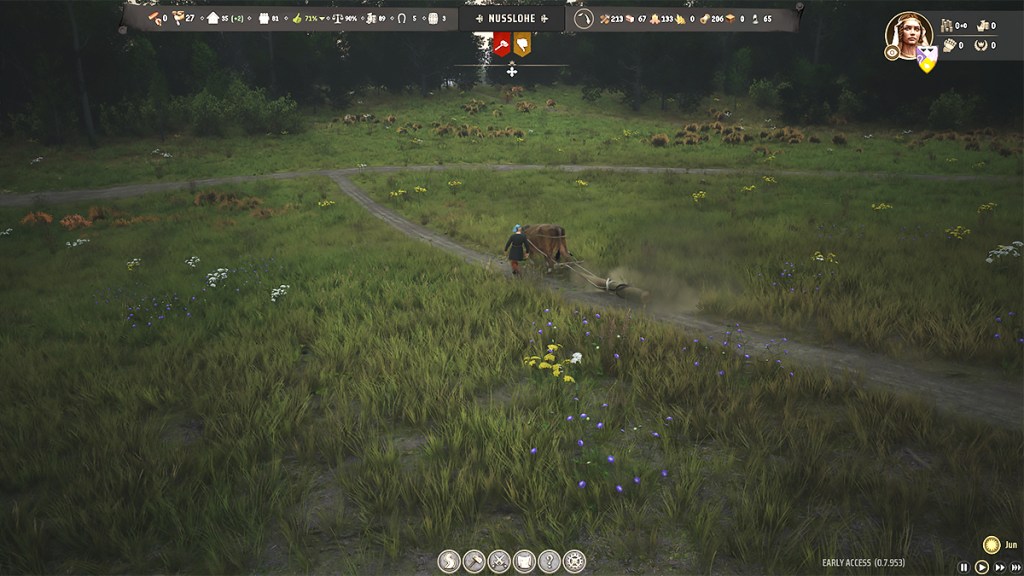
- Application for Logs and Timber: For abandoned logs, the process is similar but involves a Logging Camp. Select an existing Logging Camp, activate "Limit Work Area," and draw a zone around the scattered timber. The loggers, often with the aid of an ox, will then focus on collecting and transporting those logs back to the Logging Camp’s storage.
- The "Forced Focus" Benefit: This mechanic is powerful because it allows players to force villagers to address immediate, high-priority issues, such as clearing a construction site, rather than waiting for the general AI to get around to it. It transforms a passive waiting game into an active management task.
- Post-Cleanup Action: A critical step after using "Limit Work Area" is to remember to "clear work area" once the task is complete. Failing to do so will keep the workers confined to that specific zone, potentially hindering other necessary tasks across the settlement. Once cleared, they will revert to their broader operational parameters.
3. Dynamic Management of Logging Camps for Timber:
Logs often present a unique challenge due to their size and the requirement of oxen for efficient transport. If a Logging Camp’s oxen are all busy with ongoing tree-felling operations, abandoned logs might languish.
- The Oxen Factor: Unlike smaller goods, logs typically require an ox to be moved efficiently. If all oxen assigned to Logging Camps are actively engaged in felling trees or transporting newly cut timber from designated forests, they may not be available to pick up scattered, "old" logs.
- Temporary De-assignment: A clever trick to free up oxen and redirect villager labor is to temporarily unassign workers from an existing Logging Camp. This action immediately frees any oxen associated with that camp and causes the now-idle villagers to prioritize any unassigned log-moving tasks. This can be a quicker alternative to setting a work area if multiple small piles of logs are scattered. Once the logs are cleared, the workers can be reassigned.
- Strategic New Logging Camp Placement: For very large or isolated piles of logs, especially those far from existing Logging Camps, building a new, temporary Logging Camp directly adjacent to the abandoned timber can be highly effective. Assign one worker and ensure an ox is available. Use the "Limit Work Area" function on this new camp to focus its efforts solely on clearing the nearby logs. Once the area is clean, the temporary Logging Camp can be demolished, recouping some of its initial timber cost. This micro-management technique ensures rapid clearance of even the most stubborn timber obstructions.
Background Context: Manor Lords’ Simulation Philosophy and Early Access Status
The existence of these logistical challenges, while sometimes frustrating, aligns with the broader design philosophy of Manor Lords and its development status. Slavic Magic, the sole developer, has consistently expressed a commitment to creating a realistic, organic medieval town simulation. This vision often entails complex AI behaviors and intricate interdependencies between various game systems. Villagers are not merely automata responding instantly to player commands; they have their own routines, priorities, and paths, mimicking the somewhat chaotic yet ultimately functional nature of a medieval community.

The game’s early access phase, launched in April 2024, provides crucial context. During early access, developers gather extensive player feedback, identify emergent gameplay issues, and continuously refine core mechanics. Aspects like villager pathfinding, task prioritization algorithms, and resource management quirks are common areas of adjustment in games at this stage. What players perceive as a "bug" (e.g., villagers ignoring supplies) might be an intended, albeit perhaps unoptimized, aspect of the simulation that will be iterated upon based on community input and telemetry data. The developer’s responsiveness to player concerns through patches and updates is a hallmark of successful early access titles, suggesting that while players currently need to employ specific strategies, future versions might see more streamlined or automated solutions.
Broader Impact and Strategic Implications for Town Planning
Mastering the art of resource logistics in Manor Lords extends beyond merely clearing a construction site; it has profound implications for the overall health, efficiency, and aesthetic appeal of a player’s settlement.
- Efficiency and Economic Impact: Uncollected and decaying resources represent a direct economic loss. Every plank or stone lost to the elements is a resource that had to be gathered, potentially processed, and transported, all of which consumed valuable villager labor and time. Delays in construction due to blocked sites translate directly into slower growth, delayed production chains, and a reduced capacity to generate regional wealth (influence) or royal taxes. A lord who can efficiently manage their resources will undoubtedly build a more robust and prosperous domain.
- Aesthetic and Immersion: For many players, the visual aspect of Manor Lords is a significant draw. A tidy, well-organized town enhances immersion and reinforces the satisfaction of building a flourishing medieval community. Persistent piles of debris detract from this aesthetic, creating a sense of disarray that can break the immersion for meticulous players. Effective resource management contributes to a visually appealing and historically believable settlement.
- Decision-Making and Player Skill: The need for active micro-management in these situations elevates Manor Lords beyond a simple city-builder. It challenges players to understand the underlying mechanics, to anticipate potential bottlenecks, and to strategically deploy their limited labor force. This deepens the gameplay, transforming what might initially seem like a frustration into an opportunity for players to hone their strategic decision-making skills and adapt to the dynamic needs of their growing manor.
- Future Development Potential: As Manor Lords progresses through early access, it is plausible that developers will introduce further refinements to the villager AI and resource management systems. Potential future updates might include more intelligent idle villager behavior, dedicated "cleanup" tasks that can be assigned, or more nuanced prioritization settings within storage buildings. Such enhancements would likely streamline the process, allowing players to focus on broader strategic planning while retaining the core challenge of logistics.
In conclusion, while the sight of abandoned supplies in Manor Lords can initially be a source of bewilderment and frustration, it represents an integral part of the game’s intricate simulation. Understanding the underlying mechanics, from villager AI prioritization to the crucial role of infrastructure and specialized tools like "Limit Work Area," empowers players to transform a potential bottleneck into a manageable aspect of their burgeoning medieval economy. By strategically assigning workers, optimizing road networks, and employing targeted micro-management techniques, players can ensure their settlements remain efficient, aesthetically pleasing, and poised for sustained growth, ultimately reinforcing the deep and rewarding experience that Manor Lords offers. The ongoing journey through early access promises further refinements, but for now, the path to a thriving manor lies in the hands of a lord capable of mastering the art of logistical precision.