


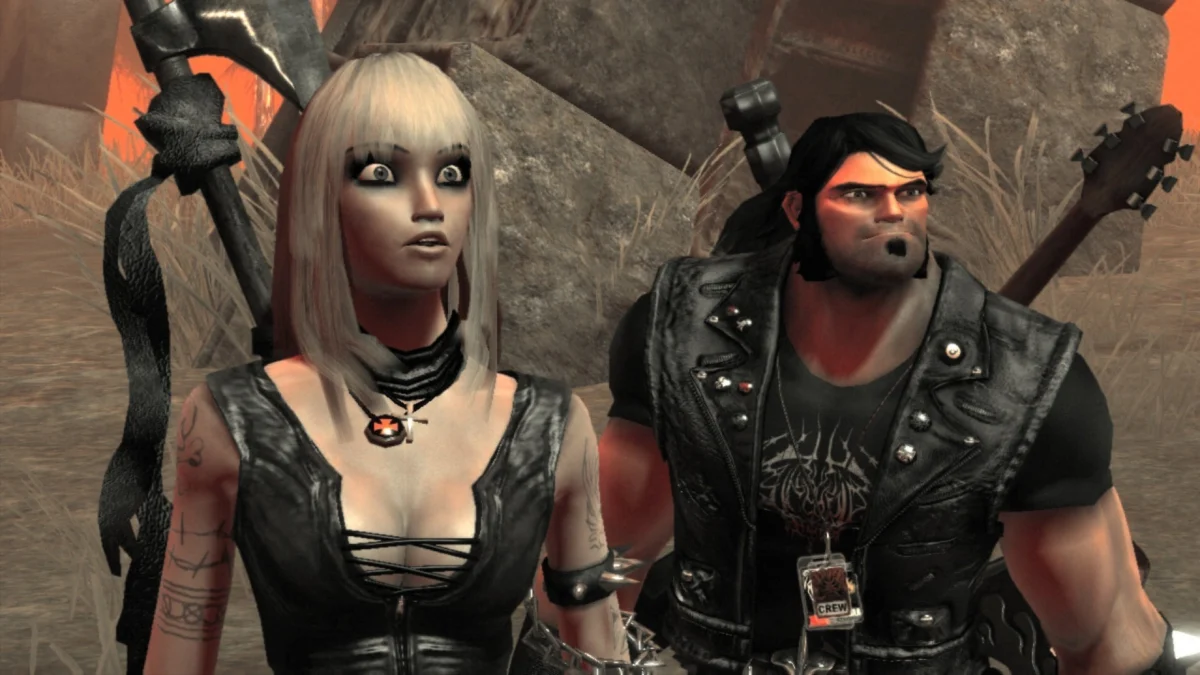
In a move that has simultaneously captivated and perplexed the video game industry, veteran developer Double Fine Productions, recently re-established as an independent studio after a period under Xbox Game Studios, has unveiled an extraordinary stretch goal for its latest crowdfunding initiative: a staggering $100 million USD to fund a sequel to its cult-classic heavy metal action-adventure, Brütal Legend. The announcement, made in September 2026, comes as part of their "Amnesia Fortnight 2026" Kickstarter campaign, a well-established tradition for the studio designed to foster rapid prototyping and community involvement in game design.
The "Amnesia Fortnight 2026" Campaign: A Return to Roots
Double Fine’s "Amnesia Fortnight" concept is not new; it dates back over a decade as an internal game jam designed to quickly prototype new game ideas. The 2026 iteration, however, marks a significant moment as the studio’s first major independent crowdfunding effort since parting ways with Microsoft. The Kickstarter project, titled "AMNESIA FORTNIGHT 2026: INDIE REBOOT," invites backers to vote on various game concepts pitched by Double Fine developers, with the most popular ideas progressing to a two-week prototyping phase. This process, which offers a transparent look into early game development, has historically been a cornerstone of Double Fine’s engagement with its fanbase.
The current campaign has demonstrated immediate success, rapidly approaching its initial funding goal of £296,238 (approximately $375,000 USD at current exchange rates) with over a month remaining. This swift achievement underscores the enduring loyalty of Double Fine’s community and their eagerness to support the studio in its newly independent chapter. The initial funding target is earmarked for covering the costs associated with running the game jam, including developer time, resources, and the production of documentary content chronicling the process.
The $100 Million Gauntlet: Brütal Legend 2’s Audacious Ask
While the primary goal for "Amnesia Fortnight 2026" is modest and easily achievable, it is the "Stretch Goals" section that has truly ignited industry discussion and fan debate. Among a series of more conventional targets, one particular entry stands out: "Brütal Legend 2 – $100,000,000 USD." This figure, dwarfing the initial campaign goal by several orders of magnitude, immediately prompted speculation that it might be a tongue-in-cheek jest from a studio known for its playful approach.
However, Double Fine quickly dispelled notions of it being purely a joke, with official statements confirming their genuine desire to pursue the project if such an unprecedented sum could be raised. "We would absolutely love to make Brütal Legend 2 if it were possible," a representative stated, reinforcing the ambition behind the seemingly impossible target. This clarification, while confirming the studio’s sincerity, has done little to quell the industry’s surprise and the public’s skepticism regarding the feasibility of such an endeavor through crowdfunding.
A Legacy Forged in Metal: The Original Brütal Legend’s Journey
To understand the fervor surrounding a potential Brütal Legend 2, it is essential to revisit the original game. Released in October 2009, Brütal Legend was a unique blend of action-adventure and real-time strategy elements, steeped in heavy metal iconography and lore. Directed by industry veteran Tim Schafer, the game starred actor Jack Black as the roadie Eddie Riggs, who is transported to a fantasy world inspired by heavy metal album covers. The game featured an all-star voice cast including Ozzy Osbourne, Lemmy Kilmister, and Lita Ford, and boasted a legendary soundtrack comprising over 100 heavy metal tracks.
Despite its critical acclaim for its innovative gameplay, unique aesthetic, and humorous writing, Brütal Legend faced a tumultuous launch. Its release was preceded by a legal battle with Activision over the game’s title, which complicated marketing efforts. While ultimately successful in court, the distraction undoubtedly impacted its commercial performance. Sales were respectable but not blockbuster, falling short of establishing it as a major franchise. Critics praised its originality and charm, but some found its genre-blending mechanics to be occasionally unwieldy. Over the years, however, Brütal Legend cultivated a dedicated cult following, with fans consistently expressing a desire for a sequel. Its legacy is one of creative ambition, unique artistic vision, and a testament to Double Fine’s distinct design philosophy.
Double Fine’s Journey: From Independence to Xbox and Back
Double Fine Productions was founded in 2000 by Tim Schafer after his departure from LucasArts. Known for developing critically acclaimed, narrative-driven games with distinct art styles and quirky humor, the studio built a reputation for titles like Psychonauts, Costume Quest, and Broken Age. In 2012, Double Fine famously turned to Kickstarter for Broken Age, becoming one of the earliest high-profile successes on the platform, signaling a new era for independent game funding.
In June 2019, at E3, Microsoft announced its acquisition of Double Fine Productions, integrating it into Xbox Game Studios. This move was part of a broader strategy by Xbox to bolster its first-party development capabilities and expand its Game Pass offerings. During its tenure under Microsoft, Double Fine released Psychonauts 2 in 2021, a highly anticipated sequel that was largely funded prior to the acquisition, with Microsoft providing the final push to completion. Psychonauts 2 was a critical darling, praised for its innovative level design, heartfelt story, and imaginative world-building, and was released to wide acclaim on Xbox, PC, and PlayStation platforms.
The recent departure of Double Fine from Xbox Game Studios, announced over the past couple of months in 2026, marks a significant shift for the studio. While specific details of the separation remain largely private, it signals Double Fine’s renewed commitment to an independent development path. This transition positions them once again as a standalone entity, free from the corporate structures and potential strategic mandates that can accompany ownership by a large platform holder. The "Amnesia Fortnight 2026" Kickstarter, therefore, serves as a symbolic re-declaration of this independence, inviting the community to directly participate in shaping the studio’s future.
The Xbox Question: Unpacking Community Concerns
The announcement of a $100 million stretch goal for Brütal Legend 2 has inevitably led to a chorus of questions from the gaming community, primarily centered around why such a project was not greenlit during Double Fine’s period under Xbox ownership. Many fans voiced frustration, questioning the rationale behind setting an astronomically high crowdfunding goal for a sequel to a beloved title, while the studio was previously backed by one of the largest technology companies in the world.
Industry observers suggest several potential reasons for this perceived disconnect. Firstly, creative freedom, while often touted, can still be subject to commercial realities and strategic priorities within a large publisher like Xbox. Microsoft’s investment in its first-party studios typically aligns with its broader ecosystem goals, such as expanding the Game Pass library with titles that have broad appeal or demonstrate strong commercial viability. While Brütal Legend has a devoted fanbase, its niche appeal and mixed commercial performance might not have aligned with Xbox’s portfolio strategy for high-budget projects.
Secondly, music licensing for a game heavily reliant on an extensive catalog of real-world heavy metal tracks presents a significant financial and logistical challenge. Securing rights for a sequel, especially for a game intended for global distribution across various platforms, would entail substantial costs and complex negotiations, potentially escalating the overall budget to a level Xbox might have deemed too risky for a Brütal Legend sequel. Publishers are often hesitant to take on projects with inherent, large-scale third-party licensing costs that can complicate long-term revenue streams and intellectual property management.
Finally, internal studio priorities and resource allocation play a role. During its time with Xbox, Double Fine was primarily focused on delivering Psychonauts 2, a project that consumed significant development resources and attention. Following its release, other concepts or new intellectual properties might have been prioritized for future development within the Xbox framework, or the studio might have simply opted for independence to pursue projects with full creative control, even if it meant taking on the immense challenge of self-funding. While the definitive reasons remain undisclosed, the questions highlight the complex interplay between creative ambition, commercial viability, and corporate strategy in the modern game industry.
The Economics of AAA Game Development: What $100 Million Buys
To contextualize the $100 million target, it’s crucial to understand the financial realities of developing a modern "AAA" video game. In the current landscape, the average budget for a major title from a large studio can range anywhere from $50 million to well over $200 million, encompassing development costs, marketing, and distribution. Games like Cyberpunk 2077 reportedly cost over $174 million in development alone, while Grand Theft Auto V had an estimated combined development and marketing budget of $265 million.
A $100 million budget for Brütal Legend 2 would position it firmly within the realm of high-end AAA production. Such a sum would cover:
- Team Salaries: Employing a large team of designers, programmers, artists, animators, sound engineers, and quality assurance testers for several years.
- Technology & Tools: Licensing game engines, middleware, and specialized software.
- Asset Creation: Developing high-fidelity 3D models, textures, environments, and animations.
- Voice Acting & Music: Securing top-tier talent and, crucially for Brütal Legend, extensive music licensing for a robust heavy metal soundtrack. This alone could consume tens of millions of dollars.
- Motion Capture: For realistic character movements and cutscenes.
- Marketing & PR: A substantial portion of the budget would be allocated to advertising, promotions, and community management to ensure a wide release.
- Quality Assurance & Localization: Extensive testing and translation for multiple languages.
- Platform Fees & Distribution: Costs associated with digital storefronts and, if applicable, physical production.
Given the scope and ambition typically associated with Double Fine’s projects, and the specific requirements of a Brütal Legend sequel (especially the music), a $100 million budget, while immense, is not entirely out of line for a high-quality, large-scale production aiming for a broad audience. The challenge lies solely in the method of funding.
Crowdfunding’s High Stakes: Precedent and Pitfalls
The history of crowdfunding in video games, particularly on platforms like Kickstarter, offers both inspiring successes and cautionary tales. Double Fine itself was a pioneer with Broken Age in 2012, raising over $3.3 million, significantly exceeding its $400,000 goal. Other notable examples include Pillars of Eternity ($3.9 million), Divinity: Original Sin II ($2 million), and Bloodstained: Ritual of the Night ($5.5 million). These campaigns demonstrated the power of passionate communities to directly fund niche projects that might struggle to find traditional publisher backing.
However, the scale of $100 million is unprecedented for a single video game Kickstarter. Even the most successful gaming campaigns, like Shenmue 3, which garnered over $6.3 million on Kickstarter (though its overall budget was much larger with additional Sony funding), pale in comparison. The most significant crowdfunding success in gaming, Star Citizen, has raised over $600 million to date, but this has been an ongoing, multi-year campaign across various platforms, continually selling digital assets and ship packages, rather than a single, upfront Kickstarter pledge drive for a specific game.
The pitfalls of such an ambitious crowdfunding goal are numerous. The sheer difficulty of reaching $100 million within a typical Kickstarter timeframe is immense. Even if partially successful, failing to meet the full target could lead to questions about the project’s viability, potentially impacting investor confidence or future crowdfunding efforts. There’s also the risk of donor fatigue, as the industry has seen a cooling off of the initial crowdfunding frenzy. Furthermore, managing such a large budget and delivering on promises to thousands, or even millions, of backers presents enormous logistical and development challenges. The transparency required for a crowdfunded project of this scale would be intense, demanding constant communication and progress updates to maintain trust.
Implications for Double Fine and the Industry
The $100 million Brütal Legend 2 stretch goal carries significant implications for Double Fine and, by extension, the broader video game industry. For Double Fine, it is a bold statement of intent, showcasing the studio’s unbridled ambition now that it is unshackled from corporate oversight. It signals their willingness to dream big, even if the path to realizing those dreams is exceptionally steep. While some might view it as a publicity stunt or an unrealistic fantasy, it undeniably generates massive discussion and keeps Brütal Legend in the public consciousness, potentially driving interest in the original game and Double Fine’s other independent projects.
Strategically, even if the $100 million goal is not met, the campaign serves as a powerful market research tool. The level of engagement and the amount raised, even if a fraction of the target, would provide Double Fine with valuable data on the actual demand for a Brütal Legend sequel. This data could then be leveraged in discussions with potential investors, private equity firms, or even other publishers who might be willing to co-fund a project with demonstrated community interest. It redefines the concept of "proof of concept" in a direct, quantifiable manner.
For the industry, this event pushes the boundaries of what is considered possible through crowdfunding. It forces a re-evaluation of the role of direct community funding for large-scale projects. While unlikely to establish a new norm for AAA funding overnight, it sparks conversations about alternative financing models, the limits of fan enthusiasm, and the perceived value of creative independence versus corporate backing. It also highlights the continued desire among players for unique, IP-driven experiences that might not always fit neatly into a publisher’s commercial strategy.
The Road Ahead: Double Fine’s Independent Future
As of September 2026, the prospect of Double Fine raising $100 million for Brütal Legend 2 through a single Kickstarter campaign remains highly improbable. The sheer scale of the ask, combined with the historical performance of crowdfunding efforts, points to an outcome where this specific stretch goal is unlikely to be met.
However, Double Fine’s journey is far from over. The "Amnesia Fortnight 2026" campaign itself is a success, ensuring that new, innovative prototypes will emerge from the studio. Their renewed independence allows them the creative freedom that their fans cherish, enabling them to pursue projects both big and small, unconstrained by external mandates. While the dream of Brütal Legend 2 might seem distant, the enthusiasm it has generated underscores the enduring appeal of Double Fine’s unique brand of game development. The industry will undoubtedly watch with keen interest to see what the future holds for this resilient and creatively driven studio, irrespective of whether Eddie Riggs ever gets to shred again in a fully funded sequel.