


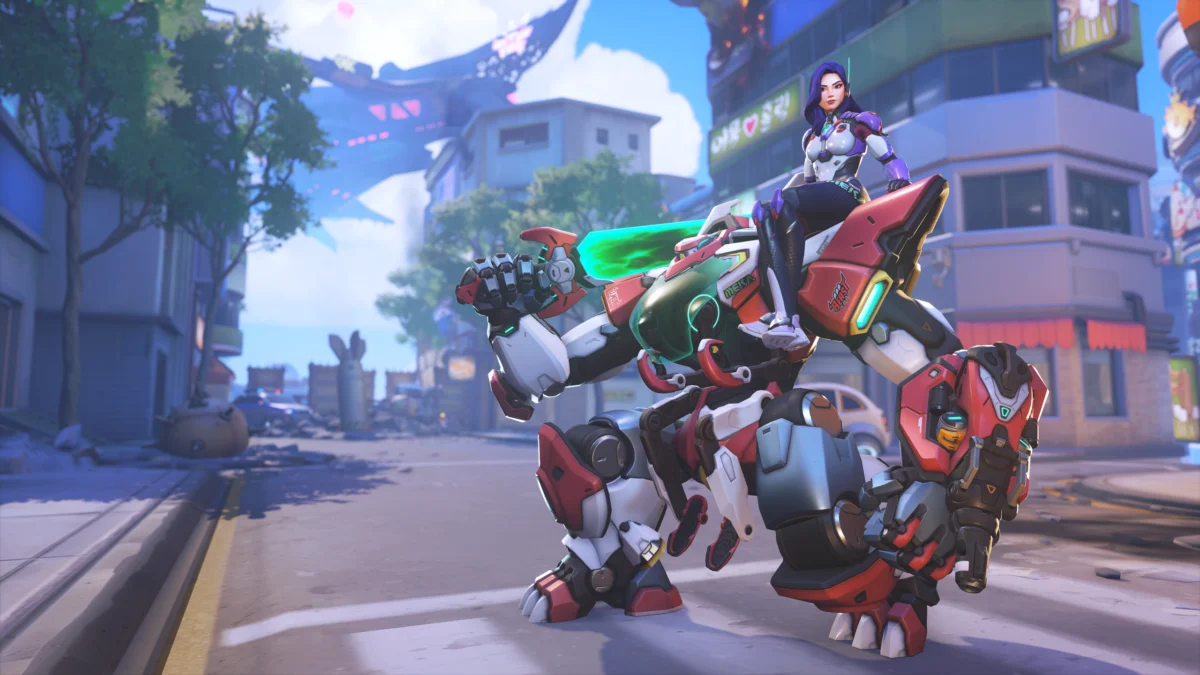
Overwatch players are poised for a significant shift in the game’s tactical landscape as Season 4 officially launches on August 11, introducing the highly anticipated new tank hero, D.Mon. Yuna "D.Mon" Lee, a formidable mech pilot hailing from the elite MEKA Squad alongside the iconic D.Va, brings a fresh and distinct playstyle to the hero shooter’s tank roster, promising to redefine frontline engagements and strategic team compositions. Her arrival marks the first new tank hero since Domina was introduced in February, filling a long-standing void and generating considerable excitement within the community.
The Long-Awaited Arrival: D.Mon’s Journey from Lore to Live Game
The introduction of D.Mon is not merely a new character drop but the culmination of years of community anticipation and careful development. Fans of Overwatch’s rich lore have been familiar with D.Mon since 2018, when she made her initial appearance in D.Va’s "Shooting Star" cinematic. In this pivotal animated short, she was depicted as a key member of the MEKA Squad, defending South Korea from colossal omnic threats. Her presence in the lore ignited a fervent demand from players for her to become a playable hero, yearning for more mech-piloting characters to join D.Va in the fight. This sustained community interest has been a powerful motivator for the development team. Lead Hero Producer Kenny Hudson articulated this sentiment in a recent group media interview, stating, "The story of this hero has been great attention to detail, and pride in the craft." He further acknowledged that, much like the player base, the Overwatch team itself has harbored "high expectations for this hero for years," indicating a deep personal investment in her realization. This extensive gestation period underscores the developers’ commitment to delivering a hero that not only meets but exceeds player expectations, blending established lore with innovative gameplay mechanics.

A New Leader Emerges: D.Mon’s Distinct Persona and Design Philosophy
D.Mon’s character, Yuna Lee, steps onto the battlefield as the new leader of South Korea’s MEKA Squad, embodying a persona that stands in intriguing contrast to her more flamboyant teammate, D.Va. Eleni Rivera, a narrative designer for Overwatch, describes D.Mon as an "untouchable, cool ice queen." This description paints a picture of a composed, strategic, and perhaps more reserved leader, a stark departure from the MEKA team’s former lore-mentioned leader, who was characterized as much louder and more assertive. Rivera elaborated on this contrast, noting that D.Va often operated with a more individualistic leadership style, pursuing her own objectives. D.Mon, conversely, is portrayed as being "much more about being a cool, collected team player," suggesting a focus on synergy, calculated maneuvers, and maintaining team cohesion.
This narrative distinction is mirrored in her gameplay design. While D.Va fulfills a ballistic-based mech fantasy, engaging enemies with projectiles and explosive bursts, D.Mon introduces an agile, sci-fi sword-and-shield archetype to Overwatch. This design choice directly addresses a desire within the development team to expand the game’s melee tank options, moving beyond the established, hammer-wielding brawler, Reinhardt. Hudson explained the rationale, stating the team aimed to "give those players who like to play up-close and personal with their tanks more to choose from." The choice of a plasma sword and energy shield not only provides a unique aesthetic but also fundamentally alters the engagement dynamic for players who gravitate towards aggressive, front-line tanking. It’s a deliberate effort to diversify the tactical approaches available within the tank role, offering a hero that rewards different skill sets and strategic thinking than previous additions.
Unpacking the Kit: D.Mon’s Agile Sword-and-Shield Arsenal

D.Mon’s ability kit is meticulously crafted to support her identity as a highly mobile, aggressive melee tank with crucial defensive capabilities. Her primary fire involves swinging a Plasma Sword in a wide arc directly in front of her, delivering close-quarters damage to multiple targets. Complementing this, her secondary fire deploys an Energy Shield, providing crucial protection against incoming fire. The synergy between these two abilities is further enhanced: while the shield is active, activating primary fire allows D.Mon to execute a Shield Bash, lunging forward with her sword to deal damage and knock back enemies. This combination of offense and defense on a single action allows for aggressive pushes and disruptive plays.
Beyond her primary melee and shielding, D.Mon possesses a Fusion Repeater ability, granting her a temporary burst of ranged damage. This resource-based ability allows her to engage targets from a short distance, either to poke before a dive or to finish off retreating, low-health enemies. Her mobility is further defined by a Horizontal Dash ability, a resource-based movement tool that propels her quickly along the ground. This dash is a cornerstone of her unique playstyle, enabling her to rapidly close distances, reposition, or escape dangerous situations. Crucially, D.Mon retains the ability to dash while her shield is active, a significant advantage that sets her apart from other melee tanks who often sacrifice movement for defense. This "mobile shield" dynamic allows her to aggressively contest space and push through chokepoints with greater impunity than a static shield tank.
Her ultimate ability, Limit Break, is a devastating offensive and defensive tool. Upon activation, D.Mon charges her plasma sword before unleashing a powerful swing through a wide arc. Enemies caught in the arc take substantial damage, but more importantly, they receive increased damage from all subsequent attacks for a brief duration. Additionally, D.Mon gains a significant amount of overhealth upon activation, temporarily boosting her survivability during the intense moments of engagement. This dual effect makes Limit Break a potent initiator for team pushes or a crucial tool for turning the tide of a losing team fight.
In a design parallel to D.Va, should D.Mon’s mech be destroyed, she transitions into her more vulnerable Pilot Form. In this state, she wields a smaller, less potent weapon but can gradually build up ultimate charge to call down a new mech. The re-entry of her mech onto the battlefield is itself an offensive maneuver, dealing damage and knocking back any nearby enemies, providing a small window of crowd control upon her return to the fight. This "mech-out" and "mech-call" mechanic adds another layer of tactical depth, forcing players to manage their mech’s health and strategically plan their re-entry.

Strategic Depth: Mastering D.Mon’s Battlefield Role
Internal playtests, as shared by Kenny Hudson, indicate that D.Mon is exceptionally effective at "taking space," a critical role for any tank. Her kit strongly supports "rush compositions," which thrive on quickly closing the distance to the enemy team and overwhelming them. Heroes like Lúcio and Juno, with their speed-boosting abilities, synergize incredibly well with D.Mon, enabling her to dive into the enemy backline with her shield up and plasma sword swinging. The damage amplification provided by her Limit Break ultimate also makes her an excellent enabler for other damage-dealing ultimates, such as Soldier: 76’s Tactical Visor or Pharah’s Barrage, allowing her team to secure crucial eliminations during decisive engagements.
However, D.Mon’s power comes with a strategic caveat: she "has to play heavily around cooldowns," particularly the fuel for her horizontal dash. Efficient resource management will be key to maximizing her impact and avoiding situations where she is left vulnerable without her primary mobility tool. Her ability to quickly reposition and engage makes her a formidable opponent for tanks that rely on static barriers or maintaining distance, such as Domina (presumably Doomfist) and Sigma. Her aggressive, close-quarters style, coupled with her shield and dash, allows her to bypass or nullify their defensive setups. Similarly, low-mobility damage and support heroes like Cassidy, Ana, and Illari could find themselves easily overwhelmed by a D.Mon who skillfully dashes into their personal space with her shield active, leaving them with few escape options.
Conversely, D.Mon’s effectiveness can be significantly curtailed by enemy compositions that excel at maintaining distance, utilizing high ground, or possessing extreme mobility. Teams with a strong contingent of long-range damage dealers, especially on maps with verticality, can chip away at D.Mon before she can effectively close the gap. Highly mobile tank counterparts such as Winston or Wrecking Ball, paired with agile damage heroes like Tracer, Echo, or Pharah, and elusive supports like Kiriko, Lúcio, or Jetpack Cat, could prove challenging. These heroes’ ability to quickly disengage, reposition, or flank makes them difficult targets for D.Mon’s plasma sword, potentially leaving her isolated and vulnerable in the front lines. Her lack of vertical mobility, unlike D.Va’s booster jets, also means she must rely on team support to access elevated positions, further defining her tactical limitations.

Impact on the Meta: Reshaping Tank Dynamics
D.Mon’s introduction is poised to have a considerable impact on the Overwatch meta, potentially shifting the balance of power within the tank role and opening up new strategic avenues for team compositions. Her unique blend of aggressive melee, mobile defense, and damage amplification challenges existing paradigms and offers fresh tactical options. The game’s shift to a 5v5 format in Overwatch 2 has made the single tank’s role more pivotal than ever, demanding heroes who can both absorb damage and create opportunities for their team. D.Mon’s kit seems tailor-made for this environment, offering both durability and disruptive potential.
Her design suggests a move towards a more dynamic and proactive tank playstyle. For competitive play and esports, D.Mon could become a staple in specific "dive" or "brawl" compositions, forcing opponents to adapt their strategies or risk being overrun. Teams might experiment with faster, more aggressive compositions, leveraging D.Mon’s ability to quickly engage and amplify damage. Balancing a hero with such a diverse toolkit – melee, ranged, shield, dash, overhealth, and damage amplification – presents a complex challenge for the developers, as even minor adjustments could drastically alter her viability and impact on the meta. The community will closely watch how D.Mon integrates into the ecosystem, whether she becomes a niche pick or a dominant force, and how her presence influences hero selection across all roles.
Revitalizing the Tank Role: Player Engagement and Future Prospects

The tank role in Overwatch has historically been the least popular among players, often perceived as the most demanding. It requires an intricate understanding of map layouts, precise macro-strategic decision-making, and a considerable degree of mental fortitude to withstand the constant pressure and focus fire from enemy teams. Many players, including seasoned veterans, often gravitate towards the more straightforward damage or support roles, finding more immediate gratification in shooting enemies or healing allies.
However, a well-played tank can be the linchpin of a successful team, delivering an electrifying and uniquely rewarding experience. The satisfaction of leading the charge, drawing enemy attention, and meticulously carving out space for teammates to operate is unparalleled. Unfortunately, this glory is frequently undermined by factors such as uncoordinated teammates, swift enemy counter-swaps, or the overwhelming deluge of crowd-control abilities and damage directed squarely at the tank.
D.Mon offers a compelling opportunity to revitalize interest in the tank role. Her kit, reminiscent of Junker Queen’s self-sufficient brawling style, offers a blend of offensive and defensive capabilities that reward skilled play. Junker Queen, for example, rewards precision with her knife throws and axe swings, allowing a proficient player to dominate a lobby through sheer mechanical skill and tactical awareness. D.Mon appears to offer a similar high-skill ceiling. Her Fusion Repeater, capable of bonus damage on headshots, encourages precise aiming, while her dash ability presents numerous opportunities for creative and practiced uses – from quick flanks to surprising engagements. The potential thrill of turning a losing fight with a perfectly timed Limit Break, gaining crucial overhealth while enabling the team to shred through remaining enemies, is a powerful draw.
The anticipation for D.Mon’s release has already spurred increased engagement in the tank role within the community. Players are actively practicing and refining their tank gameplay in preparation for her arrival, signaling a renewed enthusiasm for the position. This is a significant achievement for the Overwatch development team, as it marks the first time since Junker Queen’s launch in 2022 that a new tank hero has generated such widespread excitement and potential for widespread adoption. D.Mon’s introduction is more than just a new hero; it’s a strategic move to re-energize a critical role within the game, promising fresh tactical possibilities and a renewed sense of purpose for tank players. Her unique blend of aggression, mobility, and defensive utility ensures that Overwatch Season 4 will be a season defined by dynamic front-line engagements and evolving team strategies. The battlefield awaits her debut.