


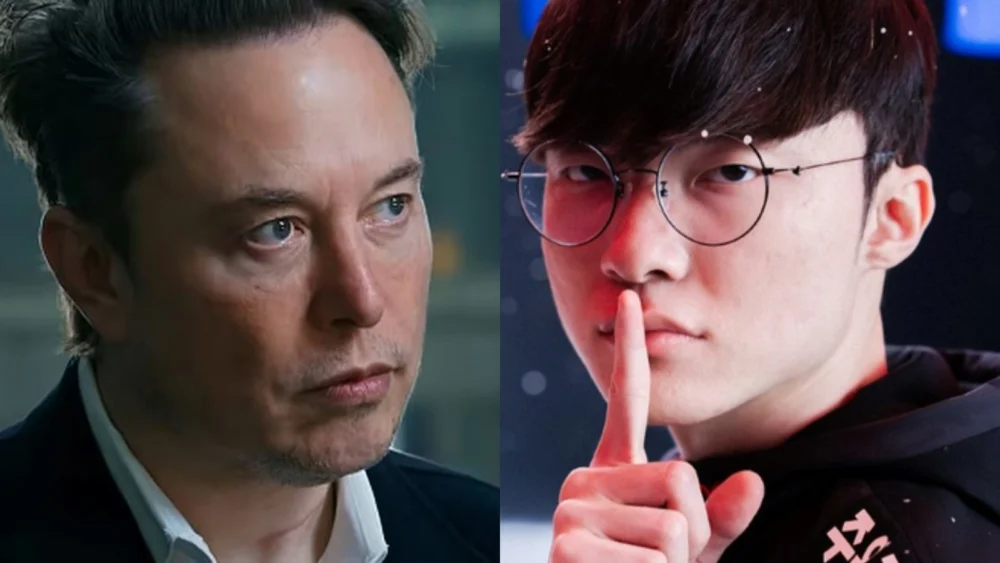
The world of esports and artificial intelligence has been set ablaze by a groundbreaking challenge issued by technology mogul Elon Musk. The founder of SpaceX and Tesla, and owner of X (formerly Twitter), has formally proposed a high-stakes exhibition match pitting his advanced AI, Grok, against the undisputed champions of League of Legends, T1, and their legendary mid-laner, Lee "Faker" Sang-hyeok. T1 and Faker have officially accepted this unprecedented gauntlet, setting the stage for a potential clash that could redefine the boundaries of human versus artificial intelligence in competitive gaming.
The genesis of this ambitious endeavor stems from Musk’s fervent belief in the transformative potential of AI, particularly in the realm of video game development. He has consistently articulated a vision where AI could not only assist but entirely create sophisticated gaming experiences. This vision has manifested in the ongoing development of Grok, an AI model designed for broad applicability, including complex strategic environments. Musk has previously voiced his aspirations for an AI-driven game studio and even posited that AI could independently develop an entire video game by the year 2029. The challenge to T1 and Faker represents a significant intermediate step, a direct test of Grok’s capabilities in one of the most complex and competitive esports titles globally. Musk’s proposal draws a clear parallel to historical benchmarks of AI achievement, such as IBM’s Deep Blue defeating chess grandmaster Garry Kasparov, framing this potential League of Legends match as a modern-day iteration of that intellectual duel. The target year for this monumental confrontation is set for 2026, allowing ample time for Grok’s development and for T1 to prepare for an entirely novel opponent.
Grok’s Capabilities and Musk’s Constraints
Elon Musk, through a post on his platform X, detailed the core capabilities he envisions for Grok 5 in this unique challenge. He stated, "Let’s see if Grok 5 can beat the best human team League Of Legends in 2026 with these important constraints." The AI’s fundamental advantage, according to Musk, lies in its ability to learn and adapt by simply processing game instructions and engaging in iterative experimentation. This suggests a sophisticated learning algorithm capable of mastering complex game mechanics and strategic nuances.
However, to ensure a more balanced and engaging contest, Musk has outlined specific constraints designed to level the playing field and prevent Grok from leveraging purely computational advantages. These constraints are crucial for framing the challenge as a true test of strategic intelligence rather than raw processing power:
- Visual Input Limitation: Grok will only be able to perceive the game through a camera feed, mirroring the visual experience of a human player with 20/20 vision. This means the AI will not have direct access to game data or a bird’s-eye view of the entire map, a significant handicap compared to typical AI agents in games.
- Human-Level Reaction and Input Speed: The AI’s reaction latency and click rate will be capped at levels comparable to a human player. This prevents Grok from executing commands with superhuman speed, a common advantage of AI in fast-paced digital environments.
These carefully curated limitations are designed to isolate and test Grok’s strategic decision-making, adaptability, and understanding of complex in-game dynamics, rather than its ability to simply process information faster than any human.

The Genesis of the Challenge and Initial Reactions
The announcement of Musk’s challenge quickly reverberated through the esports and AI communities. The proposition ignited a firestorm of discussion, with many prominent figures in League of Legends and AI research weighing in.
Eugene "Pobelter" Park, a former professional League of Legends player who has transitioned into esports analysis and commentary, expressed keen interest. He responded to Musk’s post, stating, "Would love to help and offer insight as a former League pro, I thought AI vs Dota 2 was really interesting and always wanted to see it vs League." This sentiment highlights the broader fascination with AI’s potential in esports, a field that has seen significant AI advancements in other games like Dota 2.
Adding another layer of intrigue, Oriol Vinyals, a researcher known for his work in AI and gaming, particularly his achievement of Grandmaster status in StarCraft, piqued Musk’s interest with a suggestion. Vinyals proposed that Grok could potentially compete in Blizzard’s iconic real-time strategy game, StarCraft, instead of League of Legends. He humorously added, "Bonus points if you get the robots to operate the mouse and keyboard," referencing the physical interface of gaming. Musk’s simple yet affirmative reply, "Sounds good," suggests an openness to exploring AI challenges across different gaming genres.
Skepticism and Counterarguments
While the challenge has generated considerable excitement, it has also been met with significant skepticism from seasoned veterans of the League of Legends professional scene. Many question whether Grok, even with the outlined constraints, can realistically compete at the highest level by 2026.
Joedat "Voyboy" Esfahani, another prominent former professional League of Legends player, articulated his doubts, arguing that the complexity and inherent variables within League of Legends present a formidable barrier for AI. He stated, "You wouldn’t even be able to beat an LCS team, much less Faker and the boys. League has far too many variables / interaction & game knowledge context / legit team coordination required to win at the highest level." His assessment points to the intricate team coordination, strategic depth, and nuanced understanding of game flow that are paramount in professional League of Legends, elements that are notoriously difficult for AI to fully replicate.
Yiliang "Doublelift" Peng, a highly respected former professional ADC player and streamer, echoed this sentiment of doubt. He expressed extreme skepticism about Grok’s ability to defeat T1 or even himself in a one-on-one match, going so far as to jokingly pledge to shave his head if Grok managed to best him. This bold claim underscores the perceived gap between current AI capabilities and the refined human skill and strategic mastery demonstrated by top-tier professional players.

T1 and Riot Games’ Official Responses
The reigning champions, T1, have responded to Elon Musk’s challenge with a mixture of confidence and playful bravado. The organization officially accepted the proposal on X, posting, "We are ready," accompanied by a GIF of Faker. They then directly challenged Musk, asking, "Are you?" This response signals T1’s readiness to face the AI opponent and highlights their unwavering belief in their own capabilities and Faker’s legendary status.
The potential impact of such a match has also captured the attention of Riot Games, the developer and publisher of League of Legends. Marc Merrill, co-founder and president of Riot Games, directly engaged with Elon Musk on X, commenting, "let’s discuss." This interaction strongly suggests that Riot Games is not only aware of the proposed challenge but is actively considering its involvement, potentially in a capacity to promote or facilitate the event. The prospect of Riot Games officially endorsing and supporting a T1 vs. Grok match could elevate it to an unprecedented level of mainstream attention, merging the worlds of cutting-edge AI research with the global phenomenon of esports.
Broader Implications and Future Prospects
The potential showdown between T1 and Grok transcends a mere gaming exhibition; it represents a significant milestone in the ongoing dialogue about artificial intelligence’s role in human endeavors. If Grok were to achieve even a modicum of success against a team of T1’s caliber, it would serve as a powerful testament to the rapid advancements in AI’s strategic and adaptive capabilities. Conversely, a decisive victory for T1 would underscore the enduring complexity of human intuition, teamwork, and adaptability in highly competitive environments.
The inclusion of specific constraints, such as limiting visual input and reaction times to human levels, is a critical aspect of this challenge. It shifts the focus from raw computational power to the AI’s ability to understand, strategize, and execute within parameters that closely mirror human gameplay. This approach offers a more nuanced assessment of AI’s progress in areas like decision-making under uncertainty, tactical planning, and adapting to dynamic game states – elements that are at the core of League of Legends’ strategic depth.
The timeline of 2026 provides a tangible goalpost for AI development. It allows for iterative improvements in Grok’s algorithms and for T1 to prepare for an opponent that will learn and evolve. The broader implications extend beyond esports, potentially informing advancements in AI for fields requiring complex strategic planning, such as logistics, finance, or even military operations.
While no official details regarding the format, broadcasting, or specific date have been confirmed, the engagement from T1, Riot Games, and prominent figures in the esports community indicates a strong possibility of this event materializing. Should it proceed, the T1 versus Grok League of Legends match could very well become one of the most-watched and discussed esports events in history, marking a pivotal moment in the ongoing narrative of artificial intelligence’s integration into human culture and competition. The journey from Deep Blue versus Kasparov to Grok versus Faker represents a remarkable evolution, showcasing the expanding frontiers of both human intellect and artificial intelligence.